Saudi Arabia, Turkey and Pakistan sign defence pact

Daftar Isi
Three Muslim Powers Forge Mutual Defense Commitment in Mecca
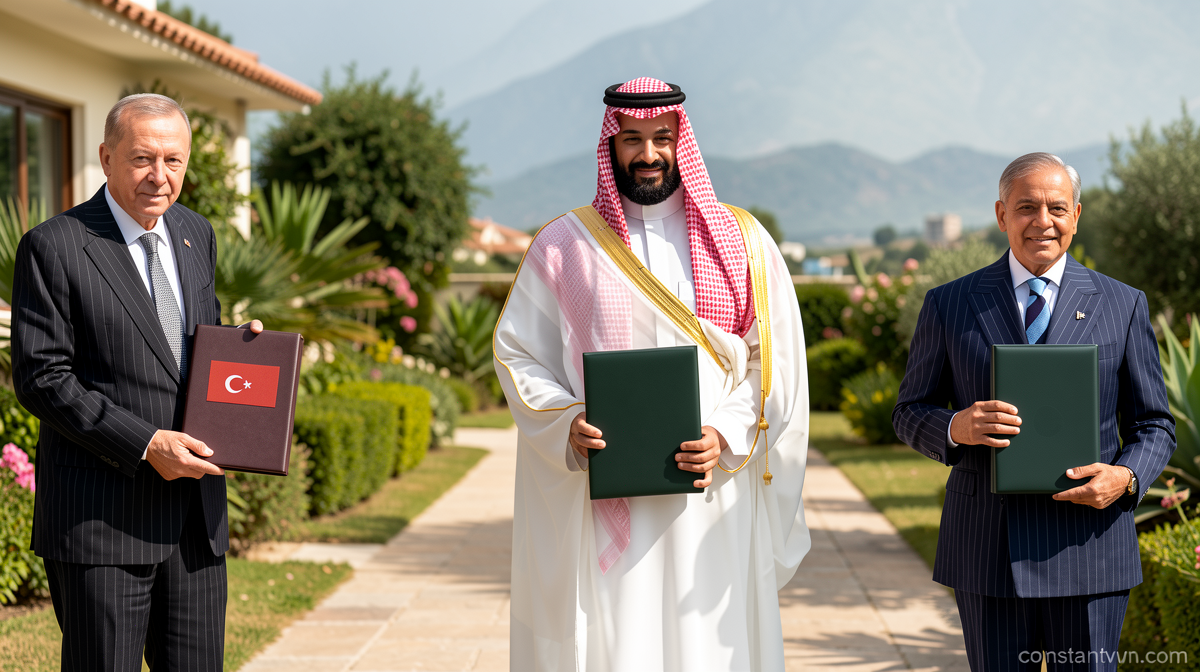
Constantvpn.com – In a significant geopolitical development, Saudi Arabia, Turkey, and Pakistan have formalized a comprehensive defense agreement that establishes collective security guarantees among the three nations. The landmark accord, unveiled during a high-level summit in Mecca, declares that any military aggression directed at one signatory will be treated as an attack upon all three parties.
The agreement was finalized following discussions between Turkish President Recep Tayyip Erdogan, Saudi Crown Prince Mohammed bin Salman, and Pakistani Prime Minister Shehbaz Sharif. This trilateral arrangement represents one of the most substantial regional security frameworks to emerge in recent years, bringing together three of the world’s most influential Muslim-majority countries.
Regional Tensions Drive the Agreement
The timing of this defense pact reflects heightened concerns across the Middle East and South Asia. Following coordinated military operations by the United States and Israel against Iran on February 28, regional stability has faced considerable pressure. Iranian forces and their allied groups responded by targeting facilities in Saudi Arabia and other Gulf nations, while simultaneously disrupting critical maritime routes including the Strait of Hormuz and Red Sea shipping lanes.
These developments have prompted Gulf states to reconsider their security architectures, particularly as traditional alliances appear less reliable amid shifting global power dynamics. The Mecca agreement emerges as part of a broader recalibration of defense strategies across the region.
Tehran’s Skeptical Response
Iran has reacted sharply to the new arrangement, with senior officials expressing doubt about its practical effectiveness. Ebrahim Rezaei, a member of Iran’s National Security commission, published a critical assessment on his social media platform, arguing that the pact offers limited security benefits.
The Saudis should know that a paper agreement with Turkey and Pakistan does not bring them security, just as years of unilateral milking of the Americans did not bring them security.
Rezaei’s comments reflect broader Iranian skepticism about Western-backed security arrangements and suggest Tehran views the new pact as primarily symbolic rather than operationally transformative.
Complementary Benefits for Each Nation
While the agreement establishes mutual defense commitments, it deliberately avoids specifying exact obligations for each party. A Turkish official described the arrangement as purely defensive in character, though the precise circumstances triggering collective response remain flexible.
For Saudi Arabia, the pact provides additional security layers in a region experiencing unprecedented volatility. The kingdom faces multiple threats, including maritime pressure from Yemen’s Iran-backed Houthi rebels, who recently announced a maritime embargo targeting Saudi airports, oil infrastructure, and commercial vessels in the Red Sea. The Saudis also remain concerned about potential Israeli military actions beyond their borders, as demonstrated by recent strikes on Doha targeting Hamas leadership.
Pakistan enters the arrangement with different priorities. The country experienced escalated tensions with India in May 2025, though full-scale war was avoided. Having Saudi Arabia’s economic resources and Turkey’s military-industrial capacity as potential allies strengthens Islamabad’s strategic position considerably. Additionally, Pakistan has been expanding its diplomatic footprint, serving as an intermediary between Iran and the United States and hosting ceasefire negotiations, thereby elevating its regional standing.
Turkey’s motivations center on economic and industrial opportunities. According to Burcu Ozcelik from the London-based Royal United Services Institute, the agreement opens avenues for joint production, technology partnerships, procurement arrangements, and enhanced military interoperability among the three nations’ defense sectors.
Implementation Challenges Ahead
The practical application of this mutual defense commitment will require careful navigation of complex geopolitical scenarios. Questions remain about specific trigger conditions: Would Turkey be compelled to participate in military operations against Yemen if Saudi Arabia resumed full-scale engagement with Houthi forces? Must Saudi Arabia declare war on India should Pakistan face renewed conflict with its eastern neighbor?
Each scenario demands sophisticated diplomatic calculations aimed at preventing unintended escalation while honoring collective security obligations. The agreement’s deliberately flexible language allows for case-by-case assessment rather than automatic responses.
Nevertheless, the primary objective of deterrence appears achievable. The mere existence of two additional regional powers willing to support any signatory raises the potential costs of aggression considerably. While the agreement may not render conflict impossible, it establishes a framework that makes military action against any one member more expensive and diplomatically complicated for potential adversaries.
This development marks a significant moment in regional security architecture, demonstrating how middle powers can collaborate to create alternative security arrangements independent of traditional Western alliances. The Mecca agreement’s long-term success will depend on how effectively the three nations translate their mutual commitments into coordinated action when challenges arise.
Related Reading
Frequently Asked Questions
What is Saudi Arabia Turkey and Pakistan sign?
Saudi Arabia Turkey and Pakistan sign is the main topic of this guide. The article explains the context, practical details, and next steps readers should understand.
Why does Saudi Arabia Turkey and Pakistan sign matter?
Saudi Arabia Turkey and Pakistan sign matters because readers are looking for a useful answer, not just a short summary. Good content should match search intent and help them decide what to do next.