VAR official says hand gesture was ‘involuntary, subconscious twitch’
VAR Official Clarifies Involuntary Hand Gesture Amid Social Media Speculation
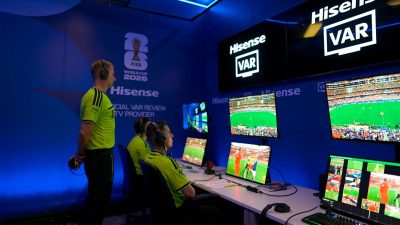
Constantvpn.com – FIFA is seeking clarification regarding a hand gesture made by a video assistant referee (VAR) during a match. The incident occurred when Shaun Evans, an Australian official, was captured on camera displaying an upside-down “OK” sign while the World Cup broadcast highlighted the VAR team at the referee hub in Dallas prior to Germany’s 7-1 victory over Curacao on Sunday. Evans, who is part of FIFA’s video assistant referee system, described the gesture as “an involuntary, subconscious twitch” in a statement released by the governing body. He emphasized that he was “unaware” of the movement and denied any intent to “communicate a message, affiliation, game or belief of any kind.” The gesture, which involves forming an “OK” symbol with the right hand flipped upside down, has sparked significant debate due to its dual symbolism—both as a casual sign of approval and as a marker of white supremacist ideology.
FIFA Investigation Finds No Breach of Rules
Following the footage’s release, FIFA launched an investigation and concluded that there was “no evidence of breaches of the Fifa Disciplinary Code.” The organization confirmed that Evans would face no formal action, though the incident generated a wave of online speculation. Evans, 38, has since provided video evidence to support his claim that the movement was unintentional. He noted that the gesture repeated multiple times during the match, often while holding a pen between his fingers, further underscoring its spontaneity. “Officiating at the World Cup is the biggest honour of my career,” he stated, “and I look forward to supporting my colleagues for the rest of the tournament.”
“The coverage following this incident simply does not reflect who I am,” Evans said in his statement. “I understand how the gesture has been interpreted and regret any confusion, but I want to be very clear that I did not knowingly or deliberately make the hand symbol suggested.”
Symbolism and Context of the Gesture
The upside-down “OK” sign, often referred to as the “white power” symbol, has been associated with far-right groups in recent years. Its use as a hate symbol was highlighted by the Anti-Defamation League (ADL) in 2019, when the gesture was added to a list of discriminatory signals. However, the sign also has a benign interpretation, commonly used in casual settings to indicate agreement. This ambiguity has led to widespread interpretations, with some viewing the gesture as harmless and others as a subtle expression of ideological alignment.
Evans’s movement closely resembles the one used in the “circle game,” a social game popularized in the U.S. sitcom *Malcolm in the Middle* and later turned into an internet meme. In this game, participants form an “OK” symbol with their hands below the waist, and when someone else sees it, they receive a playful punch on the shoulder. Despite its lighthearted origins, the gesture has been adopted by far-right groups as a coded signal, particularly in contexts where they can express their beliefs without direct confrontation.
Reactions from Refereeing Bodies
The Professional Football Referees’ Association (PFRA) in Australia expressed support for Evans’s explanation, stating that he has “consistently represented the values expected of football officials: professionalism, respect and integrity.” The association praised his public statement, emphasizing the importance of “fairness, context and due process” in addressing such concerns. “We acknowledge Shaun’s public statement and recognize the significance of providing clarity in situations where gestures may be misinterpreted,” the PFRA added.
Meanwhile, FIFA’s decision to investigate the incident aligns with its broader efforts to monitor officials’ conduct during the tournament. Before matches, the governing body has been showcasing referees and VAR teams as part of its global coverage, often displaying their names and roles alongside their images. However, the approach shifted after the Germany-Curacao game, with VAR officials now positioned to face the monitors rather than the camera. This change aims to minimize potential misinterpretations, though the gesture’s visibility remains a topic of discussion.
Global Debate and Cultural Significance
The incident has reignited conversations about the cultural and political meanings of gestures in sports. The upside-down “OK” symbol, once a playful tool, now carries weight in discussions about racism and bias. The anti-discrimination Fare network, which collaborates with FIFA and UEFA to combat racial prejudice, had previously urged FIFA to address the issue before the organization’s recent statements. “Advice from our experts is that the gesture used clearly resembles an upside-down ‘OK’ hand symbol used as a ‘white power’ symbol,” the network noted.
Evans’s situation also highlights the challenges faced by officials in maintaining their reputations in the face of rapid media scrutiny. While the gesture was unintentional, the speed at which it was interpreted and amplified by social media underscores the power of visual symbols in shaping public perception. FIFA’s swift response to the controversy, combined with Evans’s personal explanation, has been seen by some as a balanced approach to resolving the situation. However, others argue that more context is needed to fully understand the significance of such gestures in high-stakes environments.
Broader Implications for the World Cup
As the World Cup progresses, the incident serves as a reminder of the heightened expectations placed on officials. The tournament’s global audience, spanning cultures and ideologies, requires clarity in every detail. Evans’s case has been used as an example of how even minor actions can spark debate, especially in a sport where impartiality is paramount. His availability for future matches has been confirmed, with FIFA expressing confidence in his ability to continue his role without prejudice.
The event also reflects a growing trend of examining the symbolic language of sports. From the “circle game” to the “OK” sign, gestures have become a focal point for cultural and political discourse. As FIFA and other organizations navigate these complexities, the balance between professionalism and public perception remains a critical challenge. Evans’s statement, coupled with the evidence he provided, aims to restore trust in the VAR system, though the incident will linger as a cautionary tale about the importance of context in interpreting human actions.
Related Stories and Trends
While the focus on Evans’s gesture has dominated recent discussions, the World Cup has also seen other notable developments. Tactical trends such as the use of false nines and the 4-4-2 formation continue to shape match strategies, with teams adapting to maximize their chances of success. Additionally, the tournament’s hydration breaks have become a point of interest, with some nations benefiting more than others from the practice. Recent upsets, like Cape Verde’s stunning victory over Spain, have further fueled debates about the unpredictable nature of the competition.
As the World Cup advances, the interplay between on-field performance and off-field symbolism will remain a subject of analysis. Evans’s case illustrates how a single gesture can amplify both the positive and negative aspects of a referee’s role. While FIFA has taken steps to reassure the public, the incident underscores the need for ongoing dialogue about the cultural implications of sports imagery. For now, Evans is set to continue his duties, with the hope that his explanation will quell the controversy and keep the spotlight on the game itself.
