
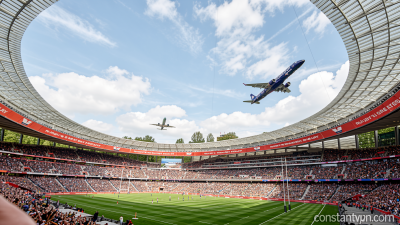
Two Jets, One Stadium, and a Nation Holding Its Breath
Constantvpn.com – When flares erupted into the Cape Town night sky and two fighter-style jets screamed overhead in tight formation, the thousands packed inside DHL Stadium were not watching a rugby warm-up. They were witnessing a calculated aerial display by Airlink, a South African regional carrier, whose twin aircraft reportedly grazed the upper rim of the venue at a height measured in mere feet. The manoeuvre, staged immediately before a high-stakes Test match pitting the Springboks against New Zealand’s All Blacks, ignited a wave of reactions ranging from stunned admiration to outright alarm.
The spectacle unfolded in seconds: one aircraft painted green, the other black, threading through the stadium’s airspace in close proximity while spectators below looked up. For a brief window, the boundary between sport and aviation performance dissolved entirely. Social media erupted within minutes. Some commentators called the flyby dangerously audacious, questioning whether any commercial operation should position two aircraft so close to a structure filled with tens of thousands of people. Others lauded the extraordinary skill and coordination the manoeuvre demanded, framing it as a showcase of South African aviation competence.
Airlink’s Response: Deliberate, Approved, Rehearsed
Rather than retreat from the controversy, Airlink leaned into the moment. On its social media channels, the airline paired the footage with a terse three-word caption:
“Planning. Precision. Performance.”
In a fuller statement later reproduced on a South African government news portal, the carrier detailed the operational safeguards behind the display. Each of the two aircraft carried a crew of three senior captains, assigned to distinct roles: commander, co-pilot, and a dedicated safety and technical officer. The airline stressed that the flypast was executed within parameters it described as pre-cleared and repeatedly rehearsed.
“The two aircraft were flown by highly experienced crew, with each comprised of three senior captains operating in the roles of commander, co-pilot and safety/technical officer,” the airline stated. It added that the flights were performed with the “approved and rehearsed safety altitude and speed limits for the flypast.”
The airline also noted that the operation carried the backing of national aviation authorities, a point it raised to counter accusations of recklessness. In practical terms, this means the flight path, altitude envelope, and speed corridors had been vetted before the event, and that the pilots had run through the sequence multiple times in preparation.
The Numbers Behind the Fear
Flight-tracking platform Flightradar24, which aggregates ADS-B and other telemetry data from aircraft worldwide, offered a quantitative reading of the event. Its post-event analysis concluded that the lead aircraft cleared the stadium’s highest point by less than 50 feet — roughly 15 metres. At that altitude, over a structure whose roofline is already well above ground level, the margin between the fuselage and the concrete parapet was, by any aviation standard, extraordinarily slim. The trailing aircraft, flying in close formation behind the lead jet, compounded the risk profile: a single deviation in heading or altitude could have brought two heavy machines into contact with the stadium structure or with each other.
Those figures explain why the stunt divided public opinion so sharply. Aviation safety culture generally favours generous vertical and lateral separation, particularly over populated areas. A commercial airline choosing to fly its own aircraft at single-digit-metre clearance above a packed arena sits at the far edge of conventional operational practice, even when authorities have signed off on the plan.
A Tradition Rooted in Rugby and National Identity
The low-altitude flyby over a major South African sporting event is not an isolated novelty. It draws on a lineage that stretches back to one of the most emotionally charged moments in the country’s sporting history. In June 1995, a South African Airways jet roared over Loftus Versfeld in Johannesburg moments before the Rugby World Cup final, in which the Springboks defeated New Zealand to claim the Webb Ellis Cup. That victory, set against the backdrop of a nation still healing from decades of apartheid, became a defining symbol of post-apartheid unity.
The final was later dramatised in the 2009 Hollywood film Invictus, starring Morgan Freeman as Nelson Mandela. In the most iconic scene, the newly inaugurated president — South Africa’s first black head of state — steps onto the field wearing the Springbok jersey, a garment long associated with the apartheid-era establishment and previously closed to players who were not white. The image of Mandela in that green-and-gold shirt, with the stadium roaring beneath him, remains one of the most recognised photographs of modern South African history.
Against that backdrop, the Airlink flyby at DHL Stadium carried an unmistakable cultural charge. For many South Africans watching, the jets overhead were not merely a marketing stunt by a domestic airline. They were an echo of 1995, a reminder that the country’s pilots and engineers could execute feats of precision on the world stage. Social media commentary from the event was saturated with national pride, with users celebrating the skill involved and framing the display as proof that South African aviation talent remains world-class.
What Comes Next
The episode is likely to prompt closer scrutiny of how commercial carriers interact with major sporting venues in South Africa. Aviation regulators may review whether the altitude and separation parameters used at DHL Stadium represent a replicable template or a one-off exception. Airlines, stadium operators, and event organisers will face the question of how to balance spectacle with the conservative safety margins that underpin commercial aviation. For now, the footage of two jets threading the stadium’s airspace at Cape Town will circulate for years, a reminder that the line between showmanship and risk can be measured in metres — and that a nation’s sporting pride can make even the most audacious clearance feel, to those below, like a moment of pure triumph.
Related Reading
Frequently Asked Questions
What is South African airline defends low altitude?
South African airline defends low altitude is the main topic of this guide. The article explains the context, practical details, and next steps readers should understand.
Why does South African airline defends low altitude matter?
South African airline defends low altitude matters because readers are looking for a useful answer, not just a short summary. Good content should match search intent and help them decide what to do next.