
Where Speed Meets Sacred Ground: Monza’s Unbroken Thread Through Formula 1 History
Constantvpn.com – Every autumn, the roar of engines echoes through a stretch of royal woodland north of Milan, and the world of motorsport gathers at a place that has become inseparable from its own mythology. Monza — the so-called “cathedral of speed” — stands as the single most enduring fixture on the Formula 1 calendar. Since the sport’s inaugural season in 1950, the circuit has staged a grand prix in every year except one. That lone absence came in 1980, when the track underwent renovation work. No other venue can claim such an unbroken lineage of competition.
The circuit sits within a royal park, its long straights flanked by dense woodland that gives the place an almost cathedral-like solemnity. For Ferrari fans — the tifosi who pack the grandstands in scarlet — Monza is not merely a race track. It is a place of worship. The Italian marque has called this stretch of tarmac its spiritual home for decades, and the emotional intensity of a home race here has no parallel elsewhere on the calendar.
The stakes at Monza have always been existential. Seventy-six years ago, the very first Formula 1 world championship was decided on this very track. Last year, Red Bull’s Max Verstappen produced the fastest qualifying lap ever recorded in the sport’s history, again at Monza. The venue has witnessed title clinches, heartbreaking crashes, controversial finishes, and moments of pure, unrepeatable drama. To trace the history of Formula 1 is, in many ways, to trace the history of this one circuit.
The Founding Era: Alfa, Ferrari, and the First Titles
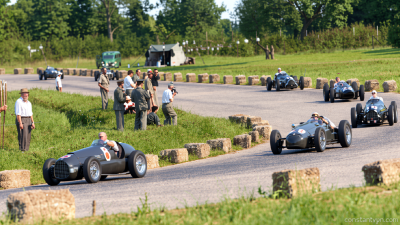
The 1950 Italian Grand Prix closed Formula 1’s maiden season. Giuseppe Farina, driving an Alfa Romeo, crossed the line to claim both the race and the inaugural drivers’ championship. He remains the only driver ever to win the title on home soil. Farina’s dominance in those early years was absolute — he, Juan Manuel Fangio, and Alberto Ascari collectively claimed the first eight world titles between them.
By 1953, the grid at Monza featured all three of those champions lining up together. Fangio, in a Maserati, took the race that weekend, but Ascari, in a Ferrari, accumulated enough points across the season to carry the title. The era of near-total Italian and Argentine supremacy over the championship was well established by then.
Banking, Brotherhood, and the First Woman
Monza’s steep banked corners — still physically present at the circuit today — were a defining feature of the track until the 1961 season. In 1956, Fangio, Stirling Moss, and Peter Collins navigated those banks during a race that became a study in team loyalty. Moss, driving a Maserati, took the win. Collins, the British driver, handed his car to his Argentine teammate Fangio after the race, allowing them to share second place. Those points proved decisive: Fangio collected his fourth of five world championships that year.
Two years later, in 1958, the grid carried a landmark of its own. Maria Teresa de Filippis, an Italian driver, became the first woman ever to compete in a Formula 1 race, piloting a Maserati at her home event. Her presence on the grid marked a milestone that the sport would not see matched for decades.
Tragedy at the Lesmos
The 1961 Italian Grand Prix will always be remembered for what happened on its second lap. Wolfgang von Trips, a Ferrari driver who was on the verge of clinching the world championship, collided with Jim Clark’s Lotus. His car launched over an embankment and into a crowd of spectators. Von Trips and fourteen others were killed. The image of the German driver before that fateful race remains one of the most haunting in the sport’s visual archive.
Spectators watching through the Lesmos corners in 1962 saw a different kind of drama unfold. By 1963, Scotsman Jim Clark had turned the track into his own proving ground, collecting a garland after winning the grand prix to seal his first of two drivers’ titles with Lotus.
Family, Slipstream, and the Narrowest of Margins
In the pits before the 1967 race, Graham Hill adjusted his helmet and visor while surrounded by his family — wife Bette and their children. Among them stood a six-year-old Damon Hill, who would go on to claim the 1996 world championship.
Before chicanes were added to the layout, Monza’s long straights turned every race into a war of slipstreaming. In 1969, Matra’s Jackie Stewart crossed the line just ahead of Jochen Rindt in a Lotus, Jean-Pierre Beltoise in a second Matra, and Bruce McLaren representing his own team. The top four finishers were separated by less than two-tenths of a second.
The following year brought heartbreak of a different order. Nina Rindt sat in the pits, timekeeping for her husband during a practice session in 1970. Shortly after that session, Jochen Rindt was killed on the approach to the Parabolica corner, almost certainly due to a suspension failure on his Lotus. Weeks later, he became Formula 1’s only posthumous world champion.
Thrills, Scars, and the Hunt–Lauda War
The 1971 finish was another masterclass in razor-thin margins. BRM’s Peter Gethin edged past Ronnie Peterson in a March, Francois Cevert in a Tyrrell, Mike Hailwood in a Surtees, and Howden Ganley in a second BRM. Six-tenths of a second separated the top five.
In 1973, team owner Frank Williams organized a charity-style race around the circuit. James Hunt led the pack at the start, but it was Williams himself — visible behind a bare-chested runner — who crossed the line first and collected the £750 prize.
By 1976, Monza had become the stage for one of the sport’s greatest rivalries. Niki Lauda, still bearing the visible scars of his near-fatal crash at the Nürburgring German Grand Prix, returned to racing just six weeks after that accident. He drove at Monza in significant pain, finishing fourth to extend his championship lead over McLaren’s James Hunt. Hunt ultimately prevailed by a single point at season’s end, but Lauda’s decision to race at all — at that speed, with those wounds — remains one of the most extraordinary acts of will in motorsport history.
The 1978 Italian Grand Prix opened with a multi-car accident behind the leaders, a reminder that even in an era of increasing safety, Monza’s speed demanded its toll.
From Farina’s Alfa to Verstappen’s record lap, the circuit has absorbed every era of the sport. Its story is, quite literally, the story of Formula 1 itself.
Related Reading
Frequently Asked Questions
What is Monza memories?
Monza memories is the main topic of this guide. The article explains the context, practical details, and next steps readers should understand.
Why does Monza memories matter?
Monza memories matters because readers are looking for a useful answer, not just a short summary. Good content should match search intent and help them decide what to do next.