
Author: Joseph Johnson – constantvpn.com

  • Carney calls Trump’s fresh tariffs a ‘miscalculation’ after trade talks collapse

    Carney calls Trump’s fresh tariffs a ‘miscalculation’ after trade talks collapse

    Canada Declares Trade War as US Tariff Talks Collapse

    Constantvpn.com – Canada’s Prime Minister Mark Carney addressed his country on Saturday morning with a blunt verdict on the fractured negotiations with Washington: the latest American tariff package was a “miscalculation” engineered to “hurt and divide us.” The remarks came hours after bilateral trade talks collapsed late Friday, ending more than a year of intermittent negotiations between two of North America’s most economically intertwined nations.

    “They asked too much and they offered too little,” Carney told Canadians, declaring the country now locked in a trade “war.”

    The prime minister confirmed that Ottawa would impose retaliatory duties matching every new American levy “dollar-for-dollar,” effective 8 September. The countermeasures will span steel, dairy products, household appliances, and electronics, among other categories. Carney stressed that Canada was acting “reluctantly” and that full details of the response package would be published in the coming days.

    The Scope of the New American Duties

    The tariffs imposed by Washington carry a 50% rate and apply to roughly $20 billion (approximately £15 billion or C$28 billion) of Canadian exports — representing about five percent of total Canadian goods shipped to the United States. Affected product lines include wine, dairy items, cement, clothing, and hockey equipment. These new levies stack on top of existing American duties already targeting Canadian steel, aluminium, automobiles, and lumber, meaning a substantial share of bilateral trade now faces layered tariff exposure.

    For readers unfamiliar with the mechanics: a tariff is a tax levied on goods crossing a border from one country to another. Proponents argue such measures shield domestic manufacturers and generate home-country employment. Critics counter that the costs are passed through to consumers, inflating retail prices while destabilising supply chains and inviting retaliatory cycles that shrink global trade volumes.

    How the Talks Fell Apart

    Both governments had expressed optimism earlier in the week that a comprehensive deal was within reach. The rupture came when each side accused the other of introducing last-minute alterations to previously agreed terms. Carney characterised the American position as “unfair” and “uneconomic,” while US negotiators countered that Canada had made “new demands and walk backs” on language already settled.

    Carney pushed back firmly on the American narrative: “We clarified what was on offer and were continually disappointed by the answers.” He said Washington had tabled conditions he deemed “unacceptable,” including provisions that would constrain Canada’s freedom to negotiate separate trade agreements with other nations.

    On Saturday, US Trade Representative Jamieson Greer told Fox News that no timetable existed for reopening the talks. He noted that Washington had been willing to trim certain tariff lines as part of the deal that ultimately failed.

    Provincial and Opposition Reactions

    Political support for Carney’s hardline posture came quickly from across the Canadian spectrum. Doug Ford, premier of Ontario — the country’s most populous province — endorsed the prime minister’s stance and declared that Trump “can’t be trusted.” David Eby, premier of British Columbia, framed the American demand for restrictions on Canada’s independent trade authority in stark terms, warning it “would reduce us to the economic equivalent of the 51st state.” He added: “It was never acceptable to Canadians.”

    Pierre Poilievre, leader of the Conservative opposition, described the newest American levies as “unjustified.” Christine Fréchette, premier of Quebec, cautioned that jobs would likely be lost in sectors exposed to the new duties, and pledged provincial measures to cushion affected workers and industries. “Behind these numbers are real people,” she said. Danielle Smith, premier of oil-rich Alberta, which has sought closer commercial ties with the Trump administration, called on both governments to return to the negotiating table.

    The Wider USMCA Backdrop

    The collapse does not occur in isolation. Canada, the United States, and Mexico are simultaneously undergoing a mandatory review of the United States–Mexico–Canada Agreement (USMCA), the trade pact Trump signed during his first term to supersede the 1994 North American Free Trade Agreement. USMCA underpins approximately $1.6 trillion (£1.2 trillion) in annual trilateral commerce across the three economies.

    Earlier this summer, Ottawa and Mexico City formally requested that the agreement be renewed for another 16 years. Washington declined to extend it in its present configuration, leaving the legal architecture of North American trade in a state of uncertainty even as bilateral tariff negotiations unravel. The convergence of these two crises — the collapsed bilateral talks and the stalled USMCA renewal — places an unprecedented strain on the deepest economic partnership in North American history, with no publicly articulated pathway toward resolution.

    Trump had not commented publicly on the breakdown as of Saturday. The absence of a presidential response, combined with Greer’s statement that talks would not resume, leaves Canadian exporters, American importers, and cross-border supply chains facing an extended period of elevated costs and regulatory ambiguity.

    Frequently Asked Questions

    What is Carney calls Trump s fresh tariffs?

    Carney calls Trump s fresh tariffs is the main topic of this guide. The article explains the context, practical details, and next steps readers should understand.

    Why does Carney calls Trump s fresh tariffs matter?

    Carney calls Trump s fresh tariffs matters because readers are looking for a useful answer, not just a short summary. Good content should match search intent and help them decide what to do next.

  • Arran ferry evacuated over ‘bomb threat’ by passenger rescued from sea

    Arran ferry evacuated over ‘bomb threat’ by passenger rescued from sea

    Ferry Evacuated at Ardrossan After Passenger Pulled from Sea Claims Bomb Aboard

    Constantvpn.com – A routine crossing between Scotland’s Isle of Arran and the mainland was brought to a sudden halt on Friday afternoon when a passenger who had fallen overboard allegedly told crew members that an explosive device was hidden somewhere on the vessel. The disruption forced every traveller aboard to disembark on foot at Ardrossan harbour while officers conducted a full inspection of the ship.

    The incident unfolded on the MV Caledonian Isles, which had departed Brodick at 16:40 carrying 329 passengers. Shortly after departure, the ferry’s own rescue boat was deployed to retrieve a man from the water. Once back on deck, the individual reportedly informed the crew that a bomb was present on board, prompting an immediate evacuation protocol.

    Passengers Moved to Safety While Search Underway

    With the vessel berthed at Ardrossan, all 329 travellers were directed ashore on foot. Police Scotland moved the group, along with other people waiting at the port, into the car park of a nearby supermarket to keep them clear of the operational area. The ship was then searched thoroughly before officers permitted passengers to return and retrieve their vehicles.

    A Police Scotland spokesperson confirmed the outcome of the investigation:

    “We were made aware that a man had gone overboard and caused a disturbance and made threats when he was rescued. A 23-year-old man has been arrested. The incident has since concluded and there is no threat to the wider public.”

    The force added that it was established the threats “were not credible,” meaning no explosive device was found during the inspection.

    Service Disruption and Emergency Response

    The evacuation and subsequent search consumed enough time that all remaining sailings scheduled to depart Ardrossan on Friday evening were cancelled. Crew members needed to be debriefed, and emergency equipment aboard the vessel had to be replenished before the ship could resume operations.

    To mitigate the knock-on effect for island residents and visitors stranded without transport, an additional crossing was arranged at 19:50 on the MV Alfred, sailing from the nearby port of Troon. CalMac stated that affected passengers holding confirmed bookings would be contacted directly by its customer services team to arrange alternative travel or refunds.

    CalMac’s Role in Keeping Islands Connected

    The episode underscores how dependent communities on Scotland’s west coast remain on a single, tightly scheduled ferry network. CalMac operates as the United Kingdom’s largest ferry company, maintaining 29 routes that span roughly 200 miles of coastline. For residents of Arran and neighbouring islands, the daily crossings are not merely a transport option but the lifeline linking them to hospitals, schools, workplaces, and supply chains on the mainland.

    Even a brief interruption to that schedule can ripple through local businesses, healthcare access, and daily routines. The company has previously faced disruptions from weather, mechanical faults, and labour disputes, each of which has prompted government-backed support packages for island enterprises. The Friday incident, while resolved without injury, added another chapter to that pattern of vulnerability.

    Operator Response

    Duncan Mackison, chief executive of CalMac, issued a statement praising the coordinated response of everyone involved:

    “This was a fast-moving situation that was handled professionally by our crew, Ardrossan port staff and emergency services and I would like to extend my thanks and gratitude to them.”

    The company emphasised that the safety of passengers and crew remained its top priority throughout the event and that a full internal review of the sequence of actions would follow.

    What Happened Next

    The 23-year-old man arrested in connection with the overboard incident and subsequent threats was taken into custody by Police Scotland. No further details about his condition, background, or the circumstances that led to his entry into the sea were released at the time of reporting. The investigation into the disturbance and the credibility of the bomb claim was described as concluded, with no ongoing threat to the public.

    For the 329 passengers who spent an unplanned evening in a supermarket car park rather than on their booked crossing, the episode was a stark reminder of how quickly a calm sea crossing can become an emergency procedure — and how the entire island’s evening schedule can hinge on a single vessel’s ability to sail.

    Frequently Asked Questions

    What is Arran ferry evacuated over bomb threat?

    Arran ferry evacuated over bomb threat is the main topic of this guide. The article explains the context, practical details, and next steps readers should understand.

    Why does Arran ferry evacuated over bomb threat matter?

    Arran ferry evacuated over bomb threat matters because readers are looking for a useful answer, not just a short summary. Good content should match search intent and help them decide what to do next.

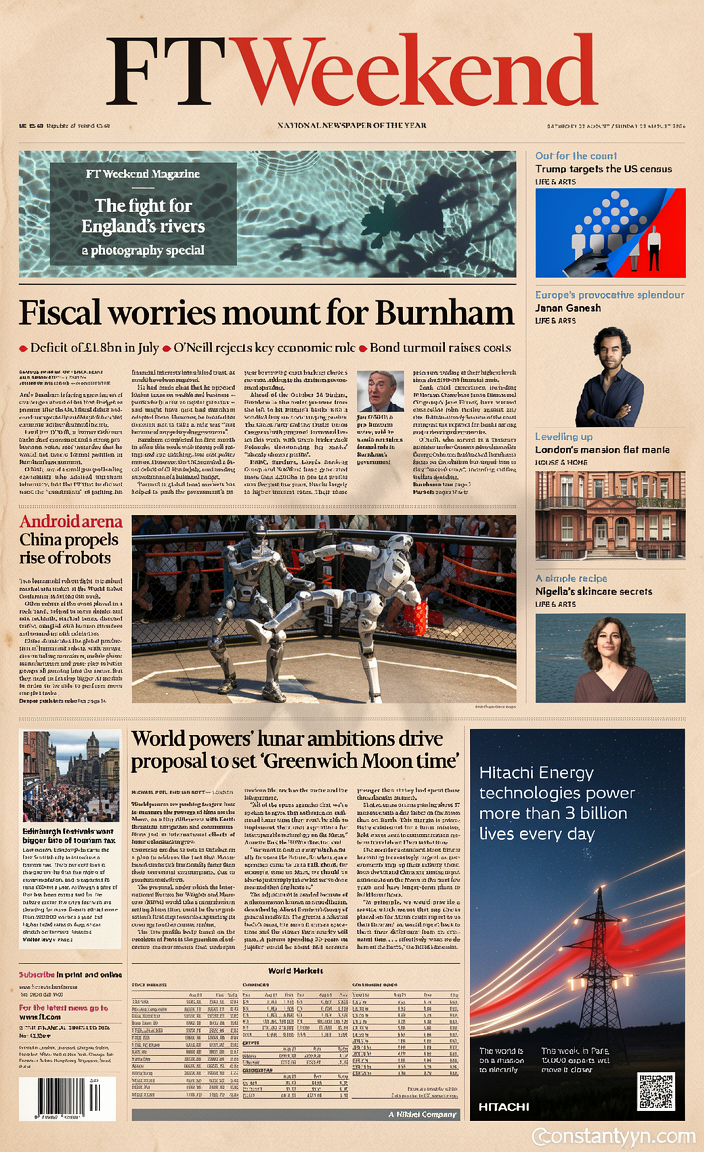
  • ‘Fiscal worries mount’ and ‘Meghan in Guy Ritchie talks’

    ‘Fiscal worries mount’ and ‘Meghan in Guy Ritchie talks’

    UK Press Roundup: Economic Alarm, Royal Casting Drama, and a Legal Landslide

    Constantvpn.com – The morning’s broadsheets and tabloids carry a mix of fiscal anxiety, celebrity spectacle, and institutional scrutiny, painting a picture of a nation navigating competing pressures on its economy, its public figures, and its legal system.

    Burnham’s Economic Gambit Hits a Wall

    The Financial Times opens with a blunt warning: the government’s financial position is deteriorating faster than many had anticipated. The paper’s front-page headline reads, in stark terms, that fiscal concerns are escalating around Prime Minister Andy Burnham’s administration. Central to the story is the revelation that Burnham’s chosen candidate for the role of chief economic adviser has turned down the appointment — a development that signals either a lack of confidence in the government’s economic trajectory or a shortage of senior talent willing to step into the role under current conditions.

    The FT points to two specific indicators of strain: ongoing turbulence in the government bond market, where investors have been repricing UK debt at higher yields, and a fiscal deficit standing at £1.8 billion for the period in question. Together, these figures suggest that the Treasury’s borrowing costs and spending gaps are creating a squeeze that no single policy adjustment can easily resolve. The bond-market turbulence, in particular, raises the cost of servicing existing debt and narrows the fiscal space available for new spending commitments.

    On the same front page, the FT also carries a lighter item: proposals to establish a so-called “Greenwich Moon Time” standard, a concept that would extend the historic Greenwich Mean Time framework to lunar operations. The initiative arrives as major spacefaring powers — the United States, China, India, and others — intensify their ambitions to establish sustained presence on the Moon, making coordination over timekeeping and scheduling increasingly practical rather than purely theoretical.

    Meghan Marks a Return to British Screen

    The Daily Mirror leads with the headline “Duchess and the Gentlemen,” announcing that Meghan, Duchess of Sussex, is in discussions with director Guy Ritchie about joining the cast of his upcoming gangster series The Gentlemen. The Telegraph, meanwhile, features a photograph of Meghan dressed in pink alongside the note that she is engaged in “advanced discussions” regarding the project. The Daily Star takes a more tabloid-tinged angle, headlining the story as “Meg’s lock stock… and two moaning Royals.”

    The casting talks land against the backdrop of a recent bombshell announcement: Meghan and Prince Harry intend to return to live in the United Kingdom, a move that has already reshaped the couple’s relationship with British institutions and media. A role in a Ritchie production would represent a significant step back into the entertainment industry after years of distance from Hollywood’s centre of gravity, and it would place the Duchess squarely within the British cultural landscape once again.

    Mandelson Inquiry Faces a Structural Problem

    The Daily Telegraph also reports that the criminal investigation into Lord Peter Mandelson is, by its own account, “at risk of collapse.” The inquiry centres on whether the former minister passed confidential government information to the late financier Jeffrey Epstein. According to the paper, the investigation could be severely hampered because US authorities are deemed “unlikely to hand over key Epstein files” that would be needed to establish or refute the chain of disclosures. Lord Mandelson has publicly denied any wrongdoing. The procedural difficulty — dependence on American cooperation for documents held in US custody — introduces a layer of complexity that goes beyond the usual domestic investigative process and raises questions about how far a UK prosecution can proceed without that external evidence.

    £34 Million Privacy Verdict Lands

    A separate legal story dominates several titles. The Times reports that Prince Harry, Sir Elton John, and a group of other celebrities “could face £34m bill” following their unsuccessful privacy action. The presiding judge ruled that the claimants had presented their case in a manner that was “unreasonable to a high degree,” a finding that shifts the costs burden onto the plaintiffs. The Daily Mail marks the ruling as a “day of reckoning,” headlining it with the line that “Harry, Elton & co will have to pay millions to Mail,” and describing the outcome as a “disaster for Prince Harry.” The i Paper similarly leads on the “huge legal bill” now facing the prince alongside other named claimants, including Liz Hurley and Sadie Frost.

    The ruling carries implications well beyond the individual parties. It reinforces a judicial posture that discourages what courts view as overreaching privacy claims, and it signals to future litigants that the costs consequences of an unreasonable presentation can be severe. For the media defendants, the decision affirms the viability of resisting broad privacy injunctions where the claimants’ own conduct or public profile undermines their expectation of confidentiality.

    Parliamentary Freebies and a Football Bid

    The Guardian reports that Members of Parliament have already accepted £400,000 worth of freebies this year, drawing fresh criticism that they have been “failing to learn their lesson.” The reference points to the 2024 outcry after former Prime Minister Sir Keir Starmer accepted football tickets, an episode that prompted calls for stricter disclosure norms. The Guardian’s framing suggests that the institutional lesson from that episode has not been absorbed.

    Separately, the i Paper carries a story indicating that the UK is planning a new bid for the men’s football World Cup, a move that would place England back in the running for one of the sport’s most lucrative hosting opportunities.

    A French Mother’s Warning

    The Daily Express turns to a story from France, headlining a quote from a local mother:

    “In France we too are afraid of illegal migrants.”

    The woman describes villagers living “in terror after illegal migrants moved in,” a sentiment the paper uses to draw a parallel with domestic anxieties about immigration and community cohesion.

    Across the spread, the day’s front pages collectively underscore a theme of institutions under pressure — fiscal, legal, investigative, and social — while celebrity narratives provide a counterweight of spectacle and personal reinvention.

    Frequently Asked Questions

    What is Fiscal worries mount and Meghan in Guy?

    Fiscal worries mount and Meghan in Guy is the main topic of this guide. The article explains the context, practical details, and next steps readers should understand.

    Why does Fiscal worries mount and Meghan in Guy matter?

    Fiscal worries mount and Meghan in Guy matters because readers are looking for a useful answer, not just a short summary. Good content should match search intent and help them decide what to do next.

  • Drugs at their fingertips, intense pressure: Why child stars fall into addiction

    Drugs at their fingertips, intense pressure: Why child stars fall into addiction

    Child Stardom, Adult Consequences: The Hidden Toll of Early Fame on Mental Health

    Constantvpn.com – The sudden passing of actress Hayden Panettiere at age 36 has thrust a long-simmering question back into public view: what happens to young performers when the machinery of celebrity meets an undeveloped nervous system? Panettiere’s death, confirmed by the coroner’s office in Greenville, South Carolina, has reignited debate over how Hollywood’s relentless demands on child actors can set the stage for lifelong struggles with substance dependence and psychological distress.

    What authorities have confirmed

    Greenville’s coroner’s office stated that first responders arrived at a scene involving a woman in cardiac arrest and that the subsequent autopsy revealed no signs of physical trauma. A definitive cause of death has not yet been announced, with additional laboratory tests still pending. Audio recordings from police dispatchers and responding crews indicated they were dispatched to a cardiac arrest call and described resuscitation efforts following what appeared to be a possible overdose.

    A police report noted that Panettiere’s ex-boyfriend, Brian Hickerson — who has publicly acknowledged abusing her — along with his brother Zack, were present at the location when emergency personnel arrived. Police have indicated there is no suggestion of wrongdoing on either man’s part. The US Drug Enforcement Administration has joined the ongoing investigation, according to American media coverage, though it remains unclear whether drugs or alcohol contributed to her death.

    A memoir written in the shadow of addiction

    Months before her death, Panettiere published a memoir in which she laid bare years of battles with substance abuse, postpartum depression, and the grief of losing her 28-year-old brother. In one passage, she recalled being sixteen years old and preparing for a red-carpet event tied to the NBC science-fiction series Heroes, which had propelled her into mainstream recognition. A member of her entourage handed her a pill meant to boost her energy before the appearance.

    “Within minutes, a wave of energy washed over me, like I’d just woken up from the most refreshing night’s sleep of my life,” she wrote.

    She later described that single pill as

    “the gateway drug that ushered me toward the good of pharmaceuticals and the downfall of addiction.”

    The memoir offered readers an unflinching account of how early exposure to pharmaceuticals, combined with the exhaustion of constant public performance, created a trajectory from which recovery became extraordinarily difficult.

    Why early fame elevates risk

    Addiction specialists explain that child performers occupy a uniquely vulnerable position. Lucas Trautman, medical director of Oxford Treatment Center in Mississippi, has treated numerous young entertainers and notes that these individuals gain “adult access” to alcohol and drugs without the protective scaffolding of adult supervision.

    “We aren’t equipped at a young age to be able to say no to it, to manage it, to correctly stay away from it altogether,” Trautman explained.

    He emphasized that while outsiders may perceive child actors as having everything at their fingertips — fame, wealth, access — they were simultaneously exposed during critical developmental windows to adult pressures, traumatic experiences, and environments that most people encounter only later in life. That convergence, he argued, creates distinctive risk factors for both mental-health disorders and substance dependence.

    William Moyers, vice-president of public affairs at Hazelden Betty Ford — the largest nonprofit addiction-treatment organization in the United States — praised Panettiere’s decision to speak publicly about her struggles. Yet he cautioned that the very visibility that defined her career may have deprived her of private space to heal.

    “Her entire life from the beginning was centred in the intense public spotlight, and this didn’t give Hayden much in the way of a respite,” Moyers said. He has been in recovery from his own addiction since 1989.

    A pattern among young performers

    Panettiere’s experience is not isolated. Drew Barrymore entered rehabilitation at age twelve. Demi Lovato, who rose to prominence on Disney Channel, described a car accident in her early teens after which doctors prescribed opiates. Speaking on the podcast Call Her Daddy in 2022, Lovato recalled that her mother did not anticipate needing to lock away the medication from a thirteen-year-old — yet Lovato was already drinking at that point.

    Actress Michelle Rodriguez, who once co-hosted the World Music Awards alongside Panettiere, voiced her alarm at the frequency of young deaths in the industry this week.

    “I just can’t stand how many young people are leaving us lately. It’s disheartening, and it’s making me think, ‘What’s going on?’ It’s not normal,” she told Variety.

    Broader implications

    Panettiere’s death arrives roughly a year after another prominent young entertainer’s passing, underscoring a pattern that industry observers and clinicians find increasingly difficult to dismiss. The convergence of factors — early pharmaceutical exposure, chronic sleep disruption, public scrutiny that leaves no private room for recovery, and the absence of adult boundaries around substances — creates a compounding risk that standard adult-oriented treatment models are not always designed to address.

    For families of young performers and for the studios that employ them, the question now is whether the infrastructure of care — from on-set medical oversight to post-career transition support — will evolve to match the documented dangers. Until it does, the next generation of child stars will continue navigating adult pressures with tools and protections that have not yet caught up to the reality of their lives.

    Frequently Asked Questions

    What is Drugs at their fingertips intense pressure?

    Drugs at their fingertips intense pressure is the main topic of this guide. The article explains the context, practical details, and next steps readers should understand.

    Why does Drugs at their fingertips intense pressure matter?

    Drugs at their fingertips intense pressure matters because readers are looking for a useful answer, not just a short summary. Good content should match search intent and help them decide what to do next.

  • Brandon Flowers: Is fame worth it? I’m not sure anymore

    Brandon Flowers: Is fame worth it? I’m not sure anymore

    Brandon Flowers Trades Stadium Anthems for Nashville Steel Strings — and Questions Everything

    Constantvpn.com – For a quarter century, the voice atop “Mr Brightside” and “When You Were Young” has belonged to Brandon Flowers, the frontman who helped turn The Killers into one of the most recognizable stadium-rock acts of the 21st century. Yet the singer has spent those same years nursing a quieter, more personal obsession: country music. Now, with The Killers paused since their set at this summer’s UEFA Champions League final, Flowers has returned to that obsession in full force. His third solo record, Thrasher, marks his first solo release in eleven years and represents a deliberate pivot away from the arena-scale sound that built his career.

    A Childhood Frequency Re-tuned

    The roots of that pivot stretch back to Nephi, Utah, where Flowers grew up listening to his father spin Johnny Cash, Merle Haggard, and John Conlee through a car stereo. School dances hosted at the local golf club invariably featured a country-western slow dance, embedding the genre’s cadence into his earliest social memories. Years later, after relocating back home, Flowers found himself revisiting those childhood haunts and discovering the pull had never faded.

    “You know, a lot of guys in my line of business develop drug addictions. I got a country addiction.”

    The album was tracked at Nashville’s RCA Studio A — the same room where Dolly Parton laid down “Jolene” and “I Will Always Love You” — surrounded by a roster of veteran session players. Pedal-steel icon Bruce Bouton, harmonica veteran Charlie McCoy (now 85), and Americana singer-songwriter Margo Price all contributed. Flowers insists the sessions were conducted live, with everyone playing together in the room.

    “I sang live with them and I think they really appreciated that, because it’s a very romantic way of doing it. It’s not something that people do anymore. To actually get that energy down on tape is a different thing.”

    Digging Up the Diary

    Flowers has long claimed his personal experiences were “not interesting enough” for songwriting. That calculus has shifted. Thrasher draws heavily on his rural upbringing and his years working in Las Vegas casinos, material he is now excavating from old diary entries. One track pays tribute to his brother-in-law, who died suddenly several years ago. Another, titled “Miss America,” takes aim at the opioid epidemic that devastated his hometown.

    “It’s a sad thing, you know? It’s basically doctors prescribing people heroin, and it took so many lives unnecessarily.”

    He elaborates on the human toll: in his own graduating class from that small town, a significant number of classmates have since died. Prescription opioids are chemically related to but not identical with heroin, yet Flowers uses the comparison to convey the shock of watching peers disappear.

    “Even just in my graduating class in that little town, so many of the kids are gone. It’s kind of staggering. Such a dirty business.”

    The Elvis Question

    The record also functions as a mid-career reckoning. On a track called “American Dream,” Flowers imagines meeting Elvis Presley — aboard a flying Tesla, no less — and asking whether fame and fortune deliver what they promise. In the song, Elvis simply laughs. In life, the question has gnawed at Flowers for years.

    “Sometimes I wonder, what am I trying to achieve, and what am I trying to prove, and who am I trying to prove it to, and what have I gotten from it?”

    The songwriting spark came from conversations with his three teenage sons, whom he worries are measuring themselves against his public success. Flowers has long kept his family insulated from the trappings of celebrity — no gold records in the bathroom, no constant talk of chart positions. He points to his own father as proof that contentment need not correlate with income: his dad, now 82, earned roughly $25,000 a year for most of his working life, yet spends his days painting and hunting garage sales with evident joy.

    “So yeah, I don’t know if it’s worth it. I don’t know anymore.”

    Marriage, Distance, and the Road Ahead

    Approaching his 21st wedding anniversary, Flowers acknowledges that periodic absences from home — a byproduct of touring — carry an unexpected silver lining.

    “There’s a danger you could grow apart, but there’s also this great rediscovery that can happen, and a freshness it can bring, when you return.”

    He also takes fan relationships seriously enough to feel uneasy about a lyric on the Killers’ most recent album, “In Another Life,” which prompted some listeners to interrogate their own partnerships. Flowers describes himself as quietly spoken and self-effacing, his anecdotes punctuated by nervous laughter — a marked contrast to the stage-fright battles he discussed in interviews during the band’s peak years.

    As for The Killers themselves, Flowers confirms the group is on hiatus but says he has “business in mind” for their eventual return. Whether that return will carry the stadium-rock vocabulary of “Human” or something closer to the pedal-steel textures of Thrasher remains to be seen. What is clear is that the man who once channeled British new wave into arena anthems now finds his most honest voice in a slow dance at a Utah golf club, and in the question he can no longer stop asking: is all of this actually worth it?

    Frequently Asked Questions

    What is Brandon Flowers?

    Brandon Flowers is the main topic of this guide. The article explains the context, practical details, and next steps readers should understand.

    Why does Brandon Flowers matter?

    Brandon Flowers matters because readers are looking for a useful answer, not just a short summary. Good content should match search intent and help them decide what to do next.

  • GCSE results, resits and appeals – what to do if you are unhappy with your grades

    GCSE results, resits and appeals – what to do if you are unhappy with your grades

    GCSE Results Resits and Appeals: A Practical Guide

    Constantvpn.com – Every August, hundreds of thousands of sixteen-year-olds across England, Wales, and Northern Ireland face the same question: what happens now? GCSE results resits and appeals become the central concern for any student whose grades fall short of the marks needed for A-levels, apprenticeships, or other post-16 routes. Results are released from 08:00 BST on Thursday 20 August, and the immediate aftermath demands clear, structured decision-making rather than panic.

    How a pupil receives their grades depends on where they sit. In England, scores appear on a smartphone via the Education Record app, with digital access opening at 11:00 on results day. Schools and colleges in Wales and Northern Ireland still hand results out in person, usually in a classroom or assembly hall where families are present to hear the outcome aloud.

    Understanding the Grades and Grade Boundaries

    England uses a numerical scale from 9 (top) to 1 (bottom). A score of 4 is the “standard pass” and 5 the “strong pass”; most universities and further-education colleges set grade 4 in English and Mathematics as the minimum entry requirement for post-16 programmes. Wales and Northern Ireland generally retain letter grades (A* through E) unless the paper is set by an English exam board, in which case the numeric scale applies.

    On results day, each exam board publishes its grade boundaries — the minimum raw-mark cut-offs for every grade. These figures are set by examiners and released simultaneously with individual scores, so students and parents can check precisely where a mark landed relative to the threshold.

    Challenging a Mark: Step-by-Step Appeal Process

    The appeals pathway follows a strict escalation ladder, and the school or college acts as the student’s intermediary at every stage. First, the pupil raises the concern with their institution, which contacts the exam board to request a formal review of the marks. That review checks for arithmetic slips, misallocated marks, or procedural errors.

    If the grade stands after review and the student still believes the marking was unfair, the school or college lodges a formal appeal with the board. Should dissatisfaction persist, a further review can be sought through the national regulator — Ofqual in England, the Council for Curriculum, Examinations and Assessment (CCEA) in Northern Ireland, or Qualifications Wales in Wales. Students do not contact boards or regulators directly; all communication flows through the school or college.

    Remember: you cannot appeal a grade on your own. Every step of the GCSE results resits and appeals process runs through your school or college as the official channel.

    Resitting: Planning a Second Sitting

    Any GCSE subject may be resat in the following academic year. For English and Mathematics specifically, the next resit sitting is expected in November 2026. Students taking these resits are allowed to study them alongside their new post-16 subjects, so the extra workload slots into an already demanding timetable rather than requiring a full year off.

    Those weighing a resit should speak to their school or college early to identify the most practical route — a dedicated resit course, private candidature, or integration into a broader programme. The choice affects university application timelines, apprenticeship start dates, and personal finances, so early planning is strongly advisable.

    Routes Beyond Results Day

    In England, young people must remain in some form of official education or training until age 18. Options include full-time A-levels, the International Baccalaureate, vocational qualifications (NVQs, BTec Level 3, TechBacs, Cambridge Technicals), and — exclusive to England — T-levels. Each pathway carries its own entry requirements, grading structure, and labour-market recognition.

    Apprenticeships offer a distinct route in which young workers earn a salary while spending roughly 80% of their time in a workplace setting, receiving structured training alongside on-the-job experience. Entry requirements vary by sector and employer, but most demand at least a grade 4 in English and Mathematics GCSEs.

    Frequently Asked Questions

    Can I appeal my GCSE grade directly to the exam board?

    No. You must go through your school or college, which contacts the board on your behalf. Direct student-to-board appeals are not accepted.

    What happens if my appeal succeeds?

    The exam board corrects the grade and issues an updated certificate. Your school or college will inform you of the revised result and any implications for your next steps.

    Is there a deadline for requesting a resit?

    Yes. Entry deadlines for the November 2026 resit sitting are set by each exam board and typically fall in the autumn term. Contact your school or college well before the deadline to secure a place.

    Do resit grades count the same as original grades?

    Yes. A resit grade is treated identically to a first-sitting grade by universities, colleges, and employers. The certificate will note the year of the sitting but carries the same weight.

  • Trump threatens ‘tremendous economic consequences’ on any country helping Iran

    Trump threatens ‘tremendous economic consequences’ on any country helping Iran

    Trump Threatens Economic Consequences on Iran Partners

    Constantvpn.com – The sixty-day ceasefire between Washington and Tehran expired on Monday with no visible diplomatic off-ramp, and within hours President Donald Trump moved to tighten the economic vise around the Islamic Republic. In a Wednesday-evening Truth Social post written entirely in capital letters, he declared he was unleashing “the most crushing economic operation ever taken against any country!” The announcement extended what the administration calls Operation Economic Fury beyond direct sanctions, reaching every foreign government or institution that keeps commercial or financial channels open to Tehran. In effect, Trump threatens tremendous economic consequences on any nation that continues to trade with, finance, or provide logistical cover for the Iranian economy.

    What Trump Said and What He Left Unspecified

    Trump framed the escalation as a direct response to Iran’s refusal to accept a negotiated settlement. He branded the initiative “economic D-Day” and enumerated the channels he wanted shut down immediately.

    “ANY country that allows its financial institutions, wept businesses, airports, or government entities to provide any type of lifeline to Iran will itself face TREMENDOUS Economic Consequences.”

    “Oil smuggling, swap lines, cash transfers, exchange houses, ship registries, front companies — It all needs to stop NOW. You know who you are.”

    No individual nation was named in the post, yet the language left little doubt about which trading partners sat in the crosshairs. Equally notable was the absence of any concrete penalty schedule: the president offered no specifics on what tariffs, asset freezes, or retaliatory measures those countries might actually face.

    Gulf Fallout: UAE Cuts Ties After Missile Incidents

    The presidential warning landed one day after the United Arab Emirates — a close American ally — announced it would sever all financial and economic connections with Iran. The decision followed a fresh missile episode: the UAE defence ministry reported detecting two ballistic missiles launched from Iranian territory and aimed at maritime traffic. Both projectiles struck the sea without hitting a vessel. The episode highlighted how deeply intertwined Gulf financial infrastructure and Iranian commerce remain; for years, Iranian actors have routed funds through Dubai’s exchange houses and shell-company networks, making the emirate’s decision a significant disruption to Tehran’s cash-flow channels.

    In response, Iran’s armed forces issued a warning to neighbouring Gulf states, cautioning them against offering any form of logistical or operational support to American military forces. Tehran stated that any such assistance would be treated as active collusion with the United States.

    China: The Unnamed Target

    Although Beijing was never explicitly mentioned, Chinese firms remain the single largest purchasers of Iranian crude oil — a revenue stream that underpins much of Tehran’s state budget. Since the conflict opened at the end of February, Washington has already sanctioned a number of so-called teapot refineries, privately owned oil-processing plants concentrated in Shandong province in eastern China. At the time of those designations, China’s Ministry of Commerce declared the measures “in violation of international law and the basic norms governing international relations” and issued a domestic order stating that the sanctions “shall not be recognised, enforced, or complied with.” The Chinese embassy in Washington was contacted for comment on the latest presidential post but had not responded as of publication.

    Operation Economic Fury: Scope and Trajectory

    Launched in April, Operation Economic Fury represented a coordinated effort between the Treasury Department and the Pentagon to dismantle Iran’s revenue architecture. Its twin pillars were sweeping sanctions on foreign banks and firms dealing with Tehran, combined with a naval blockade designed to choke off exports from the Islamic Republic. Last week, Treasury Secretary Scott Bessent told reporters the United States would soon impose a degree of economic isolation on Iran “like the world has never seen before.” The Wednesday post extends that architecture one step further, threatening secondary penalties on any third-party nation that continues to trade with or finance the Iranian economy.

    The broader conflict has already thrown shipping through the Strait of Hormuz into severe disarray, pushing global energy prices higher. Roughly twenty percent of the world’s crude oil and liquified natural gas normally transits that narrow waterway, and the United States and Oman have been conducting joint coordination efforts to keep lanes open amid the disruption.

    Frequently Asked Questions

    What exactly does “tremendous economic consequences” mean in practice? Trump did not specify concrete penalties. Based on the channels he named — swap lines, cash transfers, exchange houses, ship registries, front companies — analysts expect secondary sanctions, possible tariffs on goods transiting those channels, and restrictions on access to dollar clearing systems for firms in countries that continue dealing with Iran.

    Which countries are most exposed to this threat? China, the United Arab Emirates, Turkey, and several South Asian and Gulf states maintain significant trade or financial links with Iran. The UAE has already severed formal ties. China, as the largest buyer of Iranian crude, faces the greatest commercial exposure, though Beijing has publicly rejected U.S. sanctions as unlawful.

    How does this differ from the existing sanctions regime? Previous measures targeted Iranian banks, firms, and shipping directly. The new posture adds a secondary layer: foreign governments and institutions that keep channels open to Tehran risk penalties of their own. That shift from primary to secondary enforcement is what makes the escalation qualitatively different.

    What role does the Strait of Hormuz play? About twenty percent of global crude oil and LNG transits the strait. Disruption there amplifies the economic pressure Trump is applying, raising energy prices worldwide and increasing the cost of any country that depends on Gulf energy imports.

  • Harry and Meghan are experts in surprise – but is their UK return forever?

    Harry and Meghan are experts in surprise – but is their UK return forever?

    The Sussexes Are Coming Home — But Not the Way Anyone Expected

    Constantvpn.com – For years, the Duke and Duchess of Sussex have built a reputation around unpredictability. Major life choices announced without warning, public appearances that upend protocol, business ventures launched on a whim — the pattern has been so consistent that observers have almost stopped being surprised. Yet the announcement that Harry and Meghan intend to relocate permanently to Britain still lands with a jolt, precisely because the couple has spent the better part of a decade cultivating a life on the other side of the Atlantic.

    What makes this particular move different from earlier speculation is its suddenness. Conversations about spending more time in Europe had circulated informally for some time, but the decision to actually uproot and settle in Britain was finalized only recently. A family trip to the UK in July proved to be the tipping point. Harry, Meghan, Prince Archie, and Princess Lilibet spent days at Highgrove with King Charles and also visited the extended Spencer family — the aunts, uncles, and cousins who were Diana’s own siblings and their children. The children’s first extended time with those relatives, combined with a broader European itinerary that included a stop in Portugal (where the Sussexes maintain a residence), was described by those close to the family as “such a great time.” That experience converted a vague possibility into a concrete plan.

    What Is Driving the Relocation

    Those briefed on the couple’s thinking are emphatic that no crisis in American life prompted the change. There was no scandal, no legal emergency, no professional collapse. The motivation is simpler and more personal: Harry wants to be physically close to his family, and both parents want their children educated in the British system. Schools have already been selected for Archie and Lilibet. Because virtually every English school begins its academic year by the second week of September, the family is expected to be physically present in Britain within roughly ten days of the announcement.

    The precise address has not been disclosed, but London is off the table. Rumour points toward the Cotswolds or the Northampton area, both within reasonable driving distance of Althorp House — the Northamptonshire estate that served as the childhood home of Diana, Princess of Wales, and remains the seat of the Spencer family. Trading a multi-million-dollar California mansion for a somewhat chillier English countryside property fits the couple’s stated priorities.

    The King’s Reaction — and What It Does Not Mean

    King Charles was not a party to the decision. He was informed on a Sunday that his son and daughter-in-law were making the move, and the news came as a genuine surprise to him and to the wider Royal Family. He is understood to welcome the prospect of more private, informal time with Harry, Meghan, and the children. That warmth, however, should not be read as a signal that the fracture between Harry and Prince William has healed.

    The sibling relationship remains what insiders describe as broken. There is no visible trajectory toward reconciliation. William has never forgiven what he regards as Harry’s public airing of private family grievances — first through the memoir Spare, then through the 2021 Oprah Winfrey interview that sent shockwaves through the institution. No official comment has come from the Prince or Princess of Wales, which is unsurprising given how severely the relationship was damaged. To put it plainly, the Prince of Wales is unlikely to greet his brother’s return with open arms, particularly given the sense of a rival household it will create within the same country.

    No Royal Duties, No Official Role

    The Sussexes are returning as private citizens. They are non-working royals, and the Royal Household has shown no interest in constructing a hybrid arrangement in which the couple splits time between official engagement and private life. Any professional activity they undertake in Britain will be entirely separate from royal duty. Meghan has been exploring ways to grow her As Ever lifestyle brand beyond the American market, and questions about whether her products might one day share supermarket shelf space with the King’s Duchy Organic line remain open-ended. For now, no such commercial crossover is planned or confirmed.

    Security and the Unresolved Home Office Dispute

    In the United States, the couple has relied on a privately funded security detail. Whether that team will accompany them across the Atlantic, whether they will seek official Metropolitan Police protection, and whether the long-running dispute between Harry and the Home Office over state-funded security has been resolved — none of these questions drew a response when raised with those close to the family. The dispute dates back to Harry’s repeated requests for official protection while visiting Britain, a request the government has consistently declined. Last year, after losing a legal challenge on the matter, Harry made a statement that now reads with particular irony:

    “I can’t see a world in which I would bring my wife and children back to the UK at this point.”

    That was twelve months ago. The world has shifted.

    “For Now”

    The couple is not framing this as a permanent, irreversible repatriation. They are expecting to be in Britain for what has been characterised as “an extended period of time.” The qualifier matters. Britain will be home — for now. Whether that “now” stretches into years or contracts back into a transatlantic split depends on factors no one outside the household can predict.

    Public reaction will, as always, track the existing fault lines. Those who champion the Sussexes will celebrate the children’s access to their British relatives and the couple’s stated desire for a grounded family life. Those who oppose them will point to the optics of a family that left royal duty in 2020 now re-entering the same postcode district, however informally. The love-them-or-hate-them dynamic shows no sign of moderating. What is new is simply the geography: the boat has rocked one more time, and this time it has docked.

    Frequently Asked Questions

    What is Harry and Meghan are experts in surprise?

    Harry and Meghan are experts in surprise is the main topic of this guide. The article explains the context, practical details, and next steps readers should understand.

    Why does Harry and Meghan are experts in surprise matter?

    Harry and Meghan are experts in surprise matters because readers are looking for a useful answer, not just a short summary. Good content should match search intent and help them decide what to do next.

  • Demand for degree apprenticeships quadruples in three years

    Demand for degree apprenticeships quadruples in three years

    England’s Degree Apprenticeship Race Has Become a Numbers Game Few Applicants Can Win

    Constantvpn.com – The gap between young people wanting a paid university qualification and the handful of slots employers actually offer has widened to a degree that borders on absurd. Freedom of Information records obtained through the government’s Find An Apprenticeship platform reveal that applicants for degree-level roles in England surged from roughly 8,100 to 21,800 over a three-year span, while the number of advertised positions collapsed by nearly half, dropping from 7,300 to 3,700. In practical terms, the odds of securing a place have quadrupled in difficulty within a single academic cycle.

    The figures paint a stark picture of a system under severe strain. For the current academic year, there were 11.3 applications competing for every Level 6 apprenticeship slot, compared with just 2.8 in the 2023-24 cycle. Across Levels 4, 5, and 6 combined, the ratio climbed to 10.6 applicants per position, up from 3.6. Those qualification levels correspond to the first, second, and third years of a standard undergraduate degree, meaning the most competitive segment of the market is precisely where young people are seeking to avoid the financial burden of traditional higher education.

    Why the Surge Is Happening Now

    The appetite for degree apprenticeships — programmes that bundle a fully funded university qualification with a regular salary — has been fuelled by mounting scrutiny of university costs. More prospective students are weighing commutes from home to slash living expenses, and pressure is building for reform of student loan repayment structures. Against that backdrop, a route that delivers both a degree and an income without tuition debt looks, on paper, like the rational choice.

    Prime Minister Andy Burnham reinforced the policy signal last month, stating his intention to ensure teenagers have technical pathways into careers that can rival the prestige of a university degree. The Department for Work and Pensions, in turn, said it was “backing employers who take on young apprentices.” Yet the data suggests employer capacity has not kept pace with demand. Many companies have trimmed hiring amid elevated labour costs and broader economic uncertainty, shrinking the pool of available roles even as applications multiply.

    The Application Experience: More Like a Job Hunt Than a University Entry

    Those who have navigated the process describe an experience closer to corporate recruitment than to UCAS. Daniel Edwards, 21, submitted applications to 11 apprenticeship programmes before landing an engineering degree apprenticeship. He also put his name forward through UCAS as a safety net.

    “University was more straightforward. It’s one personal statement that you put out to all universities. Your degree apprenticeship… you’ve got a cover letter, a CV. It’s like applying for a real job. You’ve really got to convey your passion for that specific company.”

    Anna Helder, 18, went further, submitting 35 applications while still at Hereford Sixth Form College before finally securing a project management role in London. She described the process as emotionally exhausting, with long stretches of silence punctuated by sudden demands.

    “I found it overwhelming the amount of stages that you have to go through. You could go two months with zero contact from the company and then suddenly just an email saying: ‘You’ve got an assessment centre next week.’”

    What Happens When You Miss Out

    Kieran McRae, 22, applied for a degree apprenticeship and was turned away. He called the experience “devastated.” He enrolled in computer science at the University of Birmingham, where he shared lecture halls, laboratories, and tutorials with apprentices who had been accepted onto the very programme that rejected him.

    “[There] was, I think, always a bit of jealousy. Not to say that I wasn’t happy for them… but I knew that I was not getting that same free degree or the same salary.”

    McRae now says he is content with the path he took, particularly because his course included industry placements — something the University of Birmingham noted had grown increasingly important to offer when apprenticeship competition is this intense. Still, he was unequivocal about his preference: “If I was 18 and offered the degree apprenticeship, 100% I would have taken it.”

    Platform Data and Broader Market Signals

    The government-run Find An Apprenticeship website, which is subject to Freedom of Information requests, captures only a slice of the market. Employers also advertise directly and through private platforms. Oliver Sidwell, director of Higherin, one such service, reported that searches for degree apprenticeships on his platform rose by more than 80 percent this year. He noted that employers were listing more roles through his service, but demand was outpacing supply.

    Vicky Orsmond, who advises students at Hereford Sixth Form College on career choices, confirmed that “significant concern” about university costs had driven a sharp uptick in interest among her pupils. She cautioned, however, that translating that interest into an actual placement remained extremely difficult given the current applicant-to-vacancy ratios.

    What the Numbers Mean for Prospective Applicants

    For an 18-year-old weighing options this autumn, the arithmetic is unforgiving. With fewer than 4,000 degree-level slots advertised through the central government channel and over 21,000 applicants vying for them, the probability of success through that single route is slim. The rational strategy emerging among applicants is to treat the apprenticeship application as a long-shot alongside a conventional UCAS submission, accepting that the “backup” may well become the primary outcome. Employers, for their part, face a policy question: whether the current subsidy structure is sufficient to incentivise the hiring volumes needed to close the gap between demand and supply, or whether the model requires recalibration before the next intake cycle.

    Frequently Asked Questions

    What is Demand for degree apprenticeships quadruples in three?

    Demand for degree apprenticeships quadruples in three is the main topic of this guide. The article explains the context, practical details, and next steps readers should understand.

    Why does Demand for degree apprenticeships quadruples in three matter?

    Demand for degree apprenticeships quadruples in three matters because readers are looking for a useful answer, not just a short summary. Good content should match search intent and help them decide what to do next.

  • Serco employee charged over sharing asylum seeker addresses

    Serco employee charged over sharing asylum seeker addresses

    Thetford Accommodation Worker Faces Misconduct Charge After Asylum Seeker Addresses Circulated

    Constantvpn.com – A 62-year-old employee of a private firm contracted to house asylum seekers in Norfolk has been formally charged with misconduct in public office, following the release of residential addresses that were subsequently targeted by angry crowds during three consecutive nights of disorder in the town of Thetford. The case has drawn renewed attention to the fraught relationship between local communities and the placement of asylum accommodation in smaller English towns.

    The Disturbances in Thetford

    Earlier this month, residents and visitors gathered outside several streets in Thetford, Norfolk, where asylum seekers were being housed under government arrangements. Over three nights, crowds converged on properties along St John’s Way, Bracken Road, Clover Way, Elm Road, and Chester Way. Police deployed a heavy presence to manage the situation and protect residents and occupants of the buildings. The episodes of violent disorder left the town shaken and prompted questions about how information regarding the locations had become publicly known.

    Thetford, a market town of roughly 15,000 people situated in west Norfolk, has experienced growing tension around the siting of asylum accommodation in recent years. The issue has become a flashpoint across much of rural England, where smaller communities often feel that the scale of arrivals exceeds what local infrastructure can absorb. In Thetford, the concentration of properties on a handful of residential streets amplified the sense of disruption among neighbours.

    The Charge Against James Jobson

    The individual now facing prosecution is James Jobson, aged 62, of Highlow Road, Costessey, a suburb near Norwich. Jobson is employed by Serco, the multinational services company that operates accommodation contracts for the Home Office on behalf of asylum seekers awaiting decisions on their claims. He appeared at Ipswich Magistrates’ Court on Monday to answer the charge.

    According to the charging document, between 3 and 14 August, while acting in his capacity as a public officer employed by Serco, Jobson “wilfully and without reasonable excuse or justification” committed misconduct in a manner which “amounted to an abuse of the public’s trust in the office.” The charge of misconduct in public office carries a maximum sentence of two years’ imprisonment, though sentencing practice varies considerably depending on the circumstances and the degree of harm caused.

    Jobson was remanded in custody at the conclusion of his first court appearance. He is due to stand trial at Norwich Crown Court on 14 September, where the full case will be heard before a judge and jury.

    Police and Company Responses

    Norfolk Police confirmed that the prosecution was connected to the dissemination of information relating to multiple addresses in Thetford, which were subsequently targeted during the nights of violent disorder. The force stated plainly that the release of those details formed the basis of the criminal charge.

    A spokesperson for Serco issued a brief statement addressing the ongoing proceedings:

    “This matter is currently being handled by the police, and we are cooperating fully. As this relates to an ongoing legal process, it would be inappropriate to comment further.”

    The company’s measured response reflects the standard position of large contractors when employees face criminal proceedings. Serco operates a network of asylum accommodation sites across England and has been under sustained scrutiny since the government expanded its use of private-sector housing to manage the backlog of pending asylum claims.

    Broader Context and Implications

    The case sits within a wider national conversation about transparency, data handling, and community relations in the asylum system. When addresses of occupied properties become known to the public, the occupants — often vulnerable people who have fled conflict or persecution — face heightened exposure to hostility. The question of who holds that information, how it is stored, and under what circumstances it might be shared has become a matter of significant public interest.

    For Thetford residents, the three nights of disorder represented a rupture in the daily rhythm of a small town. For the asylum seekers housed on those streets, the experience was one of fear and uncertainty. The criminal charge now before the courts seeks to establish whether an individual in a position of trust deliberately or recklessly allowed confidential location data to reach the wider community, and whether that act contributed materially to the disturbances that followed.

    The September hearing at Norwich Crown Court will determine whether Jobson is convicted. If found guilty, sentencing will take account of the scale of the disorder, the vulnerability of those whose addresses were exposed, and the degree to which the defendant’s actions were a contributing factor. The outcome will be watched closely by both local residents and by those who follow the ongoing debate over how Britain manages its asylum obligations in small towns where the social fabric is already under strain.

    Frequently Asked Questions

    What is Serco employee charged over sharing asylum?

    Serco employee charged over sharing asylum is the main topic of this guide. The article explains the context, practical details, and next steps readers should understand.

    Why does Serco employee charged over sharing asylum matter?

    Serco employee charged over sharing asylum matters because readers are looking for a useful answer, not just a short summary. Good content should match search intent and help them decide what to do next.