
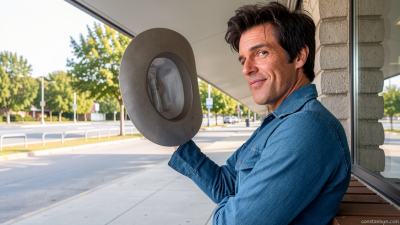
Brandon Flowers Trades Stadium Anthems for Nashville Steel Strings — and Questions Everything
Constantvpn.com – For a quarter century, the voice atop “Mr Brightside” and “When You Were Young” has belonged to Brandon Flowers, the frontman who helped turn The Killers into one of the most recognizable stadium-rock acts of the 21st century. Yet the singer has spent those same years nursing a quieter, more personal obsession: country music. Now, with The Killers paused since their set at this summer’s UEFA Champions League final, Flowers has returned to that obsession in full force. His third solo record, Thrasher, marks his first solo release in eleven years and represents a deliberate pivot away from the arena-scale sound that built his career.
A Childhood Frequency Re-tuned
The roots of that pivot stretch back to Nephi, Utah, where Flowers grew up listening to his father spin Johnny Cash, Merle Haggard, and John Conlee through a car stereo. School dances hosted at the local golf club invariably featured a country-western slow dance, embedding the genre’s cadence into his earliest social memories. Years later, after relocating back home, Flowers found himself revisiting those childhood haunts and discovering the pull had never faded.
“You know, a lot of guys in my line of business develop drug addictions. I got a country addiction.”
The album was tracked at Nashville’s RCA Studio A — the same room where Dolly Parton laid down “Jolene” and “I Will Always Love You” — surrounded by a roster of veteran session players. Pedal-steel icon Bruce Bouton, harmonica veteran Charlie McCoy (now 85), and Americana singer-songwriter Margo Price all contributed. Flowers insists the sessions were conducted live, with everyone playing together in the room.
“I sang live with them and I think they really appreciated that, because it’s a very romantic way of doing it. It’s not something that people do anymore. To actually get that energy down on tape is a different thing.”
Digging Up the Diary
Flowers has long claimed his personal experiences were “not interesting enough” for songwriting. That calculus has shifted. Thrasher draws heavily on his rural upbringing and his years working in Las Vegas casinos, material he is now excavating from old diary entries. One track pays tribute to his brother-in-law, who died suddenly several years ago. Another, titled “Miss America,” takes aim at the opioid epidemic that devastated his hometown.
“It’s a sad thing, you know? It’s basically doctors prescribing people heroin, and it took so many lives unnecessarily.”
He elaborates on the human toll: in his own graduating class from that small town, a significant number of classmates have since died. Prescription opioids are chemically related to but not identical with heroin, yet Flowers uses the comparison to convey the shock of watching peers disappear.
“Even just in my graduating class in that little town, so many of the kids are gone. It’s kind of staggering. Such a dirty business.”
The Elvis Question
The record also functions as a mid-career reckoning. On a track called “American Dream,” Flowers imagines meeting Elvis Presley — aboard a flying Tesla, no less — and asking whether fame and fortune deliver what they promise. In the song, Elvis simply laughs. In life, the question has gnawed at Flowers for years.
“Sometimes I wonder, what am I trying to achieve, and what am I trying to prove, and who am I trying to prove it to, and what have I gotten from it?”
The songwriting spark came from conversations with his three teenage sons, whom he worries are measuring themselves against his public success. Flowers has long kept his family insulated from the trappings of celebrity — no gold records in the bathroom, no constant talk of chart positions. He points to his own father as proof that contentment need not correlate with income: his dad, now 82, earned roughly $25,000 a year for most of his working life, yet spends his days painting and hunting garage sales with evident joy.
“So yeah, I don’t know if it’s worth it. I don’t know anymore.”
Marriage, Distance, and the Road Ahead
Approaching his 21st wedding anniversary, Flowers acknowledges that periodic absences from home — a byproduct of touring — carry an unexpected silver lining.
“There’s a danger you could grow apart, but there’s also this great rediscovery that can happen, and a freshness it can bring, when you return.”
He also takes fan relationships seriously enough to feel uneasy about a lyric on the Killers’ most recent album, “In Another Life,” which prompted some listeners to interrogate their own partnerships. Flowers describes himself as quietly spoken and self-effacing, his anecdotes punctuated by nervous laughter — a marked contrast to the stage-fright battles he discussed in interviews during the band’s peak years.
As for The Killers themselves, Flowers confirms the group is on hiatus but says he has “business in mind” for their eventual return. Whether that return will carry the stadium-rock vocabulary of “Human” or something closer to the pedal-steel textures of Thrasher remains to be seen. What is clear is that the man who once channeled British new wave into arena anthems now finds his most honest voice in a slow dance at a Utah golf club, and in the question he can no longer stop asking: is all of this actually worth it?
Related Reading
Frequently Asked Questions
What is Brandon Flowers?
Brandon Flowers is the main topic of this guide. The article explains the context, practical details, and next steps readers should understand.
Why does Brandon Flowers matter?
Brandon Flowers matters because readers are looking for a useful answer, not just a short summary. Good content should match search intent and help them decide what to do next.