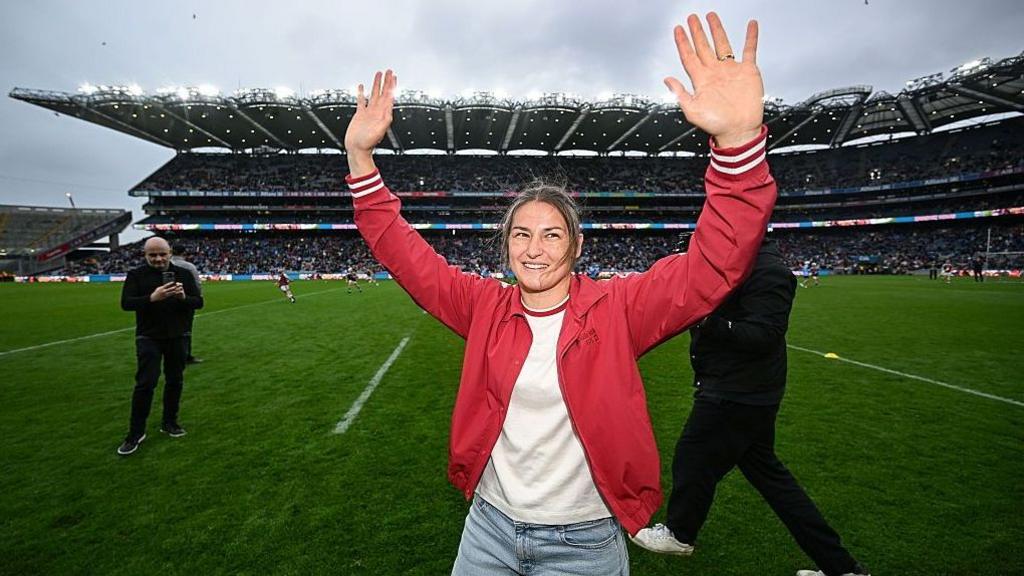
The Final Bell: How Five Pivotal Choices Forged Katie Taylor’s Unmatched Legacy
Constantvpn.com – On a Saturday evening in Dublin, an arena built to hold 82,000 spectators will watch one woman step through the ropes for the last time. Katie Taylor, aged 40, will face France’s Flora Pili in what she has described as her farewell bout. A victory on that ground would allow the Irish fighter to retire as the undisputed light-welterweight champion, capping a professional record of 25 wins and a single loss. But the significance of that night extends far beyond one title belt. Taylor’s career — which also encompasses an Olympic gold medal, five world amateur championships, and undisputed world titles at two weight divisions — has fundamentally altered how the sporting world treats women’s boxing.
Her journey did not begin in a ring. It began in a small town, in a child’s handwriting, on a sheet of paper addressed to a woman who had already broken through barriers that seemed permanent.
A Letter from Bray: The Spark Before the Fire
In the early 1990s, a ten-year-old girl in Bray, County Wicklow, wanted nothing more than to throw punches. Yet Ireland offered her no sanctioned pathway. Women’s boxing was not recognised domestically, had no place on the Olympic programme, and provided no visible route into professional competition. The landscape was barren.
One figure, however, had already navigated that barrenness. Deirdre Gogarty had emigrated to the United States and, in 1997, defeated Bonnie Canino in Louisiana to claim the WIBF featherweight title, becoming Ireland’s first female professional world champion. For the young girl in Bray, Gogarty was proof that the impossible had a precedent.
Taylor wrote to her idol with a question that carried the weight of a decade of exclusion:
“How did you do it when everyone tried to stop you?”
Gogarty’s reply, delivered years later in reflection, carried both encouragement and a quiet prophecy:
“If you keep working at it and keep showing your skills, somebody’s going to say ‘we’ve got to let this girl box.’”
Gogarty later recalled the letter with astonishment, particularly one line in which the child speculated that perhaps one day women would be permitted to compete at the Olympics. That single sentence, penned by a ten-year-old with no institutional backing, became the emotional architecture upon which everything that followed was built.
Chicago, London, Rio: The Olympic Arc
When the International Olympic Committee remained uncertain about adding women’s boxing to the Games, Taylor was invited to perform in showcase bouts before a sceptical audience of officials in Chicago. Her performances in those exhibitions dismantled every remaining objection. Manager Brian Peters, who has worked alongside Taylor throughout her career, has been blunt about the impact:
“Katie won’t say this, and I’ve been holding back from saying this, but single-handedly, Katie Taylor got women’s boxing into the Olympics.”
Women’s boxing debuted at the London 2012 Games, and Taylor captured the lightweight gold. Four years later, in Rio de Janeiro, that amateur chapter closed abruptly. A split-decision quarter-final loss to Finland’s Mira Potkonen ended her title defence and, with it, the possibility of a second consecutive Olympic medal.
Taylor has spoken openly about the devastation of that period:
“It was probably the worst year of my career. I needed a change. I needed a new mindset.”
The defeat placed her at a genuine crossroads. Another Olympic cycle demanded years of amateur competition in a system that still marginalised women’s boxing commercially. Alternatively, she could enter the professional ranks at a moment when women’s pro boxing remained largely ignored by broadcasters and sponsors. The sting of Rio pushed her toward reinvention.
A Direct Message and a Borrowed Car
Turning professional was one decision; assembling the right commercial and managerial infrastructure was another. Brian Peters stepped in first, motivated less by ambition than by concern that Taylor might fall into the hands of people unfamiliar with the sport’s demands.
“I only took her on not to see her end up with people who didn’t know what they were doing,” Peters recalls.
Then came the moment that reshaped the promotional landscape of women’s boxing. On 4 October 2016, Taylor sent a direct message on Twitter — the platform now rebranded as X — to Matchroom boss Eddie Hearn, asking whether he would consider promoting her. Hearn responded within 24 hours, inviting Taylor, Peters, and her mother Bridget to a restaurant in London. To make the occasion memorable, Hearn borrowed his father’s car for the journey.
The gesture worked. Taylor made her professional debut at Wembley Arena roughly a month later. In a sport where fractured partnerships and public feuds are routine, Taylor’s corner has remained essentially unchanged for over a decade: Peters managing, Hearn promoting, and trainer Ross Enamait in the gym. Peters describes the rarity of that continuity:
“In a business full of egos, she’s stayed loyal to everyone around her and remained the most humble person you could ever meet.”
Why the Farellight Matters
The Saturday bout at Croke Park is not merely a title fight. It is the closing scene of a narrative that began with a child’s letter, passed through Olympic showrooms and split decisions, and was sustained by a decade-long loyalty between a fighter and the small team that believed in her. Had that letter never been sent, had the Chicago showcase never taken place, had the Rio loss never forced a pivot, or had a single direct message gone unanswered in 2016, the trajectory of women’s boxing in Ireland — and arguably across the English-speaking world — would look materially different.
Taylor’s 25-1 professional record, her undisputed world titles at two weights, her Olympic gold, and her five world amateur championships together constitute a body of achievement that has no parallel in Irish sporting history. The final bell at Croke Park will not diminish that record. It will simply confirm that the story, begun in a small town by a ten-year-old with a pen and a question, has reached its intended conclusion.
Related Reading
Frequently Asked Questions
What is Five moments that shaped Taylor s legendary?
Five moments that shaped Taylor s legendary is the main topic of this guide. The article explains the context, practical details, and next steps readers should understand.
Why does Five moments that shaped Taylor s legendary matter?
Five moments that shaped Taylor s legendary matters because readers are looking for a useful answer, not just a short summary. Good content should match search intent and help them decide what to do next.