
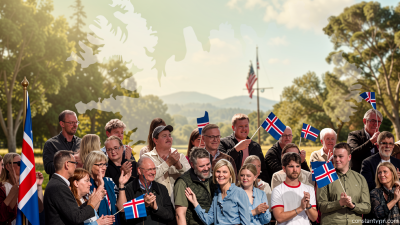
Iceland’s 400,000 Citizens Face a Binary Choice: Brussels or the Open Sea
Constantvpn.com – On Saturday, voters across Iceland’s rugged coastline and volcanic interior will cast ballots in a referendum so tightly contested that pollsters describe it as effectively unpredictable. The question before them is not whether to join the European Union outright, but whether to reopen accession negotiations that were suspended in 2013. The margin separating the two camps is so thin that a single swing district could tip the outcome.
The stakes are enormous for a nation of barely 400,000 people perched at the edge of the North Atlantic. A “Yes” vote would trigger formal talks with Brussels, though a second referendum would still be required before any final treaty could take effect, and all 27 existing EU member states would need to sign off. A “No” vote would shelve the question indefinitely, leaving Iceland to navigate an increasingly turbulent geopolitical landscape on its own.
The Currency and Cost-of-Living Argument
Proponents of closer European integration point to Iceland’s chronically volatile króna and a cost of living that ranks among the highest in the world. Finance Minister Daði Már Kristófersson, whose Liberal Reform party anchors the Yes campaign, frames membership as a stabilizing force for ordinary households and small businesses alike.
“We see the opportunity of joining the EU and adopting the euro as a very significant benefit to Icelandic companies and to the Icelandic general public.”
Kristófersson also argues that formal EU membership would insulate Iceland from pressure by far larger powers, strengthening both its trade position and its security posture. He notes that Norway, a non-EU member, nonetheless secured a successful accession framework in 1994 without completing the full process, and that Finland and Sweden obtained special agricultural terms for their northern regions. He expresses confidence that Iceland could negotiate comparable exemptions.
The Fishing Fault Line
Opponents see a different arithmetic. Fish and marine industries generate nearly 40 percent of Iceland’s total exports, and the common fisheries policy that accompanies EU membership would, in their view, dilute Reykjavik’s sovereign control over waters they consider irreplaceable. Inside a waterfront processing plant, workers in hairnets and blue overalls sort freshly landed cod and haddock into fillets destined largely for European tables. For Pétur Pálsson, boss of the Visir fishing operation, the prospect of Brussels dictating quota policy is intolerable.
“If we are in the EU, they will be the ones who make the policy.”
Guðrún Hafsteinsdóttir, opposition leader and figurehead of the No campaign, has pledged that Icelandic waters will never be shared with a supranational authority. The No campaign’s slogan — “Iceland for sale? No thanks” — captures the emotional register of the debate. Professor Eirikur Bergmann of Bifröst University, a political scientist who has tracked Icelandic politics for decades, observes that fishing is woven so deeply into national identity that no sitting politician could credibly concede it.
“They’d be expelled from the country.”
Margrét Ágústa Sigurðardóttir, head of the Icelandic Farmers’ Association, dismisses the government’s promise of a “special arrangement” protecting agriculture and fisheries. She points out that no member state has ever been granted a permanent opt-out from EU policy domains.
Geopolitics Accelerates the Clock
The referendum was originally pledged by Prime Minister Kristrún Frostadóttir’s centre-left government after its snap-election victory in 2024, with a deadline set for 2027. But a cascade of external shocks compressed the timetable. Russia’s ongoing war in Ukraine has intensified Arctic competition. US President Donald Trump’s tariff threats and repeated suggestions about Greenland’s future have added urgency. Iceland sits adjacent to the GIUK gap — the Greenland-Iceland-United Kingdom corridor through which Russian naval activity is closely monitored by Western intelligence. It is a founding NATO member yet fields no standing military of its own, a vulnerability that Kristófersson says has pushed Iceland’s strategic positioning “up the agenda.”
“Things have been moving very rapidly with respect to geopolitical challenges.”
What the Numbers Say
A poll published this week placed the Yes side at 51.3 percent against 48.7 percent for No; an earlier survey had the two camps virtually tied. Bergmann calls the outcome “impossibly [hard] to predict,” noting that both sides have deployed every rhetorical and organizational resource available to them.
Some undecided voters lean Yes precisely because this is not the final referendum. Anna Ragnarsdottir, a Reykjavik resident, explains her reasoning plainly:
“We have to know what’s in the package from the EU. If we say no, we won’t ever know.”
The Existing Framework
Even outside the EU, Iceland already participates in the European Economic Area alongside Norway and Liechtenstein, giving it access to the single market and inclusion in the Schengen border-free zone. Reykjavik first opened accession talks two years after the 2008 global financial crisis, only to abandon them in 2013 when fishing proved an insurmountable obstacle. That same obstacle remains the central dividing line today, and the outcome of Saturday’s vote will determine whether Iceland attempts to solve it a second time — or walks away from the table entirely.
Related Reading
Frequently Asked Questions
What is Iceland holds knife edge referendum on EU?
Iceland holds knife edge referendum on EU is the main topic of this guide. The article explains the context, practical details, and next steps readers should understand.
Why does Iceland holds knife edge referendum on EU matter?
Iceland holds knife edge referendum on EU matters because readers are looking for a useful answer, not just a short summary. Good content should match search intent and help them decide what to do next.