
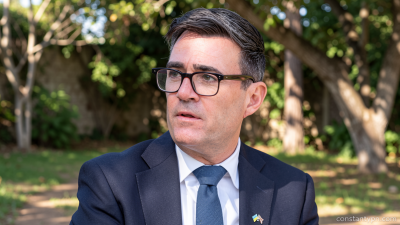
Prime Minister to Convene All-Island Economic Summit This Autumn
Constantvpn.com – Andy Burnham has announced plans to gather the heads of government from Wales, Scotland, and Northern Ireland at a single table in October, framing the gathering as a decisive step toward what he calls shared prosperity across the entire United Kingdom. The summit will take place under the banner of the National Economic Council, a body originally established by Gordon Brown’s administration in the immediate aftermath of the 2008 financial collapse and now resurrected by Burnham’s government.
The announcement landed on the eve of Burnham’s Thursday trip to south Wales — his first official visit to the country since assuming the premiership in July. He succeeded Sir Keir Starmer following his victory in the Makerfield by-election, a contest that thrust the former Greater Manchester mayor into the most powerful office in Britain.
A “Listening Tour” Framed Around Jobs and Industry
Spokespeople for Number 10 confirmed that the Welsh, Scottish, and Northern Irish first ministers — along with Northern Ireland’s deputy first minister — will sit down with the prime minister at the revived National Economic Council in October. The stated purpose is to coordinate economic strategy across all four nations and ensure that growth policy reaches every region, not just the English heartland.
Burnham’s south Wales itinerary, part of what his team describes as a “listening tour,” includes conversations with Welsh workers and apprentices centred on reindustrialisation, employment creation, and the cost-of-living squeeze. He will also sit down with Sioned Williams, the Welsh government’s deputy first minister, for bilateral talks.
“I am in south Wales today because the answers to the UK’s challenges will not come from an echo chamber. They will come from the places that know their own strengths, and from a government willing to listen and then act.”
He added that his ambition is straightforward: good jobs in every community, in every part of the UK, and that he wants every leader in the country “signed up” to that goal.
Wales’ Demands on the Table
Deputy First Minister Sioned Williams welcomed the visit as “a positive example of governments working together to improve people’s lives,” but made clear that Cardiff will use the occasion to press specific fiscal and energy demands. Among them: a fair share of the UK government’s steel fund, an energy social tariff designed to cushion households facing fuel poverty and soaring bills, and action on what she described as high standing charges levied on Welsh consumers.
“Wales is an energy-rich nation. People should see that reflected in good jobs, stronger communities and lower bills.”
The Welsh government issued a broader statement expressing its intention to discuss “shared challenges, including ensuring growth and investment in all the countries represented, and support for families facing the continuing cost-of-living crisis.” It also signalled that talks would extend to “further discussions with the UK government to progress broader priorities in Wales, including fair funding and extending devolution.”
Background: The National Economic Council Revived
The NEC was created in 2008–09 as a crisis-response mechanism, bringing together central government, local authorities, and business leaders to coordinate the economic recovery from the banking crash. It fell into dormancy for years before Burnham’s team reactivated it. A prior session under the revived structure brought together government ministers and English local authority mayors; the October sitting will mark the first time devolved first ministers are brought into the room. Number 10 said the prime minister intends to discuss “how we will drive good growth in every postcode across the UK” with his counterparts.
Political Reactions and Wider Context
The relationship between Burnham and Welsh First Minister Rhun ap Iorwerth was established informally in July, when the two met on the sidelines of the Glasgow Commonwealth Games. At the time, ap Iorwerth cautioned that it was “too early” to judge whether the new Labour prime minister would accede to Welsh demands for expanded powers and additional funding for the Senedd and the Welsh government. Downing Street responded that the prime minister sought an “open and ongoing dialogue” with his Welsh counterpart.
Plaid Cymru, the Welsh-language nationalist party, has long pressed Westminster for greater fiscal autonomy and increased funding flows to Cardiff, arguing that the current devolution settlement leaves Wales structurally disadvantaged relative to its neighbours.
Opposition voices were quick to weigh in. Welsh Liberal Democrat MP David Chadwick argued that Wales “needs action” if the prime minister is genuinely serious about easing the burden on Welsh families, implying that words alone will not suffice.
Dan Thomas, Welsh leader of Reform UK, took a sharper line ahead of the visit, suggesting that Burnham “may well be the last Labour prime minister to come to Wales.” He added: “We have no doubt that when the prime minister finally calls a general election and stops running scared, it will be the end of the line for Labour here in Wales.”
The autumn summit, if it proceeds as outlined, will represent the most significant inter-governmental economic coordination meeting since the post-2008 crisis era. Its outcome — whether it yields concrete fiscal commitments, energy policy changes, or remains largely declaratory — will be watched closely by devolved parliaments, industry bodies, and households still feeling the aftershocks of the cost-of-living crisis.
Related Reading
Frequently Asked Questions
What is Burnham calls summit of Welsh Scottish?
Burnham calls summit of Welsh Scottish is the main topic of this guide. The article explains the context, practical details, and next steps readers should understand.
Why does Burnham calls summit of Welsh Scottish matter?
Burnham calls summit of Welsh Scottish matters because readers are looking for a useful answer, not just a short summary. Good content should match search intent and help them decide what to do next.