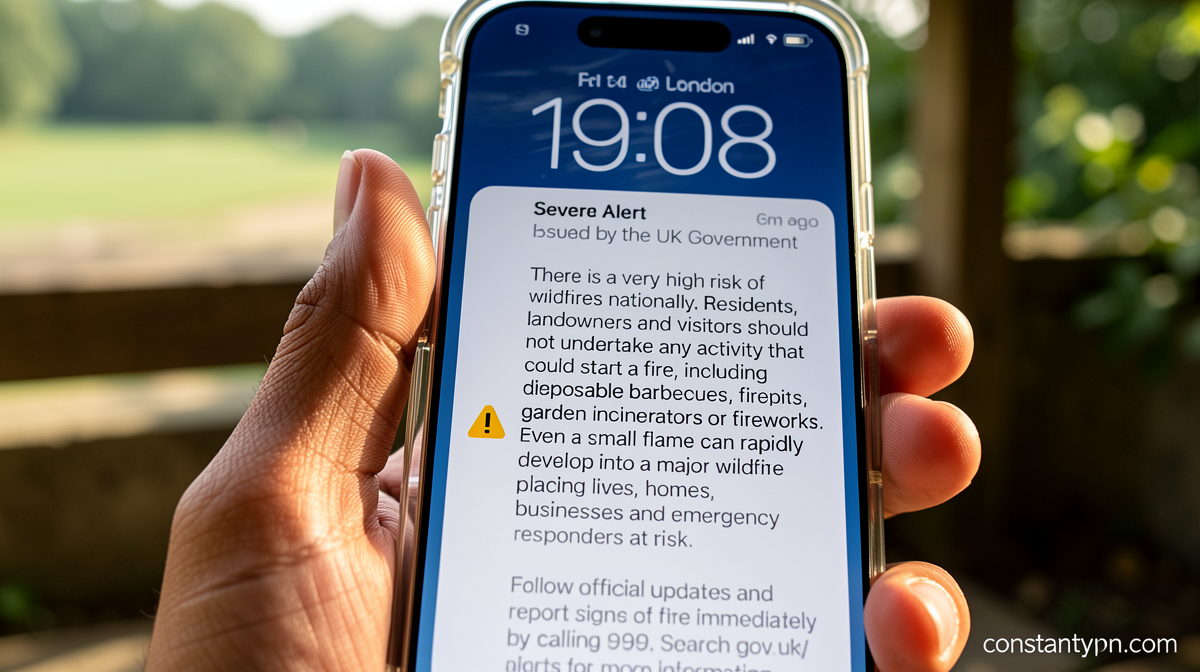
UK Government Stands by Nationwide Wildfire Phone Alert Despite Backlash
Constantvpn.com – When millions of smartphones across England and Wales chimed with a “severe alert” notification on Friday evening, most recipients assumed they were witnessing a routine public-safety message. What followed, however, was the largest single deployment of the country’s emergency broadcast system to date — and it ignited a fierce debate over transparency, domestic-abuse safety, and the sequencing of bilingual government communications.
The alert, which began reaching devices from approximately 19:00 BST on Friday, warned of a “very high risk of wildfires nationally” and urged residents to avoid disposable barbeques, naked flames, and fireworks. Prime Minister Andy Burnham publicly urged the public to treat the notification “seriously,” framing it as a necessary response to an escalating fire situation.
Government Defends the Decision
On Monday, the prime minister’s official spokesperson pushed back against criticism, declaring the alert “entirely appropriate.” According to the spokesperson, the message was dispatched “after a direct request from fire and rescue services on the front line,” and the government’s “first duty” remained to “keep people safe.”
The operational picture at the moment of broadcast was, by the spokesperson’s account, dire: 43 active fires and 11 major incidents were simultaneously consuming emergency resources, stretching them “to the very limit” and necessitating military support. In that context, the spokesperson argued, a rapid, unannounced broadcast was the correct call.
The Missing Warning
What drew sharp criticism was not the alert itself but the absence of any advance notice. A Cabinet Office press release describing the forthcoming broadcast was uploaded to the government website at roughly 18:45 on Friday — barely fifteen minutes before phones began ringing. Many journalists and media outlets missed the posting entirely, leaving the general public with virtually no preparation time.
Senior government figures had reportedly been debating whether to trigger the alert as early as Friday morning, suggesting the decision was made under considerable time pressure. A government spokesperson later confirmed that officials had been liaising closely with domestic-abuse charities during earlier system tests, though no formal pre-notification was issued before this particular broadcast.
Domestic Abuse Survivors in the Crosshairs
For survivors of domestic abuse who rely on concealed second phones to contact support services or arrange escape from abusive partners, an unannounced, loud, screen-illuminating alert can be genuinely dangerous. Women’s Aid, the national charity dedicated to ending domestic violence, has called for greater forewarning of future alerts “wherever possible.”
“Survivors of domestic abuse frequently turn to second phones to help them access lifesaving support or flee from abuse.” — Veronica Oakeshott, head of external affairs, Women’s Aid
Oakeshott stressed that keeping such devices hidden is often a matter of physical safety. She urged the government to give the public advance notice that an alert might be issued, so that survivors could temporarily silence or relocate their secret phones before a broadcast went out.
The issue is not hypothetical. The UK’s emergency alert system, introduced in 2022, can override mute settings and ring at full volume regardless of phone configuration. For someone whose partner checks devices regularly, an unexpected, loud notification can expose the very tool meant to ensure their safety.
Fire Services Report Improvement
Phil Garrigan, chair of the National Fire Chiefs Council, told BBC Radio 4’s Today programme on Monday that he was grateful for the public’s response to the alert. His organisation had observed a measurable decrease in the number of wildfires requiring emergency-service intervention over the preceding 72 hours, suggesting the broadcast had influenced household behaviour.
Nevertheless, Garrigan noted that four major incidents remained declared at the time of his interview: in Hampshire, Cambridgeshire, South Wales, and the West Midlands. The fire season, he implied, was far from over.
Welsh-First Sequencing Draws Political Fire
A secondary controversy emerged over the order in which languages were delivered. Several recipients reported that the Welsh-language version of the alert arrived on their phones before the English version. Reform UK’s Laura Anne Jones and Conservative MP Andrew RT Davies both publicly questioned why Welsh preceded English in a message intended for the entire nation.
The UK government did not issue a direct rebuttal but pointed to the Welsh Language Act, which obliges public bodies to send alerts in Welsh first and to deliver them bilingually wherever practicable. Under that legislation, the Welsh-first ordering is not a choice but a statutory requirement, and the bilingual pairing was intended to ensure comprehension across both linguistic communities.
What Comes Next
The episode has forced a reckoning over how Britain’s newest mass-communication tool balances speed against preparation. The emergency alert system was designed for moments when minutes matter — a flash flood, a chemical spill, a terror threat. Wildfire risk, while serious, typically evolves over hours rather than seconds, raising the question of whether a shorter lead time for media and at-risk groups could have been accommodated without compromising the response.
For domestic-abuse charities, the demand is narrower and more immediate: a brief public notice before any future broadcast, giving survivors a window to protect their lifeline devices. Whether the government will adopt such a protocol remains to be seen, but the pressure from Women’s Aid and allied organisations is unlikely to dissipate while the fire season continues.
Related Reading
Frequently Asked Questions
What is Wildfire phone alert was entirely appropriate?
Wildfire phone alert was entirely appropriate is the main topic of this guide. The article explains the context, practical details, and next steps readers should understand.
Why does Wildfire phone alert was entirely appropriate matter?
Wildfire phone alert was entirely appropriate matters because readers are looking for a useful answer, not just a short summary. Good content should match search intent and help them decide what to do next.
