
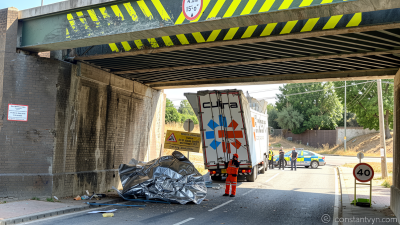
Two Lorries, Two Days: Hinckley’s Infamous Railway Bridge Strikes Again
Constantvpn.com – A stretch of the A5 Watling Street near Hinckley in Leicestershire has once again become the focal point of transport frustration after two separate lorry collisions with a railway bridge occurred within a 48-hour window. The incidents, confirmed by Leicestershire Police, forced full road closures on both Sunday morning and Monday afternoon, leaving drivers stranded and rail passengers facing delays while engineers inspected the structure.
The bridge in question already carries a grim distinction: Network Rail designated it the most frequently struck railway bridge in the entire country during its annual review. Between 1 April 2024 and 31 March 2025, the structure was hit by vehicles on 22 separate occasions — a tally that places it well ahead of any other crossing in Britain. That record, while almost certainly a statistical curiosity, translates into very real disruption for commuters, freight operators, and local residents who depend on the A5 corridor for daily travel.
The Sunday and Monday Strikes
At 05:52 BST on Sunday, a lorry collided with the underside of the bridge, prompting police to shut the carriageway immediately. Officers directed traffic onto alternative routes while the situation was assessed. Less than 36 hours later, at 13:48 on Monday, a second lorry made contact with the same structure. Leicestershire Police once again closed the road and urged motorists to seek detours.
On both occasions, engineers from Network Rail were dispatched to inspect the bridge. Following the Monday incident, the structure was examined within 30 minutes of the collision. No structural damage was identified, and train services were permitted to resume. The cumulative effect on rail operations amounted to 16 minutes of delay across the network.
A Pattern That Demands Action
The recurrence of strikes at this particular crossing is not a matter of random bad luck. Low-clearance railway bridges across the United Kingdom are struck by vehicles thousands of times each year, and the causes are well understood: drivers unfamiliar with local height restrictions, overloaded or poorly planned freight routes, and signage that is either obscured, ignored, or insufficiently prominent. The A5 Watling Street crossing sits in a corridor where heavy goods vehicles regularly transit between industrial areas, making the risk of a height-related collision a persistent operational concern.
Network Rail has long maintained that bridge strikes represent one of the single largest sources of unplanned disruption on the railway. A single impact can close a line for hours while engineers verify the integrity of girders, ballast, and track geometry. Even when no visible damage is found — as was the case on both Sunday and Monday — the mandatory inspection protocol means that trains must be held or rerouted until clearance is confirmed.
“Bridge strikes remain one of the biggest causes of disruption on the railway. We continue to urge drivers to Wise Up, Size Up by knowing the height of their vehicle, planning their route carefully and always obeying road signs and warning systems at low bridges.”
The spokesperson’s remarks underscore a point that infrastructure managers have made repeatedly: the onus falls heavily on drivers to verify vehicle dimensions before entering routes with known height restrictions. For professional hauliers, this means checking load heights against posted clearances; for private motorists towing caravans or carrying roof boxes, it means treating every low-bridge warning as a hard constraint rather than a suggestion.
The Delayed Road-Lowering Scheme
A permanent engineering solution has been identified for the Hinckley crossing. Plans exist to lower the road surface beneath the bridge, effectively increasing the vertical clearance and eliminating the height conflict that has produced so many collisions. However, the scheme was announced last month to have been delayed once again, leaving the bridge exposed to the same risk profile that produced its record-breaking strike count.
For local residents and the thousands of drivers who use the A5 corridor daily, the delay compounds an already irritating situation. Each collision triggers road closures, detours, and potential rail delays. The cumulative economic cost — lost working hours, diverted freight, increased fuel consumption on longer routes — accrues quietly but steadily, even as the headline figure of “22 strikes in a year” captures public attention.
What Drivers Should Know
Until the road-lowering works are completed, the practical advice for anyone approaching the A5 Watling Street crossing near Hinckley is straightforward. Check the posted height limit before entering the approach. If operating a vehicle whose overall height is close to or exceeds the posted figure, select an alternative route. Obey temporary signage and warning systems, particularly after recent incidents when additional monitoring may be in place. For freight operators, route-planning software should flag this crossing as a known height-restriction point, and drivers should be briefed accordingly.
The irony of a structure earning national notoriety for being hit so often is not lost on those who must navigate around it. Each strike, individually minor in terms of structural damage, collectively represents a failure of the system — of signage, of route planning, of driver vigilance, and ultimately of the infrastructure investment that would remove the hazard altogether. Until that investment materialises, the bridge will continue to sit at the centre of a pattern that Leicestershire Police, Network Rail, and local motorists would all prefer to see ended.
Related Reading
Frequently Asked Questions
What is Britain s most bashed bridge hit twice?
Britain s most bashed bridge hit twice is the main topic of this guide. The article explains the context, practical details, and next steps readers should understand.
Why does Britain s most bashed bridge hit twice matter?
Britain s most bashed bridge hit twice matters because readers are looking for a useful answer, not just a short summary. Good content should match search intent and help them decide what to do next.