Trump confirms he asked Fifa to review Balogun ban
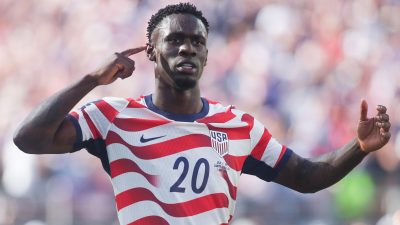
Trump Intervenes to Lift Balogun’s One-Match Suspension
Constantvpn.com – President Donald Trump has publicly stated that he requested FIFA to reconsider the one-match suspension of U.S. forward Folarin Balogun during the World Cup. The decision to revoke the ban, which would have kept Balogun out of the United States’ last-16 clash against Belgium, has sparked controversy among football authorities and fans alike. Balogun, 25, was shown a straight red card in the previous round for a foul on Bosnia-Herzegovina defender Tarik Muharemovic, leading to his automatic exclusion from the following match. However, FIFA’s surprise ruling to suspend the ban for 12 months has raised questions about the integrity of the competition and the role of political influence in disciplinary decisions.
A Controversial Call and a Political Move
The incident in question occurred during a tightly contested group-stage match between the U.S. and Bosnia-Herzegovina. Balogun, who had already scored three goals in the tournament, was sent off for a challenge that referees deemed a direct red card. Despite the official decision, Trump argued that the call was unjust and intervened to challenge it. At a press conference held at the White House, the president claimed he had only asked FIFA to review the case, emphasizing that he did not pressure officials to alter the ruling. “I don’t believe they made the decision,” Trump stated, “I think it was the commission that did, and they got it right.”
Trump’s comments were laced with criticism of referee Raphael Claus, whom he described as “a little bit suspect.” The president called the Brazilian official’s decision “horrible,” suggesting that the incident highlighted a flaw in the refereeing process. This accusation has drawn attention to the potential influence of high-profile figures on FIFA’s disciplinary actions, especially given the symbolic nature of the ban’s suspension. While Balogun’s absence would have been a minor setback for the U.S. team, the reversal has been seen by some as a political maneuver to avoid embarrassment for the American squad.
FIFA’s Ruling and the Debate Over Independence
FIFA cited Article 27 of its disciplinary code to justify the one-year suspension of Balogun’s ban. This provision allows for the temporary reduction of penalties under certain circumstances, though the exact reasoning for its application in this case remains unclear. In a statement on X, FIFA president Gianni Infantino defended the decision, noting that it was based on an ongoing legal process involving the organization’s independent judicial bodies. “The case will be decided in due course by the competent bodies,” Infantino said, adding that he had informed Trump of this during their conversation.
Infantino stressed that FIFA’s judicial committees operate autonomously, and their rulings “must always be respected.” He acknowledged that while he might be surprised by some decisions, he maintains a policy of deference to the process. “Whether we personally like a decision or not is irrelevant,” he said. “Respect for independent institutions and the rule of law is what protects the integrity of our competitions.” Despite this reassurance, critics argue that the suspension of Balogun’s ban undermines the impartiality of FIFA’s disciplinary framework, especially given the political weight of Trump’s involvement.
Reactions from Football Authorities
The Royal Belgian Football Association (RBFA) expressed astonishment at FIFA’s decision, stating that it set a dangerous precedent for fair play. “Regardless of the outcome of this match, we are deeply concerned by the events that have unfolded,” the RBFA said. They emphasized that the ruling could weaken the credibility of football’s governing body and embolden future appeals against disciplinary decisions. Similarly, the European football federation Uefa criticized the move, calling it a threat to the integrity of the World Cup. “Intervening to cancel a suspension at this stage crosses a red line,” Uefa stated, highlighting the rarity of such cases.
England head coach Thomas Tuchel, who had faced his own controversial red card decision earlier in the tournament, echoed these concerns. Tuchel had defender Jarell Quansah sent off in a dramatic 3-2 win over Mexico, a moment he later questioned. “Where to draw the line is the question I ask,” Tuchel remarked, adding that he was unsure whether the same standard would apply to other players. His comments reflect broader anxieties about the consistency of disciplinary actions and the potential for high-profile individuals to sway outcomes. “Do we appeal if a yellow card is not a yellow card?” he asked, questioning the fairness of the process.
Historical Precedent and Political Allegations
The suspension of Balogun’s ban has drawn comparisons to a historic case involving Brazil’s Garrincha in the 1962 World Cup. At that time, Garrincha was not suspended for a red card despite being sent off, an incident that led to accusations of political interference. While Garrincha’s case predated the introduction of automatic bans, the current situation raises similar concerns about the influence of external pressures on FIFA’s decisions. The RBFA pointed out that only one other red card in World Cup history has been overturned, further emphasizing the significance of this latest ruling.
FIFA’s move has left many wondering if the organization is prioritizing political considerations over sporting fairness. The decision to suspend the ban has been described as a “shock” by critics, with some arguing it weakens the authority of the disciplinary committee. However, Infantino maintained that the process was thorough, stating, “I read the decisions of the Fifa Disciplinary Committee when they are issued. Sometimes I am surprised by them. Sometimes I agree with them, and sometimes I disagree.” Yet, he admitted that the ruling was “a bit of a surprise” to him as well, underscoring the ambiguity surrounding the case.
Calling for Clarity and Consistency
While Trump claimed he had only asked for a review, some question whether his intervention was sufficient to influence the outcome. The president’s remarks, combined with his direct criticism of the referee, have added fuel to the debate over the independence of FIFA’s disciplinary bodies. Tuchel, meanwhile, has taken a more direct approach, appealing to Trump to overturn the red card given to Quansah. “I have no answer to that question,” Tuchel said, referring to the debate over where to draw the line in disciplinary rulings. “It’s my question. I don’t have an answer.”
The controversy surrounding Balogun’s suspension has also reignited discussions about the role of politics in football. Trump’s involvement highlights how high-profile figures can use their influence to impact decisions, even in matters that seem straightforward. Critics argue that this creates a perception of bias, particularly when the ruling appears to favor the U.S. team. However, supporters of the decision stress that FIFA’s judicial bodies have the authority to make such calls, and that the process is designed to ensure fairness. As the tournament progresses, the question remains: does this ruling signal a shift in how FIFA handles disciplinary matters, or is it an isolated incident?
The decision to suspend Balogun’s ban has already sparked debates about the balance between justice and politics in football. With the U.S. team set to face Belgium in Seattle, the controversy underscores the complexities of maintaining both fairness and public perception in a high-stakes international competition. As FIFA continues to defend its actions, the spotlight remains on the organization to clarify the rationale behind the reversal and ensure that such interventions are transparent and consistent with its stated principles.
The Road Ahead for FIFA and Football
In the wake of the ruling, FIFA has not yet provided a detailed explanation for its decision in the Balogun case, leaving room for speculation. The lack of clarity has prompted calls for further scrutiny, with some demanding that the organization publish its reasoning to justify the one-year suspension. For now, the focus remains on the implications of this move, as football authorities navigate the challenges of maintaining integrity in the face of political pressure. As the World Cup continues, the debate over Balogun’s suspension will likely remain a topic of discussion, both on and off the pitch.
