Osaka pays ‘love and respect to Japan’ in Wimbledon kimono
Osaka Pays ‘Love and Respect to Japan’ in Wimbledon Kimono
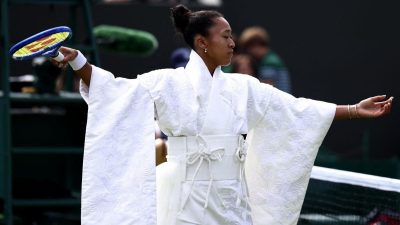
Constantvpn.com – Naomi Osaka has long been celebrated for her bold approach to tennis fashion, but her latest choice at Wimbledon took the traditional dress code to a new level. The four-time Grand Slam champion made headlines by donning a pristine white kimono for her opening match at the All England Club, blending her Japanese heritage with the tournament’s iconic all-white requirements. This marked a return to her iconic style, which has captivated audiences across major tournaments, yet required a unique interpretation to align with Wimbledon’s stringent regulations.
A Tribute to Heritage and Aesthetic
Osaka’s decision to wear the kimono was rooted in her cultural identity, reflecting a deep connection to Japan’s artistic traditions. The full-length garment, entirely white as mandated by the tournament, served as a subtle nod to the elegance of the nation’s cultural iconography. Her fashion statement came after a dazzling display at the French Open, where she had opted for a gold tennis dress that evoked the shimmer of the Eiffel Tower at night. Earlier in the year, she had stunned fans with a jellyfish-inspired outfit at the Australian Open, showcasing her ability to merge sport and artistry.
“When I think about Wimbledon, it’s obviously the all white. There’s obviously the tradition of it all,” Osaka explained following her 6-1 7-5 victory over Elsa Jacquemot. “In my head, when I think about that, I think about my cultures, my heritage, which is Japanese and Haitian. Then, if I dive deeper into Japanese culture, I think about the most iconic silhouette, which for me is a kimono. You don’t have to see the colour of a kimono to know that it is a kimono.”
A Fashion Statement with a Twist
The kimono not only honored her roots but also created a memorable moment for fans. Since her match took place on an outside court, Osaka had to be escorted through the crowd, allowing the garment to become a focal point for spectators. As she passed by, many fans paused to admire the look, sparking reactions that Osaka found both surprising and amusing.
“From my end, I thought that was really fun just because I didn’t think anyone expected that,” Osaka said. “I try to lock in a little bit and wear my headphones. I could feel when I walked by someone, they would physically turn their whole body. I thought that was really fun. It was cool because I heard some people say, ‘Wow, that’s a really beautiful kimono,’ so it was nice.”
While her outfit was a highlight of the day, Osaka also emphasized its symbolic meaning. She drew inspiration from her favorite movies, particularly the cinematic style of Lucy Liu’s character in Kill Bill. The imagery of the all-white kimono in that film resonated with her, prompting a creative evolution of the traditional design. “She has an all-white kimono, and I remember thinking that was really cool,” she recalled. “It was like my interpretation of that, while also paying a lot of respect and love to Japan.”
Pressure and Performance
Despite the fashion flair, Osaka acknowledged the added pressure her outfits could bring. The combination of her striking visuals and high expectations on the court meant she had to balance style with substance. “I wouldn’t say it eases my nerves to wear these outfits because a little part of my mind wants to do well so I can continue wearing them,” she admitted. “Obviously, like for the French Open, you don’t want to wear a ball gown and lose in the first round. That does cross my mind a little bit.”
Her return to the top 20 in the world rankings, following the birth of her daughter in 2023, has been a significant chapter in her career. While she has never advanced past the third round at Wimbledon, the 2023 US Open semi-finals marked a resurgence in her form. This year’s Wimbledon appearance, however, introduced a new dimension to her game—integrated with her signature flair for style.
“It’s something that I’m used to doing, wearing these extravagant outfits. I feel like everyone has their own way of showing that they’re into fashion. I’m always really surprised whenever I go to the locker room, I get a lot of questions about it. It seems to be fun for everyone. You just wouldn’t expect it.”
The Intersection of Sport and Style
Osaka’s ventures into fashion have sparked conversations about the growing synergy between sport and style. Her ability to transform her on-court presence into a visual spectacle has redefined the expectations of athletes in the public eye. While some may question whether the focus on attire detracts from performance, Osaka sees it as a way to connect with her audience and celebrate her cultural influences.
Her choices at Wimbledon—starting with the kimono—have set the tone for her campaign, with a mix of tradition and modernity. The 28-year-old’s ability to maintain composure under the spotlight highlights her resilience. As she prepares for upcoming matches against players like Anastasia Gasanova, the question remains: will her bold fashion choices continue to influence her performance or add to the pressure? For now, the kimono has already secured its place as a memorable moment in the tournament’s history.
Wimbledon’s opening day featured a range of standout performances, with players like British hopefuls facing early challenges. The event’s iconic atmosphere, paired with Osaka’s striking entrance, created a unique blend of tradition and innovation. As the tournament progresses, her cultural statements may become a recurring theme, further cementing her identity as both a tennis champion and a style icon.
From her early days as a rising star to her current status as a global ambassador for the sport, Osaka’s journey reflects the evolving role of athletes in the spotlight. Her ability to balance performance with personal expression underscores a new era where fashion and sport are increasingly intertwined. Whether through the elegance of a kimono or the boldness of a glittering gold dress, she continues to redefine what it means to be a tennis player in the modern age.
