
The Quiet Revolution in Autonomous Fixed-Wing Aviation
Constantvpn.com – While electric vertical take-off and landing (eVTOL) air taxis dominate headlines about the future of flight, a far less glamorous but equally consequential race is unfolding beneath the radar of public attention. A handful of companies are pushing self-flying fixed-wing aircraft toward commercial deployment — starting not with passengers, but with the unglamorous work of spraying crops and hauling cargo. Among the most advanced players in this space is Pyka, a San Francisco Bay–area start-up that designs and builds pilotless aircraft with no cockpit at all.
The company operates out of a converted Second World War-era hangar overlooking the bay, and its machines are already working fields in two continents. Roughly a dozen Pyka aircraft are active in Brazil, where they treat cotton and soybean crops — tasks once performed exclusively by human pilots. In the United States, the company’s largest autonomous fixed-wing platform received commercial civilian authorization last year, making it the biggest pilotless fixed-wing aircraft cleared for civilian operations in the country. That approval, however, is tightly scoped: flights are confined to defined agricultural zones and require both a ground operator and a visual observer on the scene.
Low-Altitude Precision Over California’s Central Valley
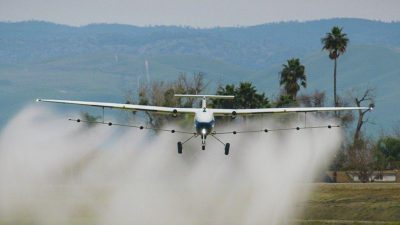
On a recent test day at a site roughly 80 kilometres (50 miles) east of the factory — accessible only via a rough dirt track — flight test engineer Russ Marotzke and a colleague were evaluating a software update on a demonstration airframe. The aircraft, a fully electric machine with its battery housed in the nose, skimmed dangerously close to the ground over an alfalfa field in California’s San Joaquin Valley. No humans were aboard.
“We can actually go lower than a human pilot can,” Marotzke noted as the plane grazed the crop canopy. Flying at reduced altitude cuts spray drift dramatically, meaning less chemical is wasted and less product is needed compared with conventional manned dusting.
Inside a shipping container parked beside the field, engineers marked the target spray zone on a computer screen. The onboard software then computed a flight path, factoring in mapped obstacles such as nearby power lines. Take-off from a short runway adjacent to the field was seamless. Approximately fifteen minutes later, after sensing its spray load — water, for that particular demonstration — was running low, the aircraft executed an autonomous landing. Crew members performed a manual refill and a battery swap, after which the plane relaunched and resumed spraying precisely where it had paused.
Each airframe carries up to 300 litres of liquid in a central tank and sustains roughly 35 minutes of flight per battery cycle. Despite sometimes being labelled “large drones,” the machines boast 11.5-metre wingspans — a scale that makes the drone moniker feel like an understatement.
Autonomy Versus Autopilot: A Critical Distinction
The distinction between what Pyka builds and what most commercial aircraft already offer is not trivial. Autopilot systems — analogous to cruise control and lane-keeping in automobiles — assist a human pilot who retains ultimate authority. True autonomous flight, by contrast, is designed to manage the entire mission envelope, from take-off through landing, with little or no human intervention, relying on algorithms that ingest sensor data and command the airframe in real time.
That distinction matters because it explains why self-flying planes have lagged behind self-driving cars despite operating in what many engineers consider a more structured, predictable environment. Mykel Kochenderfer, a specialist in safe aviation autonomy at Stanford University, points to two converging factors. First, major technology firms poured enormous capital into autonomous vehicles, effectively “doubling down” on the car problem. Second, aviation regulators impose far stricter safety thresholds than road-vehicle authorities.
“The consequences for air accidents can just be so severe,” Kochenderfer observes, underscoring why the bar for deployment is considerably higher in the sky than on the street.
Military Momentum and Regulatory Pathways
Defence procurement has been a quiet accelerant. Several companies in the autonomous fixed-wing space hold government contracts to demonstrate and trial their systems, often navigating fewer regulatory hurdles than their civilian counterparts. Some are already delivering hardware to military customers, generating operational data that feeds back into civilian product development.
Brazil’s aviation regulator granted Pyka a comparable approval earlier than the United States did, reflecting a more permissive regulatory posture toward autonomous agricultural aviation. That early foothold allowed the company to accumulate real-world flight hours on Brazilian cotton and soybean operations while its American programme worked through the longer federal approval pipeline.
Scaling Ambitions and the Passenger Horizon
Pyka currently produces around two dozen aircraft per year and targets a production rate of 1,000 units annually by 2030. Each machine is priced at $550,000, with customers receiving training to operate the fleet. The near-term commercial model centres on crop spraying and cargo delivery — tasks where labour costs, chemical-precision requirements, and repetitive route geometry make automation economically compelling.
Yet the company’s longer-term vision reaches well beyond agriculture. Co-founder and chief executive Michael Norcia envisions a large fleet of minibus-capacity Pyka aircraft shuttling passengers along the United States east and west coasts.
“A fully scaled, ubiquitous passenger operation is the holy grail,” Norcia says. “There’s a decent chance we’ll get to that point before the eVTOL industry.”
Whether that timeline holds will depend on regulatory maturation, public acceptance, and the ability to demonstrate sustained safety across thousands of autonomous flight hours. What is already clear, however, is that the skies above American and Brazilian farmland are being quietly rewritten — one pilotless pass at a time — by machines that never needed a seat, a control stick, or a human heartbeat to keep them aloft.
Related Reading
Frequently Asked Questions
What is Will self flying planes transform the skies?
Will self flying planes transform the skies is the main topic of this guide. The article explains the context, practical details, and next steps readers should understand.
Why does Will self flying planes transform the skies matter?
Will self flying planes transform the skies matters because readers are looking for a useful answer, not just a short summary. Good content should match search intent and help them decide what to do next.