
UK Press Roundup: Drought Pricing, Olympic Gold, and a Nation Under Pressure
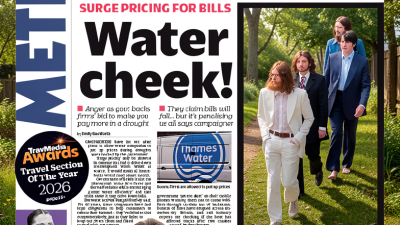
Constantvpn.com – Monday’s British broadsheets and tabloids converged on a single, urgent theme: the country’s water supply is running dangerously thin, and the government is preparing to let utilities charge more when rainfall fails. The Metro opened with the blunt accusation “Water cheek!” above a report that campaigners have launched a fresh campaign against the move, arguing that drought conditions should not become a licence for price hikes. The Daily Star mirrored the headline almost word-for-word, pairing it with a photograph of the cracked, sun-scorched turf at Ascot racecourse — a visual shorthand for how severe the dry spell has become across southern England.
Government officials defended the proposal, insisting the mechanism would
“make bills fairer and more affordable while encouraging greater water efficiency.”
The logic, as presented in Whitehall, is that variable pricing during scarcity periods gives consumers a direct financial incentive to cut consumption, while protecting the revenue base of water companies that must maintain ageing infrastructure through dry spells. Critics, however, see a scheme that punishes households precisely when they are most vulnerable — when taps run low and garden hoses are already banned.
Worst-Case Bans on the Horizon
The Times went further, reporting that officials have drafted what it described as a “reasonable worst-case scenario” under which widespread restrictions would fall on commercial car washes, private swimming pools, and other non-essential water users. The scenario, the paper noted, would also impose limits on businesses if low rainfall persists beyond the current season. For readers in the South East, where hosepipe bans have already been in force for weeks, the prospect of a formalised, multi-week ban regime carries real practical weight: landscaping firms, agricultural contractors, and hospitality operators would all face compliance deadlines.
Amy Hunt’s Unprecedented Fourth Gold
On the sports pages, Team GB’s Amy Hunt dominated the top picture slots across multiple titles after claiming a fourth gold medal at the European Championships — a tally described as unprecedented for a British athlete at that level of competition. The Daily Mail devoted its lead image to what it called “golden girl” Amy Hunt’s record-breaking win, while the broader narrative across the papers framed the achievement as a culmination of a medal run that has made her one of the most decorated British competitors of the current Olympic cycle. Hunt’s consistency across events has drawn comparisons to earlier multi-medal British champions, though the sheer volume of golds in a single European Championships programme marks a statistical first.
Secret Drone Bases and the NATO Question
The Daily Telegraph carried a defence report alleging that Russia has installed covert bases capable of launching high-powered drones deep into NATO territory. According to the paper, several Kremlin-controlled sites now feature newly constructed launch pads designed for advanced long-range drone systems. The report was careful to note, however, that no intelligence indicated Russia was planning an outright attack on the alliance — the concern, as framed, was one of capability and deterrence rather than imminent aggression. The story lands amid an already tense period of NATO enlargement and Eastern European force-posturing, giving readers a concrete illustration of how drone warfare is reshaping the calculus of territorial defence.
Housing Fast-Track and the Commuter Belt
The i Paper reported that new residential developments sited near railway stations are set to receive accelerated planning approval, a move the government frames as a major expansion of commuter towns and villages. Housing Secretary Angela Rayner defended the policy, stating it would
“tackle the housing crisis and raise living standards in every corner of the country.”
The fast-tracking mechanism shortens the time between planning application and construction commencement, aiming to put thousands of units into the pipeline within two years. For buyers priced out of London and the South East, the promise is additional supply within commuting distance; for local councils, the concern is infrastructure strain on roads, schools, and GP surgeries that were never sized for the projected population uplift.
Alzheimer’s Research Enters a “Golden Era”
The Daily Express carried a feature from the Alzheimer’s Society arguing that research into the disease is entering what the charity called “a golden era.” The group pointed to pioneering treatments and diagnostic tests it described as
“unimaginable just a decade ago”
now being brought within clinical reach. The Society urged that people living with dementia be actively supported to participate in ongoing trials, arguing that inclusion of affected patients in research design would accelerate both therapeutic and diagnostic breakthroughs. The message is aimed at families and carers who may assume that meaningful intervention is still decades away.
Youth Employment and the “Turbocharge” Call
The Guardian reported that Alan Milburn — former health secretary and now a senior adviser leading a government review of young people and work — has called for internships designed to place young people with special needs into employment to be put on “turbocharge.” Milburn argued that existing support structures are insufficient to combat joblessness among young people with learning disabilities, autism, or mental illness, and that the scale of the problem demands a step-change in funding and employer engagement rather than incremental reform.
Sex Offender Identity Loophole Under Scrutiny
The Daily Mail reported that ministers face mounting pressure to close a legal gap that permits paedophiles and other registered sex offenders to change their legal identity, effectively resetting the public record. Campaigners argue the loophole undermines the transparency that the sex-offender register was designed to provide, and that victims’ families deserve assurance that a name change cannot erase a conviction history.
Bank Tax Warning Ahead of Budget
The Financial Times reported that the chief executive of JP Morgan Chase has warned Chancellor John Healey against raising taxes on banks, arguing the measure would risk relocating jobs to lower-tax jurisdictions. The intervention comes as the financial services sector gears up for a pre-Budget lobbying campaign, with industry bodies preparing detailed costings to present to Treasury officials in the weeks before the autumn statement.
Justice Questioned: Henry Nowak Case
The Sun opened with the question “Call this justice?” above a report that the convicted killer of Henry Nowak will be permitted prison-to-prison video calls with his mother. The story reignited public debate over the conditions of long sentences and the optics of family contact for those serving life terms for murder.
Dog Attack Death Near Wakefield
The Daily Mirror reported that a man has been arrested on suspicion of murder after another man died following a dog attack on an isolated footpath near Wakefield, West Yorkshire. Police confirmed the arrest was made under suspicion of murder rather than manslaughter, signalling that investigators believe the circumstances of the incident go beyond an uncontrolled animal.
Related Reading
Frequently Asked Questions
What is Water cheek and Queen Amy s gold?
Water cheek and Queen Amy s gold is the main topic of this guide. The article explains the context, practical details, and next steps readers should understand.
Why does Water cheek and Queen Amy s gold matter?
Water cheek and Queen Amy s gold matters because readers are looking for a useful answer, not just a short summary. Good content should match search intent and help them decide what to do next.