
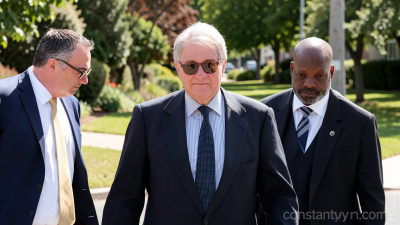
Leon Black Takes Legal Stand Against Congressional Subpoena in Epstein Probe
Constantvpn.com – One of America’s wealthiest investors has chosen the courtroom over the witness stand, filing a federal lawsuit to block a congressional committee’s attempt to compel his testimony in the ongoing investigation into Jeffrey Epstein’s financial empire and personal conduct. The move places Black squarely in opposition to the House Oversight Committee, which had issued subpoenas demanding both documentary production and an on-camera deposition under oath.
The suit, lodged in federal court in Washington on Thursday, contends that the subpoenas are legally “invalid” and bear “no legitimate connection” to the committee’s stated legislative purpose. Black’s legal team frames the action as a necessary defense against what they characterize as an overreach of congressional authority.
The June Walkout That Triggered the Confrontation
The dispute traces back to a June hearing in which Black voluntarily appeared before the committee. According to lawmakers present, he departed the room mid-testimony after questions turned to nondisclosure agreements he may have signed in connection with Epstein-related matters. That departure prompted the committee to issue the subpoenas now at the center of the litigation, ordering Black to produce the NDAs and submit to a sworn, recorded deposition.
Black has consistently maintained that he committed no wrongdoing in his years-long association with Epstein. He told the committee in June that he retained Epstein as a wealth management adviser and paid him approximately $158 million (£120 million) over that period for what he described as legitimate purposes. He further stated that he remained unaware of Epstein’s “nefarious activity until Epstein was charged with trafficking in July 2019.”
What Are NDAs and Why Do They Matter Here?
Nondisclosure agreements are contractual instruments in which two or more parties agree to keep specified information confidential. They commonly appear in employment contracts, business settlements, and private dispute resolutions. In the Epstein investigation, NDAs have become a focal point because they may conceal details about who was involved in Epstein’s network, what arrangements were made, and whether victims or associates were compensated in exchange for silence.
Black’s attorneys argue that compelling disclosure of these agreements would force the revelation of identities of women who “value their privacy, who have no known or public connection to Epstein, who bargained for confidentiality and have refused to release it.” The argument positions the lawsuit as a privacy protection rather than an evasion of accountability.
“This is no longer about finding the truth about Epstein. It is about trying to destroy Mr Black,” Susan Estrich, an attorney for Black, said in a press release on Thursday. “We were left with no choice but to file this lawsuit in response to an abuse of Congressional power.”
Congressional Reaction: Calls for Contempt
Committee members reacted swiftly and sharply to Black’s failure to appear. Robert Garcia, a member of the House Oversight Committee, issued a statement following the missed deposition date.
“By refusing to testify today, Leon Black is now defying two Congressional subpoenas,” Garcia said. “His connections to Epstein and his unwillingness to cooperate are unacceptable. We must hold him in contempt immediately.”
Chairman James Comer echoed the frustration, framing the absence as a failure to answer to the public.
“It’s a shame Leon Black is hiding behind litigation rather than provide answers to the American people,” Comer said. “Mr Black’s testimony is crucial to our investigation.”
A contempt-of-Congress finding carries serious consequences. It would allow the committee to refer Black to the Department of Justice for potential criminal prosecution, a step that has been used sparingly in modern history but carries the weight of the full authority of the federal government behind it. The threat of such a referral is generally understood to be one of the most potent levers Congress possesses to compel compliance from recalcitrant witnesses.
The Ganieva Affair and the Question of Extortion
Black’s personal history with Epstein extends beyond financial management. Court records reveal a six-year relationship with Guzel Ganieva, a former Russian model, which concluded amid allegations of abuse. In a lawsuit she later filed against Black — ultimately dismissed by a judge — Ganieva alleged that Black prepared a nondisclosure agreement in 2015 to secure her silence following the breakup.
Documents released by the US Department of Justice show that Epstein, acting in an advisory capacity, suggested in an email to his assistant that Black hire former law enforcement officers to approach Ganieva. Estrich has characterized Ganieva’s accusations as “demonstrably false,” while Black himself has previously described himself as the victim of extortion in the matter.
The judge who dismissed Ganieva’s suit cited both the NDA she had signed and approximately $9 million (£6.6 million) she received in the years following the agreement’s execution. The existence of such a payment, combined with the NDA’s terms, has made the arrangement a recurring point of inquiry in the broader Epstein investigation.
Black’s Departure from Apollo and the Epstein Files
Black stepped away from Apollo Global Management, the alternative-asset firm he co-founded, in 2021. At the time of his departure, he attributed the decision in part to the sustained public and media scrutiny surrounding his ties to Epstein, saying the attention had taken “a toll” on his health.
His name and image appear among the Epstein files released by the Department of Justice, a vast collection of photographs, videos, and investigative documents pertaining to the late financier. Officials have noted that inclusion in those files does not, by itself, suggest wrongdoing. Nevertheless, the files have become a central evidentiary resource for the congressional investigation, and Black’s presence within them has kept him in the committee’s crosshairs.
Broader Implications
The Black litigation tests the outer boundaries of congressional investigative power. If the court sustains the committee’s subpoenas, it will reinforce the view that Congress may compel testimony and document production from private individuals when pursuing a legitimate legislative inquiry — even when the subject objects on privacy or relevance grounds. If the court sides with Black, it could narrow the circumstances under which oversight committees may issue compulsory process, a development that would affect future investigations into corporate and financial matters.
For Epstein’s victims and advocates, the stakes are personal: NDAs signed under the shadow of Epstein’s network have long been suspected of silencing witnesses and complicating accountability. Whether Black’s agreements will ultimately be produced in court or remain sealed will shape how thoroughly the committee can map the full scope of Epstein’s relationships and the mechanisms used to manage them.
Related Reading
Frequently Asked Questions
What is US billionaire Leon Black defies summons?
US billionaire Leon Black defies summons is the main topic of this guide. The article explains the context, practical details, and next steps readers should understand.
Why does US billionaire Leon Black defies summons matter?
US billionaire Leon Black defies summons matters because readers are looking for a useful answer, not just a short summary. Good content should match search intent and help them decide what to do next.