
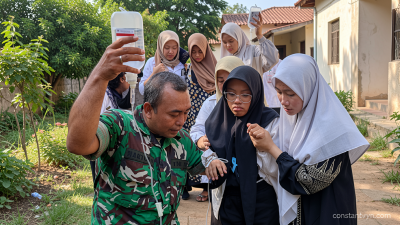
Indonesia’s Free School Meals Programme Faces Back-to-Back Poisoning Crises
Constantvpn.com – Roughly 2,000 students and teachers across the Indonesian archipelago have been struck by foodborne illness within a single three-day window, all traced to meals distributed under the government’s Makan Bergizi Gratis (MBG) initiative. The rapid succession of outbreaks has turned what was meant to be a flagship nutrition policy into a national public-health emergency and a political flashpoint for President Prabowo Subianto, whose administration has staked considerable prestige on the multibillion-dollar scheme.
The Rembang Outbreak: 777 Affected in One School
The most recent and largest single-site incident unfolded at a senior secondary school in Lasem, Rembang regency, Central Java, on Wednesday at lunchtime. A total of 752 pupils and 25 teaching staff developed symptoms consistent with acute food poisoning after consuming MBG-provided meals. Headteacher Juhartutik described the chaos that followed:
“They had diarrhoea and took turns using the toilet. There are 40 toilets in total, so they can’t accommodate everyone.”
In the aftermath, the school sent home nearly 1,200 additional pupils and 95 members of staff as a precaution, while several of the worst-affected individuals were transported to hospital. Juhartutik confirmed that the government would shoulder all associated medical expenses and that the local food distributor had arrived on campus to assume accountability for the incident.
A Pattern Across the Archipelago
The Rembang episode did not occur in isolation. Just one day earlier, on Tuesday, 730 people fell ill after eating MBG meals at an Islamic boarding school in Sidoarjo, East Java, according to a local health official. Among those affected was a parent identified as Reni, whose child experienced dizziness and nausea before progressing to more severe gastrointestinal distress. Several students at that school were so debilitated they required wheelchair transport to receive hospital care.
Further down the island chain, hundreds of additional cases have been logged across multiple schools in Tana Toraja, South Sulawesi, within the same week. Taken together, the cumulative toll exceeds 2,000 individuals, making this the most concentrated wave of school-linked food poisoning recorded in recent Indonesian history.
What Went Wrong: Storage, Preparation, and Distribution
Parents and teachers who inspected the meals described chicken that had turned slimy, dishes that appeared undercooked, and food emitting a distinctly fishy odour. In most food-poisoning events of this kind, the underlying cause traces back to improper cold-chain storage, inadequate cooking temperatures, or cross-contamination during preparation and transport. Local authorities have launched investigations into each suspected outbreak, and food samples are currently undergoing laboratory testing to identify the specific contaminant or pathogen responsible.
Accountability and Institutional Response
Achmad Sholeh Syarifudin, who heads the food distribution unit operating in Lasem, issued a public apology and accepted what he called “full responsibility for the recovery of students and teachers.” He announced that his unit would undertake a comprehensive operational review in the wake of the incident.
At the national level, the head of Indonesia’s National Nutrition Agency addressed the possibility of systemic failure:
“If it is identified that there was negligence and there are criminal elements, I apologise, we cannot help.”
The remark pointedly left open the question of whether individual contractors or officials will face formal sanctions, a matter that has drawn sharp scrutiny from opposition lawmakers and civil-society watchdogs.
Political Stakes of the MBG Programme
The Makan Bergizi Gratis scheme was unveiled as one of Prabowo Subianto’s signature domestic policies, designed to improve caloric and micronutrient intake among Indonesia’s roughly 50 million schoolchildren. Its budget runs into the multibillion-dollar range, making it one of the largest food-distribution operations ever attempted in Southeast Asia. The programme’s rapid rollout—covering tens of thousands of schools across 38 provinces—has stretched logistics, quality-control, and oversight capacity well beyond what existing infrastructure could comfortably absorb.
Even before this week’s poisoning wave, the scheme had attracted allegations of procurement corruption and sustained criticism over its per-meal cost. The latest incidents have compounded those concerns, raising the question of whether the distribution model—relying on local contractors to prepare, transport, and serve meals—can be made safe at the scale the government demands. Prabowo’s administration has already dismissed the head of the free-meals scheme in the aftermath of earlier poisoning episodes, signalling that political pressure is mounting on officials tasked with keeping the programme running.
For the families of affected children, the immediate concern is medical recovery and assurance that no further contaminated meals will reach school canteens. For policymakers, the challenge is broader: how to deliver a nationwide nutrition guarantee without sacrificing the basic food-safety safeguards that make such a programme viable in the first place.
Related Reading
Frequently Asked Questions
What is Around 2 000 fall ill in Indonesia?
Around 2 000 fall ill in Indonesia is the main topic of this guide. The article explains the context, practical details, and next steps readers should understand.
Why does Around 2 000 fall ill in Indonesia matter?
Around 2 000 fall ill in Indonesia matters because readers are looking for a useful answer, not just a short summary. Good content should match search intent and help them decide what to do next.