Simpler, older version of Stonehenge found three miles from famous site
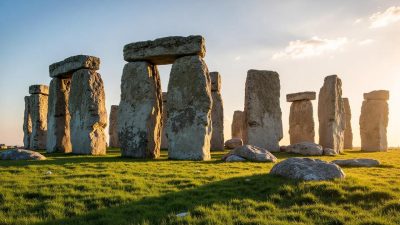
Ancient Stonehenge Replica Unearthed Three Miles from Iconic Monument
Constantvpn.com – During a recent excavation, archaeologists have uncovered what they believe to be an earlier, more basic iteration of the famed Stonehenge monument, located approximately 3 miles (5 kilometers) away from the well-known site. Though only two depressions in the earth remain, the team suggests these were once the bases for wooden posts that mirrored the alignment of the Sun during the summer and winter solstices—marking the longest and shortest days of the year—just as the current Stonehenge does. This discovery has provided new insights into the prehistoric practices of ancient communities.
Aligning with the Heavens
The structure, dated to around 5,000 years ago, predates Stonehenge by approximately 500 years. Researchers believe the wooden posts, now absent, were strategically placed to capture the Sun’s position during solstices. By connecting the two pits with a straight line, Phil Harding of Wessex Archaeology noted a precise directional correlation with the Sun’s rise and set on specific days. This alignment indicates a sophisticated understanding of celestial movements, even in the absence of the iconic stones.
“Two post pits tell me [much] about the people 5,000 years ago,” said Harding. “This tells me about the whole community, this tells me about how they were thinking, how they were behaving, how they were revering the heavens.”
The alignment’s accuracy was confirmed through advanced celestial calculations, a process described by Dr. Fabio Silva of Bournemouth University and the Skyscape Academy. He explained that the sky’s positions shift gradually over centuries, requiring reconstruction of its state 5,000 years ago. “We don’t really notice it during our lifetimes,” Silva noted. “So we basically need to rebuild the sky, knowing exactly where the Sun rose and the time of day it did so.”
Artifacts and Community Life
Alongside the post holes, the excavation revealed a wealth of artifacts, including pottery, flint tools, and animal remains, hinting at gatherings and activities centered around the site. These findings suggest that the area was not just a ceremonial location but also a hub of social interaction. The presence of a flint-made knife shaped like a disc, alongside an antler believed to have been used for digging, highlights the craftsmanship and utility of the tools.
Harding emphasized the significance of the discoidal knife, which was found in an upright position, indicating deliberate placement. “What is so special about it is the workmanship that’s gone into it,” he remarked. “That is the work of real craftsmanship.” He speculated that the knife’s design might symbolize a connection to the Sun, though its exact purpose remains a mystery.
Historical Context and Broader Implications
The Bulford site predates the earliest phase of Stonehenge’s construction, which began roughly half a millennium before the stones were erected. This timeline raises intriguing questions about the origins of the monument. Dr. Jennifer Wexler, curator of history at English Heritage, proposed that the builders of Stonehenge may have originated from or frequently visited Bulford. “The discovery of Bulford actually suggests that maybe the people who built the first stages of Stonehenge were based or living there, or at least gathering seasonally to do the construction work,” she explained.
The wooden posts at Bulford, though simpler than Stonehenge, serve as a precursor to the monumental structures that followed. Their placement suggests that early builders were experimenting with astronomical alignment long before the more elaborate Stonehenge was constructed. This finding challenges the notion that such precision was unique to the later monument, instead pointing to a broader cultural practice.
Revealing the Past Through Science
Radiocarbon dating of the artifacts has established the site’s age at 5,000 years, with the alignment of the posts verified through meticulous analysis. The process involved reconstructing the sky’s configuration from that era, accounting for the slow drift of celestial bodies over millennia. Dr. Silva’s team used this method to confirm that the two post holes were perfectly aligned with the Sun’s path on solstices, despite the posts themselves having rotted away.
Additional findings from the surrounding area included dozens of other pits containing fragments of pottery and carved animal bones. These items provide a glimpse into the daily lives of the prehistoric inhabitants. The pottery, in particular, displayed intricate decorations, reflecting both artistic expression and practical use. Flint tools, some of which were rare, further indicate the technological capabilities of the community.
Celestial Fascination and Survival
Why did these ancient people fixate on the Sun’s movements? The alignment of the Bulford site and Stonehenge suggests a deep connection between the two locations. Dr. Wexler pointed out that both were constructed during the same period, a time when early farmers were developing agricultural practices that relied heavily on seasonal cycles. “The people who built Stonehenge and the people who were at Bulford were early farmers, and their livelihoods really were connected to the Sun,” she said.
The discovery underscores the role of celestial events in prehistoric societies. By aligning their structures with solstices, these communities may have used the Sun as a natural calendar to guide farming, religious rituals, or communal events. The simplicity of the Bulford monument, compared to Stonehenge’s grandeur, offers a different perspective on how early societies approached astronomical phenomena. It shows that even basic structures could hold profound meaning.
Conclusion: A New Chapter in Prehistoric Understanding
While Stonehenge remains the most iconic prehistoric monument, the findings at Bulford reveal a parallel history. The earlier structure, with its two wooden posts and surrounding artifacts, paints a picture of a community deeply attuned to the rhythms of the natural world. Harding’s team has described this as one of the most significant discoveries of their careers, offering a tangible link to the beliefs and practices of a bygone era.
As further analysis of the site continues, the Bulford discovery may reshape our understanding of how ancient cultures interacted with the cosmos. Whether these posts were used for ritual, observation, or both, their alignment with the Sun speaks to a shared fascination with celestial patterns. This insight adds depth to the story of Stonehenge, suggesting that its builders were part of a larger network of people who sought to harmonize their lives with the heavens.
