
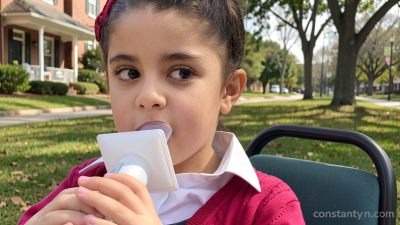
London Children’s Lungs Surged Backward After City Cut Pollution
Constantvpn.com – A five-year tracking study of more than 3,400 primary school pupils has revealed something researchers describe as genuinely startling: once air-quality rules tightened in their neighbourhoods, young children’s lungs accelerated growth at a pace that closed a measurable deficit within four years. The findings, drawn from children in London and Luton, represent what the scientists behind the work consider the most compelling evidence to date that localised clean-air interventions can reverse early childhood damage from vehicle exhaust.
Why Young Lungs Are Especially at Risk
Children breathe more air per kilogram of body weight than adults, and their respiratory and immune systems are still maturing. They also spend time closer to ground level, where exhaust fumes from traffic concentrate. The combination makes them disproportionately exposed to pollutants such as nitrogen dioxide, a gas emitted primarily by diesel and petrol engines. Chronic exposure during formative years can stunt lung development, raising the lifetime probability of asthma, cardiovascular disease, type-2 diabetes, and early mortality.
The human cost of that vulnerability was made painfully visible in 2020, when Ella Adoo-Kissi-Debrah became the first person in Britain to have air pollution formally recorded as a cause of death. She had been nine years old when she died of an asthma attack in 2013, and her case helped galvanise public and political attention to urban air quality.
Design of the Study
Researchers recruited six- to nine-year-olds attending primary schools inside London’s Ultra Low Emission Zone (Ulez) and matched them against comparable children in Luton, a town with a similar pollutant mix but lower overall concentrations. Matching criteria included socio-economic background, ethnicity, and physical-activity levels. Each child underwent annual spirometry — a standardised measurement of how much air can be forcibly exhaled in one second after a maximal inhalation — during the year preceding Ulez’s launch and across the four years that followed.
Before the policy took effect, London children’s lung capacity measured significantly below that of their Luton counterparts. By the study’s final assessment, however, the two groups had converged to near-identical levels.
“While we would expect children’s lungs to grow year on year, our results indicate that the London children’s lung growth had accelerated during the four years to ‘catch up’ with the control group in Luton to reach similar levels of lung capacity.”
Prof Chris Griffiths, a senior author affiliated with Queen Mary University of London, described his initial reaction to the data:
“I was absolutely stunned when I first saw the results. The speed of catch up in lung capacity in the London group was surprising and impressive. This shows an ambitious clean air zone can drive pollution levels down, rapidly restoring children’s stunted lung growth.”
What the Numbers Show
The proportion of London children classified as having “clinically impaired” lung capacity — a designation implying measurable damage that can manifest as persistent cough or breathlessness — dropped from 14 per cent to nine per cent over the observation window. In Luton, where smaller-scale local measures were in place, the corresponding figures moved from nine per cent to seven per cent. A secondary lung-capacity metric also improved significantly in the London cohort, though the magnitude of change was smaller, suggesting further gains remain possible.
Parallel measurements of nitrogen dioxide exposure confirmed that children in London experienced a steeper decline in pollutant levels than those in Luton during the same period. The researchers argue this temporal correlation is critical: it links the observed lung-growth acceleration directly to the air-quality improvement rather than to some unmeasured confounder.
The Policy Behind the Data
London’s Ulez was introduced in 2019 under Mayor Sadiq Khan as part of a broader programme to reduce nitrogen dioxide concentrations, which had been running well above World Health Organization guidelines in central districts. Under the scheme, older, higher-emitting vehicles face a daily charge to enter the zone. The geographic footprint has since been expanded to encompass the entire capital. The policy drew both strong public support and organised political opposition, including protests from drivers and small-business operators.
In practical terms, the lung-function gains translate into everyday capability: a child whose capacity had been suppressed can now sustain a sprint or blow out a row of candles without the breathlessness that previously limited them, Griffiths noted.
Independent Caution and Broader Implications
Prof Anna Hansell of the University of Leicester, who was not part of the research team, called the improved lung function “likely to have lifelong benefits for their health” and praised the study as “carefully conducted by well-respected researchers.” She emphasised that the geographic comparison between London and Luton was essential to isolating the policy effect from other variables.
Nonetheless, independent commentators stress that air quality is only one axis of childhood health. Nutrition, indoor environment, physical-activity patterns, and genetic susceptibility all interact with pollutant exposure. The study’s design controls for several of these factors through matching, but residual confounding cannot be eliminated entirely in an observational framework.
Even so, the scale and duration of the data set — over 3,400 children followed across five annual assessments — give the findings a weight that smaller, shorter studies have lacked. For policymakers weighing whether to replicate Ulez-style charges in other cities, the London-Luton comparison offers a rare natural experiment: a before-and-after signal embedded within a contemporaneous control, measured at the organ level rather than inferred from hospital admissions alone. The message it carries is unambiguous. When the air gets cleaner, children’s lungs respond — quickly, measurably, and in ways that may protect them for decades to come.
Related Reading
Frequently Asked Questions
What is Scientists stunned by children s lung?
Scientists stunned by children s lung is the main topic of this guide. The article explains the context, practical details, and next steps readers should understand.
Why does Scientists stunned by children s lung matter?
Scientists stunned by children s lung matters because readers are looking for a useful answer, not just a short summary. Good content should match search intent and help them decide what to do next.