
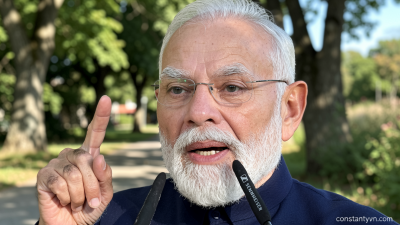
From Scripted Authority to Selfie Reels: How India’s Prime Minister Is Rebuilding His Digital Persona for a Generation That Never Met Him
Constantvpn.com – For over two decades, Narendra Modi’s public image was constructed with the precision of a state-level production: rehearsed speeches delivered from podiums, formal television addresses, and appearances staged to project unshakeable authority. Now, at 75, the Indian prime minister is posting “get-ready-with-me” reels and selfie-style video clips on Instagram, addressing young viewers as “friends” and attempting to sound like one of them. The pivot marks a striking departure from a political brand that spent years cementing a strongman identity through carefully choreographed media moments.
Modi’s Instagram timeline, which until roughly a month ago carried only polished, curated posts, now features what his team frames as more “candid” material. Among the additions: a casual behind-the-scenes style video and several direct-to-camera addresses aimed squarely at younger Indians. In one clip recorded at a graduation ceremony in Delhi, he attempted to deploy a phrase circulating among Gen Z audiences:
“First in my bloodline to build a rocket, a chip and a drone.”
The attempt landed awkwardly. But the numbers behind the account are undeniable: Modi commands more than 106 million Instagram followers, placing him among the most-followed political figures on the platform globally. Yet for years, the tone of his social media presence was never a priority for either his inner circle or the Bharatiya Janata Party’s broader digital apparatus — despite the BJP’s well-documented success in mastering online campaigning that helped carry it to power in 2014.
The Protests That Forced a Recalibration
The catalyst for this sudden tonal shift was not a polling dip or a by-election loss. It was a wave of youth-led protests that swept through Indian cities earlier this year, organized and amplified through a satirical collective known as the Cockroach Janta Party, or CJP. What began as an internet joke — a fictional party built on memes, livestreams, and Instagram reels — escalated into a movement powerful enough to compel the resignation of Education Minister Dharmendra Pradhan.
The CJP’s capacity to convert online attention into street mobilisation and sustained political pressure reportedly caught the BJP by surprise. Author and political commentator Anurag Minus Verma notes that for more than a decade the Hindu nationalist party had constructed one of India’s most formidable online political machines, leveraging WhatsApp groups, Facebook pages, and X accounts to amplify its messaging. But that infrastructure was built for a different audience, consuming content in a different rhythm.
Why the Demographics Make This a Stakes Question
The urgency behind the pivot is arithmetic. More than 60 percent of India’s population is under 35. The Gen Z cohort — those born between 1997 and 2012 — is projected by electoral analysts to constitute one of the country’s largest voting blocs by the time of the 2029 general election. Capturing their allegiance will require meeting them where they actually consume media: on platforms like Instagram, where unfiltered, personal-feeling content tends to outperform traditional political messaging in engagement metrics.
That logic explains why Modi’s team moved quickly once the protests subsided. According to reports, the prime minister reportedly instructed his cabinet ministers to ramp up their own social media engagement and reach out directly to younger citizens. The instruction signals that the party’s leadership views the digital gap not as a stylistic preference but as an electoral vulnerability.
Reception: Sarcasm, Skepticism, and the “Cringe” Factor
The initial rollout did not go smoothly. Young users responded to Modi’s first selfie-video reel — in which he broke his silence about the ongoing youth protests — with swift sarcasm. What generated the most viral attention was not the policy content but a long, conspicuous pause after he addressed viewers as “friends.” Edited versions of that moment trended across Instagram, with users layering jokes over the clip and mocking the lighting, camera angles, and overall production quality.
In subsequent posts, the team appeared to adjust: experimenting with different backdrops, angles, and lighting setups. Some younger users acknowledged the outreach as a step in the right direction. Others remained unconvinced about the timing.
“I understand why the BJP wants to connect with people my age, but the timing of this sudden increased engagement is what we really need to look at,” says Ginni Malia, 22. “The videos appear to adopt Gen Z language and formats, but fail to address the concerns that fuelled the protests.”
The problem extends beyond Modi’s personal account. BJP-affiliated social media pages have begun deploying memes, slang, and pop-culture references aimed at younger demographics. Shortly after the protests wound down, the party published a reel set in a gym, featuring young people and an older trainer arguing that young Indians should steer clear of protest activity. The comment section largely labelled the video “cringe.” Another BJP post paired the title track from the 1990s sitcom Friends with the caption “PM Modi is there for you” — a reference that resonated with millennials but carried little cultural recall among Gen Z viewers.
Among Malia’s peer group, these videos are treated as comic content rather than as genuine political outreach. They generate laughs, not persuasion.
What Comes Next
The BJP appears to recognize that its initial attempts to court younger audiences have not landed as intended. Whether the party can recalibrate quickly enough — moving past surface-level format mimicry toward substantive engagement with the policy grievances that drove the protests — will determine whether this digital rebranding becomes a durable electoral asset or another short-lived meme cycle. With the 2029 election horizon approaching and a voting bloc of unprecedented size coming of age, the margin for error in that recalibration is narrowing.
Related Reading
Frequently Asked Questions
What is Modi spent years building his strong?
Modi spent years building his strong is the main topic of this guide. The article explains the context, practical details, and next steps readers should understand.
Why does Modi spent years building his strong matter?
Modi spent years building his strong matters because readers are looking for a useful answer, not just a short summary. Good content should match search intent and help them decide what to do next.