
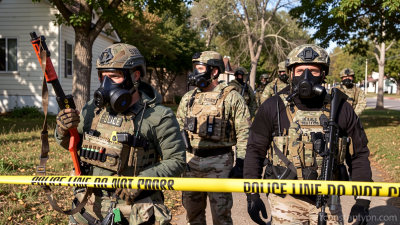
Federal Prosecutors Indict ICE Agent Over Alleged False Account of Minnesota Shooting
Constantvpn.com – The Department of Justice has moved to criminally charge a federal immigration officer for allegedly fabricating the circumstances behind a January shooting in Minnesota — a step that observers describe as unusual under the current administration, which has generally shielded its own agents from legal scrutiny. Christian Castro, an agent with Immigration and Customs Enforcement, now faces a six-count federal indictment tied to the non-fatal discharge of a handgun on 14 January. As of the latest reporting, Castro has not been taken into federal custody.
The Shooting and Competing Accounts
On the morning of 14 January, federal immigration officers were conducting door-to-door enforcement actions in a Minneapolis neighborhood as part of a large-scale deployment. DHS’s initial public explanation stated that Castro opened fire in self-defense after three Venezuelan migrants allegedly attacked him wielding a shovel and a broom handle. Minnesota state investigators tell a markedly different story. Their account holds that Castro aimed and fired through a closed front door, sending a round into the leg of a man inside the home. Officials in St. Paul added that the agent discharged his weapon while “knowing there were people who had just run inside,” and that the projectile’s final point of impact was the wall of a child’s bedroom.
The two men involved in the incident — Alfredo Alejandro Aljorna and Julio Cesar Sosa-Celis, the latter being the one struck in the leg and who survived — were initially charged under federal statutes covering forcibly assaulting, resisting, or impeding officers of the United States. Those charges were later dismissed after surveillance footage surfaced that cast doubt on the agents’ version of events. Prosecutors cited “newly discovered evidence” when dropping the case against the migrants.
From Administrative Leave to Federal Indictment
In February, ICE acknowledged internally that two immigration agents involved in the incident might have made “untruthful statements” about what transpired. Both were placed on administrative leave. Months of investigation followed, during which federal prosecutors reviewed body-camera and neighborhood surveillance video. The result: a six-count indictment against Castro, centered on perjury and false-statement counts connected to his post-incident reports.
Minnesota’s office of the top prosecutor, Keith Ellison, issued a statement welcoming the federal action. Yet Ellison cautioned that the indictment
“does not reflect the full seriousness of the violent crimes that he is charged with in Minnesota.”
His office confirmed the state’s own case — which includes separate counts of assault and false reporting of a crime — will proceed independently of the federal prosecution.
The Extradition Standoff
Castro’s physical whereabouts became a point of interstate friction. He was arrested in Texas in May and held for roughly three months while Minnesota sought his return for trial. Texas Governor Greg Abbott declined to approve the extradition request, stating he had “serious doubts” that Castro met the legal threshold of a fugitive from justice. Castro was released from Texas custody last week, leaving his next court appearance uncertain and raising questions about whether the federal government will seek its own warrant to bring him before a Minnesota or federal court.
Operation Metro Surge and the Wider Backdrop
The January shooting did not occur in isolation. It was one episode within Operation Metro Surge, a sweeping deployment of thousands of federal immigration officers into Minnesota that drew sustained public protests and, ultimately, two deaths of American citizens at the hands of agents during confrontations. The operation intensified scrutiny of ICE’s authority to use force in residential settings and prompted multiple state-level investigations.
ICE agents operate under broad statutory powers granted by the Immigration and Nationality Act, which authorizes them to detain, arrest, and remove non-citizens believed to be in the country unlawfully. Their use-of-force guidelines, published by DHS, permit officers to apply reasonable force to effect a lawful detention or arrest and to defend themselves against imminent threats. Critics of the agency have long argued that the guidelines are vague enough to permit wide discretion, particularly in close-quarters residential encounters where split-second judgments determine whether a gun is drawn.
The current indictment marks a notable departure from recent practice. Under prior administrations, federal agents charged with on-the-job misconduct were frequently tried in state courts or, in some cases, not prosecuted at all. The decision to bring six federal counts against an active ICE officer — while simultaneously allowing a parallel state case to move forward — suggests the Justice Department is attempting to demonstrate that accountability mechanisms function even within its own agencies. Whether that demonstration will be completed in a courtroom, or whether procedural obstacles such as custody logistics will delay proceedings, remains to be seen.
For the families of those affected by the January shooting, and for the broader community in Minneapolis that endured weeks of door-knocking enforcement, the question is no longer whether an investigation occurred. It is whether the outcome will match the severity of what Minnesota prosecutors describe as a deliberate act of violence committed through a closed door, aimed at people who had just taken shelter inside their own home.
Related Reading
Frequently Asked Questions
What is ICE agent charged with lying about?
ICE agent charged with lying about is the main topic of this guide. The article explains the context, practical details, and next steps readers should understand.
Why does ICE agent charged with lying about matter?
ICE agent charged with lying about matters because readers are looking for a useful answer, not just a short summary. Good content should match search intent and help them decide what to do next.