
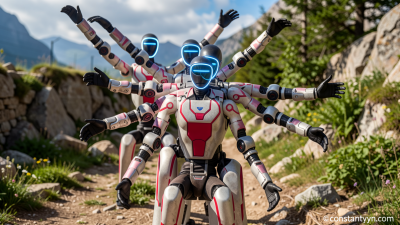
When the Rides Are Built from Silicon and Steel
Constantvpn.com – Theme parks have always chased the next sensory frontier. From the painted backdrops of nineteenth-century amusement grounds to the motion-simulated coasters of the 1990s, the industry has reinvented itself roughly every two decades. Now, in the suburbs of Seoul, South Korea, a new kind of attraction is testing whether the frontier can be crossed entirely through artificial intelligence and humanoid machinery. The venue in question is Galway Robot Park, a 16,500-square-meter complex that opened its gates to the public in the capital region, positioning itself squarely at the intersection of robotics research and consumer entertainment.
The park’s operators have been explicit about their ambition: they want to pull the capabilities of machine learning, autonomous movement, and interactive computing out of laboratories and into the hands — and faces — of ordinary visitors. That stated mission frames every exhibit, every demonstration, and every ticketed experience inside the facility.
“Our aim is to bring artificial intelligence and robotics into the world of entertainment.”
It is a deceptively simple sentence for a project that touches on labor economics, consumer psychology, and the long-term viability of an entire leisure sector. The question it raises is not whether robots can perform a trick or answer a question. The question is whether they can generate the kind of repeat-visit compulsion that keeps a theme park financially alive year after year.
Scale and Location
At 16,500 square meters, Galway Robot Park occupies a footprint comparable to a mid-sized shopping mall or a small convention hall. Its placement near Seoul gives it access to one of the world’s densest metropolitan populations — over 25 million people within the greater Seoul metropolitan area — while also sitting inside a national ecosystem where robotics is not a niche curiosity but a pillar of industrial policy. South Korea has invested heavily in autonomous systems, service robots, and AI-driven manufacturing since the early 2000s, and companies ranging from household-appliance giants to dedicated robotics startups have built commercial products that already appear in restaurants, hotels, and hospitals across the country.
The park therefore does not exist in a vacuum. It sits at the downstream end of a decades-long national push to make machines useful outside the factory floor. What the laboratory prototypes and pilot deployments have demonstrated in controlled settings, the park attempts to translate into a sustained, ticketed, family-friendly experience.
The Sustainability Problem
Every theme park, from Disneyland to Universal Studios, faces the same structural challenge: novelty decays. A coaster that thrilled visitors in its opening season becomes background scenery within three years. The industry’s answer has historically been to build bigger, faster, or more immersive rides — to escalate the physical stimulus. A robotics-based park confronts a different decay curve. A humanoid robot that waves, dances, or converses may fascinate a first-time visitor for twenty minutes. The second visit, however, demands something qualitatively different, not merely quantitatively larger.
This is where the distinction between a demonstration and an attraction becomes critical. A robot that performs a fixed choreography is, functionally, a very expensive animatronic. The moment a visitor recognizes the loop, the magic collapses. What separates a genuinely compelling robotic experience from a novelty act is adaptability — the ability of the machine to respond to the individual in front of it, to vary its behavior from encounter to encounter, to create the impression of a relationship rather than a performance.
Galway Robot Park’s stated commitment to artificial intelligence, rather than pure mechanical actuation, suggests its designers understand this distinction. An AI-driven system can, in principle, generate unbounded variation in dialogue, gesture, and scenario. But the gap between theoretical capability and a polished, reliable, family-safe visitor experience remains substantial. Downtime, awkward interactions, and the uncanny valley of near-human appearance all pose operational risks that traditional mechanical rides do not face.
What the Broader Industry Is Watching
The theme-park sector is not monolithic. Disney, Universal, and regional operators have all integrated screens, projection mapping, and app-linked interactivity into their parks over the past decade. Yet none has made autonomous robotics the central organizing principle of an entire venue. Galway Robot Park’s experiment is therefore a bellwether: if a robotics-first park can sustain ticket sales beyond its opening-year curiosity spike, it validates a business model that could reshape how leisure operators think about their core attractions. If it cannot, the lesson is equally instructive — that machines, however sophisticated, still lack the narrative depth and emotional resonance that make a story-based park worth revisiting.
South Korea’s position in this experiment is particularly consequential. The country’s robotics industry produces some of the world’s most advanced service robots, and its consumer culture already normalizes interaction with machines in daily life. A park that succeeds domestically may find its model exported to other Asian markets, where urban density and tech enthusiasm create similar conditions. A park that struggles domestically, by contrast, would signal that the technology, however impressive in isolation, does not yet translate into durable entertainment value.
The Visitor’s Calculus
For the individual standing at the ticket booth, the decision is simpler than the industry analysis. Will the experience inside be something I want to do again next month? Will my children ask to return? Will the robots feel like characters with whom I share a moment, or like expensive props in a science museum? Those questions cannot be answered from a press release or a square-meter figure. They can only be answered by walking through the gates, watching a machine turn its head toward you, and deciding whether the interaction feels like the beginning of a story or the end of a demonstration.
Galway Robot Park has staked its existence on the former. Whether the robots can keep people coming back is, ultimately, a question the park will answer not in its marketing materials but in its quarterly attendance figures, its social-media sentiment, and the quiet question every returning visitor asks themselves at the exit: “Would I do this again?”
Related Reading
Frequently Asked Questions
What is Could robots be the future of theme?
Could robots be the future of theme is the main topic of this guide. The article explains the context, practical details, and next steps readers should understand.
Why does Could robots be the future of theme matter?
Could robots be the future of theme matters because readers are looking for a useful answer, not just a short summary. Good content should match search intent and help them decide what to do next.