Cleverly says he would not have used Badenoch’s Gestapo jibe
Cleverly Says He Would Not Have Used Badenoch’s Gestapo Jibe
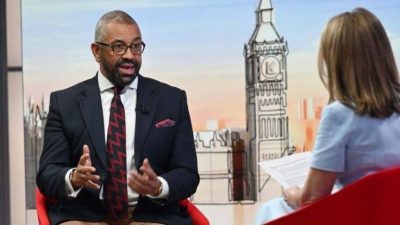
Cleverly says he would not have – During a recent interview on the BBC’s Sunday with Laura Kuenssberg programme, Sir James Cleverly addressed remarks made by Kemi Badenoch, who had likened Education Secretary Bridget Phillipson to a Gestapo officer. Cleverly, who serves as the shadow housing secretary, acknowledged the comparison but stated he would not have employed the same language. The comments came amid a heated debate over the government’s decision to impose VAT on private school fees, a move Labour has accused the Conservatives of using to target families who send their children to independent institutions.
The Context of the VAT Policy
The introduction of VAT to private school fees has sparked significant controversy. Critics argue that the policy disproportionately affects middle-class families, who often pay for their children’s education privately. Badenoch, a prominent figure within the Conservative Party, was vocal in her criticism of Phillipson, describing her as a “spiteful class warrior” during Prime Minister’s Questions earlier this week. This characterization has drawn sharp reactions from Labour, with Phillipson herself accusing Badenoch of using inappropriate rhetoric.
Badenoch’s comparison to the Gestapo—symbolizing Nazi-era oppression—was met with immediate backlash. Phillipson, in response, claimed the remark demonstrated that Badenoch was “not fit to be prime minister.” The Labour Party chairwoman, Anna Turley, later echoed this sentiment, stating that Badenoch’s shadow ministers “won’t defend the indefensible because they know full well Kemi Badenoch’s comments were completely appalling and deeply inappropriate.” Despite the criticism, Badenoch has not issued an apology, framing her remarks as a justified response to what she perceives as Labour’s unfair targeting of private schools.
Cleverly’s Defense of the Language
When pressed on whether he thought Badenoch’s use of the Gestapo analogy was appropriate, Cleverly emphasized the importance of robust political discourse. “We have a robust democracy,” he explained, “and I think one of the dangers in a desire to be collegiate and calm is that voters might think we are not holding each other to account.” He argued that while the phraseology might have been harsh, the intent was valid: to highlight the government’s policies as being driven by class warfare rather than genuine efforts to improve education.
“The point is Bridget Phillipson has pursued an agenda which has nothing to do with raising money, nothing to do with recruiting teachers, it is about punishing people who spend their own money to send their children to private school.”
Cleverly further noted that Labour’s reaction to Badenoch’s remarks was inconsistent. “When Kemi highlights the fact that these policies are vindictive and they are about class war rather than recruiting teachers, she gets vilified by the Labour Party,” he said. “And when people in the Labour Party, literally minutes earlier, describe a Conservative MP as being racist, no-one seems to bat an eyelid.” This contrast underscored the political tensions between the two parties, with Cleverly suggesting that Labour’s willingness to criticize Tory MPs for racist remarks did not extend to its own members when they made similar accusations.
The debate over the VAT policy has also raised questions about the effectiveness of the government’s approach to funding education. While the Conservatives argue that the tax is a necessary measure to support state schools, Labour has criticized the move as a way to reduce the number of teachers, citing a decline in staffing levels despite the additional revenue. Cleverly defended the policy, asserting that it was a clear attempt to address the disparity in educational funding between private and state institutions.
Phillipson’s Criticism of Badenoch
Phillipson, the Education Secretary, has faced her own share of criticism from the Conservative Party. She was recently accused of labeling comments made by Tory MP Nick Timothy as “racist” and calling for his removal. Timothy, who described a Muslim religious gathering in central London in March as an “act of domination,” denied the claim, arguing that his remarks were not racist but rather a critique of cultural influence.
Cleverly used Phillipson’s criticism of Timothy as a point to illustrate the hypocrisy in political exchanges. “When people in the Labour Party, literally minutes earlier, describe a Conservative MP as being racist, no-one seems to bat an eyelid,” he remarked. This statement highlighted the double standards he believes exist in the political arena, where the same language can be wielded to condemn or defend depending on the context.
Political Rhetoric and Public Perception
The incident has reignited discussions about the role of political rhetoric in shaping public opinion. Cleverly argued that while the Gestapo analogy might have been strong, it served a purpose in drawing attention to the underlying motivations of Labour’s policies. “So that wouldn’t have been the phraseology that I use, but you can see Kemi’s explanation there,” he said, pointing to Badenoch’s justification for the comparison.
Badenoch, meanwhile, has framed her remarks as a direct response to what she sees as Labour’s unfair treatment of private school families. She told the Spectator earlier this month that Phillipson had “acted like a Gestapo officer” in implementing the VAT policy, suggesting that the education secretary’s actions were punitive rather than supportive. This line of argument has been used to defend Badenoch’s stance, even as her comments have drawn criticism for their intensity.
Cleverly’s remarks have also sparked a broader debate about the balance between respectful dialogue and necessary confrontation in politics. He believes that robust criticism is essential, particularly when holding the government accountable for decisions that may not align with the public interest. “I do think we need to be robust,” he said, “and I do think when we see people, particularly Secretaries of State, particularly the government, doing things not for the good of the country but to scratch a party political itch, I think it’s absolutely right that we call it out.”
The Broader Implications of the Exchange
As the political battle over education funding intensifies, the clash between Cleverly and Badenoch has become a symbol of the larger ideological divide. The use of the Gestapo analogy has been criticized for its historical weight, but supporters argue that it effectively captures the essence of Labour’s approach. Meanwhile, the Conservatives have continued to push back against what they see as Labour’s overreach, with Cleverly suggesting that the party’s rhetoric has become more aggressive than necessary.
Analysts note that this incident is part of a wider trend in British politics, where increasingly charged language is used to underscore policy disagreements. The tension between the two parties has also been amplified by media coverage, with the BBC’s Sunday with Laura Kuenssberg programme playing a central role in amplifying the debate. As the discussion unfolds, the question remains: does the use of strong metaphors like “Gestapo” serve as a necessary tool for political clarity, or does it risk alienating voters and undermining the credibility of the arguments being made?
With the political landscape shifting rapidly, the exchange between Cleverly and Badenoch has become a focal point for understanding the dynamics at play. Whether the language used is seen as appropriate or not, it has undeniably highlighted the deepening rift between the Conservatives and Labour over education policy. As the debate continues, the public will be watching closely to see if the metaphor of the Gestapo becomes a defining moment in the ongoing political struggle, or if it fades into the broader fray of partisan discourse.
