Rescuers search rubble for survivors as Venezuela earthquakes kill at least 235
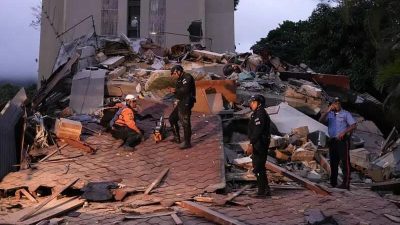
Rescuers Search Rubble for Survivors as Venezuela Earthquakes Kill At Least 235
Rescuers search rubble for survivors as Venezuela – Two significant earthquakes rocked Venezuela near its capital, Caracas, within a day, leaving at least 235 people dead and over 4,300 injured. The tremors, which occurred at 18:04 local time on Wednesday—a national holiday—caught many residents off guard, as more people were at home rather than in offices or schools. Emergency teams are working tirelessly to sift through debris in hopes of locating additional survivors, while the nation grapples with the devastation of collapsed structures and the emotional toll on communities. The quakes, measuring 7.2 and 7.5 on the Richter scale, were particularly damaging due to their shallow epicenters, according to the US Geological Survey (USGS).
Quakes Strike Near Surface, Intensifying Damage
The first quake, registering a magnitude of 7.2, was swiftly followed by a stronger 7.5-magnitude tremor just seconds later. Both events originated at depths of 20.3km and 10km, respectively, which is unusually close to the Earth’s surface. This shallow depth amplified the destruction, as buildings and infrastructure in the affected regions were unable to absorb the shock effectively. The timing of the quakes, coinciding with a national holiday, likely contributed to the higher number of casualties, with many families gathering in homes that crumbled under the force of the shaking.
Authorities in Caracas and the coastal city of La Guaira reported frantic calls for help from those trapped beneath rubble. In La Guaira, a 10-storey hotel was reduced to a pile of debris, as confirmed by BBC footage. Residents who survived the initial impact were left scrambling to find shelter, with some sleeping in the streets due to fears of further collapses. “I thought I was going to die,” said Juan Ortiz, a medical student in Caracas, describing the panic that gripped the city. His words reflect the shared trauma of those who witnessed the disaster unfold.
State of Emergency Declared, International Aid Promised
In response to the crisis, Venezuela’s interim president, Delcy Rodríguez, declared a state of emergency, prompting a coordinated effort to assess the damage and deploy resources. The National Assembly’s president, Jorge Rodríguez, confirmed the death toll had increased by Thursday, with 250 buildings reported as damaged or destroyed, primarily in La Guaira. The severity of the situation has drawn support from several countries, including the United States, which pledged $150 million in aid. The US military is sending transport ships and aircraft to assist in search and rescue operations and provide rapid relief to affected areas.
Emergency services in Caracas and surrounding regions are actively combing through rubble, with teams using specialized equipment to locate trapped individuals. In the Chacao district, Mayor Gustavo Duque reported that 11 people had died in one collapsed building, while 23 were rescued. “We’re trying to rescue as many people alive as possible,” Duque stated in a video update shared on social media. The video showed teams working to clear debris, aiming to reach those still hidden beneath the wreckage. However, the challenge remains formidable, as aftershocks continue to shake the area, with at least 30 recorded since the initial quakes.
Infrastructure Damage and Ongoing Risks
The destruction extends beyond residential areas, with major infrastructure such as the country’s main international airport in Maiquetía—located on the outskirts of Caracas—suffering severe damage and being temporarily closed. Video footage from inside the terminal revealed dust and debris falling from the ceiling, highlighting the extent of the structural harm. In Tucacas, a coastal city approximately 250km northwest of Caracas, another verified video showed a multi-storey building, suspected to be a hotel, collapsing entirely.
Despite the immediate response, the potential for further casualties remains high. The USGS warned that the disaster could lead to “high casualties and extensive damage,” with estimates suggesting a 42% probability of over 10,000 deaths and a 33% chance of exceeding 100,000 fatalities. These projections are based on factors such as the size of the population in the affected zones, historical data from similar earthquakes, and the condition of the buildings. “The disaster is likely widespread,” the USGS noted, emphasizing the scale of the challenge ahead.
Quotes from Survivors and Officials
“I’m in shock and confusion, and frustrated that I can’t help.” — Juan Ortiz, a medical student in Caracas, describing the aftermath of the quake.
Ortiz shared his experience of losing a close friend and fearing for another’s life, underscoring the personal loss and urgency of the rescue efforts. Meanwhile, Interior Minister Diosdado Cabello confirmed that buildings in the capital were also brought down, with districts like Trujillo, Yaracuy, Carabobo, Aragua, and Miranda experiencing significant damage. The collapse of structures has left many without homes, forcing them to seek refuge in open spaces or with relatives.
The earthquake’s impact is compounded by the fragility of Venezuela’s infrastructure. Many buildings, especially in coastal areas, were constructed with less seismic resilience, increasing the likelihood of failure during tremors. As the search for survivors continues, officials are urging patience, while the public remains on edge. “We’re trying to reach people who are hopefully still alive,” Duque reiterated, capturing the determination of rescue workers amid the chaos.
Geological Context and Future Concerns
Venezuela’s location on the boundary of two tectonic plates—specifically the South American and Caribbean plates—makes it prone to seismic activity. The recent quakes are believed to have resulted from the sudden release of friction between these plates, a common cause of earthquakes in the region. However, the unprecedented scale of this disaster has raised questions about preparedness and resilience.
As the situation unfolds, the focus remains on saving lives and stabilizing the affected regions. While the immediate priority is rescue operations, the long-term recovery will depend on the availability of resources and the coordination of international aid. The 42% and 33% probabilities cited by the USGS serve as a grim reminder of the potential for the death toll to rise further. Power cuts and internet disruptions have also complicated efforts to communicate with affected areas, adding to the sense of uncertainty.
With the nation’s infrastructure under strain and many residents still in the streets, the road to recovery will be long. Yet, the resilience of the people and the support from global partners offer a glimmer of hope in the face of such devastation. As the search continues, the world watches closely, aware that the true scale of the disaster may only become clear in the days and weeks to come.
