
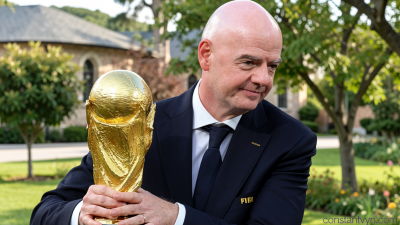
FIFA Fires Back at UEFA Over Scrapped World Cup Deal, Accusing European Body of Weeks-Long “Smear Campaign”
Constantvpn.com – The institutional rift between world football’s two most powerful governing bodies has deepened sharply after FIFA lodged court papers in the United States accusing UEFA of orchestrating a sustained “smear campaign against it and its leadership.” The filings, reviewed by journalists before publication, mark a dramatic escalation in a dispute that began when European football’s regulator moved to pursue what it describes as potential criminal claims in Switzerland over the now-abandoned FIFA Forward Enterprise (FFE) scheme.
At the heart of the conflict sits a proposal by FIFA president Gianni Infantino — who has held the role since 2016 — to carve out a commercial subsidiary holding stakes in the World Cup and sell a minority share to private investors. The plan, revealed in July of last year, triggered an immediate and fierce backlash from UEFA and several member confederations before being shelved within days. What followed was not a quiet retreat but a prolonged public campaign that FIFA now characterises as coordinated disinformation aimed at destabilising its leadership.
FIFA’s Court Response: “A Fundamental Defect”
In its US filings, FIFA asked the court to defer or oppose UEFA’s request for access to internal documents by the end of the month. The world governing body argued that UEFA’s application rests on what it calls a “fundamental defect” and multiple “legal deficiencies.”
“Uefa seeks discovery in aid of a foreign criminal proceeding that does not exist and that Uefa admittedly lacks the authority to initiate. Despite that threshold problem, Uefa asks this court to authorise sweeping discovery about the FFE.”
FIFA stressed that the FFE was never a concluded transaction but “only a proposal,” one that could have proceeded solely if a majority of its 211 member associations voted in favour and the relevant approvals of the FIFA Council were secured. In the organisation’s telling, UEFA bypassed that democratic mechanism entirely.
“Rather than participate in that democratic process, Uefa issued a press release – the beginning of a weeks-long smear campaign against Fifa and its leadership.”
What Was the FFE Scheme?
For readers unfamiliar with the mechanics: the FFE concept involved creating a new commercial entity that would hold intellectual-property rights to the World Cup tournament. A private investor would acquire roughly 20 per cent of that entity in exchange for a capital injection. Under the original terms discussed in July, venture capitalist Joshua Kushner and his firm Thrive Eternal were positioned as the lead investor, with a deal value of $4.2 billion (£3.1 billion) attached to the stake.
FIFA’s stated rationale was financial redistribution. The organisation claimed the scheme would have lifted the per-association funding allocation for the 2027–2030 cycle from £5.9 million to £14.7 million — a near-tripling of resources flowing to smaller national federations. Critics, however, questioned whether the World Cup’s commercial value had been properly assessed before any sale was contemplated.
Kushner’s Regret and the Trump Connection
The Kushner dimension added an unusual layer of political sensitivity to an already volatile story. Joshua Kushner is the brother of Jared Kushner, son-in-law of US President Donald Trump. His involvement drew scrutiny well beyond the football world, and on Sunday he issued a public statement expressing regret over the episode.
“While we stand behind the motivations of FFE, we failed to appreciate the political dynamics of global football, and the lengths some would go to… had we known what this would devolve into, we would not have gotten involved.”
UEFA has asked a New York court to compel testimony and document production from both Kushner and his company, as well as from American financier Greg Maffei, who served as a key adviser on the transaction. UEFA clarified that neither man is expected to become a defendant in any proceeding; rather, their accounts are sought to reconstruct the timeline of negotiations. According to UEFA’s lawyers, the pair first discussed the FFE concept in July 2025, and Infantino had “been discussing the underlying concept with Kushner for nearly a year before the terms sheet was ultimately signed.”
UEFA’s Core Allegations
European football’s governing body has framed its case around two principal charges. First, it alleges “criminal mismanagement” by Infantino in the handling of the proposal. Second, it contends that the World Cup was deliberately undervalued at approximately £15 billion — a figure it describes as “neither the product of an open, competitive auction, nor tested by any independent valuer.” UEFA further asserts that Infantino failed to consult FIFA’s internal hierarchy before advancing the plan, and characterises the pricing as “a fraudulently off-market price promoted by [him] for his own benefit.”
UEFA has declined to comment publicly on FIFA’s latest filings, though insiders close to the European body have suggested that if FIFA genuinely has nothing to conceal, it should simply release the requested documents and allow the legal process to proceed without delay.
The Economic Argument and Broader Power Dynamics
Beyond the courtroom, the dispute carries a structural dimension that FIFA has now made explicit. In its filings, the world governing body accused UEFA of an “economic motivation” rooted in protecting its own market dominance. The argument runs that empowering smaller, developing-world federations with greater financial resources would intensify global competition, dilute UEFA’s commercial leverage, and create rivals for its flagship tournaments such as the Champions League and the European Championship.
“If soccer is strengthened in the developing world, global competition increases, which ultimately reduces Uefa’s market power and provides more competition for its flagship tournaments. By raising funds to allow some of Fifa’s smaller member associations to better develop soccer, FFE would lead to more players from those nations choosing to represent their countries of origin and playing in their home leagues rather than playing abroad.”
That framing positions the fight not merely as a procedural disagreement over document disclosure but as a contest over the distribution of economic power within global football — a question that has simmered for years between Europe’s wealthy leagues and the rest of the world.
Infantino’s Position Under Pressure
The legal escalation lands at a moment when Infantino’s grip on the presidency is already under strain. Three continental confederations have publicly called for him to stand down, and UEFA has signalled its intention to push for his removal should the boycott threat it previously floated be dropped in favour of formal governance action. Whether the US discovery battle will accelerate or complicate that political trajectory remains uncertain, but both sides now appear committed to a prolonged contest in which the World Cup’s commercial future — and the balance of power between Europe and the wider footballing world — are effectively on trial.
Related Reading
Frequently Asked Questions
What is Fifa accuses Uefa of smear campaign?
Fifa accuses Uefa of smear campaign is the main topic of this guide. The article explains the context, practical details, and next steps readers should understand.
Why does Fifa accuses Uefa of smear campaign matter?
Fifa accuses Uefa of smear campaign matters because readers are looking for a useful answer, not just a short summary. Good content should match search intent and help them decide what to do next.