
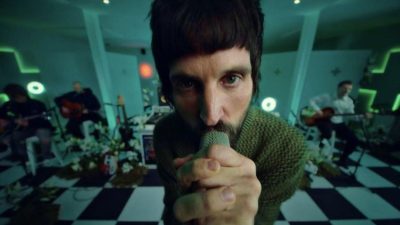
Kasabian’s Serge Pizzorno Trades Midnight Benders for a Structured Morning Routine — and Aims to Make You Sing Along
Constantvpn.com – Ten days before the release of Kasabian’s ninth studio album, Act III, the band’s frontman invited visitors into a black cube wedged into the Leicestershire farmland where he now composes. The session was meant to preview new material, but what emerged was something broader: a portrait of a musician who has deliberately abandoned the romantic chaos of his twenties in favour of discipline, melody, and a pointed critique of the algorithmic culture now shaping how young people consume music.
The Studio at the End of a Country Lane
Reaching the property requires driving deep into rural Leicestershire, past fields and fish ponds, to a gated house where Pizzorno’s wife Amy greets visitors alongside two dogs he describes as “unruly.” Inside, the kitchen carries his own visual art — a warped Count Duckula painting, a vintage apothecary cabinet — while a framed photograph of the band’s recent Finsbury Park concert rests in bubble wrap at the base of the staircase.
Pizzorno, dressed in a dog-print designer shirt, leads guests through a side gate and over a scatter of abandoned Nerf guns into a walled garden. There, jutting into the open countryside, sits the studio: a stark black structure guarded by a towering gorilla sculpture. He built it so that creative impulses could be acted on immediately, without commuting to a commercial facility. On days when inspiration fails to arrive, a basketball court sits just outside the walls.
Inside, eccentric vintage synthesizers line the racks — many of which appear on the new record’s track “Going, going, gong.” Wall-mounted artwork doubles as acoustic dampening. A small fridge holds milk for tea. Above the entrance, a pharmacist’s sign glows with the studio’s self-appointed nickname, “The Sergery,” a pun that stretched to its logical extreme in 2025 when Pizzorno received an honorary doctorate in music. A gong waits in silence in one corner. Four bobblehead Kasabian figures, rescued from the band’s Call music video, nod in unison as the new tracks cue up.
From Three-Day Benders to Four-Hour Sessions
The working method inside the cube is austere. Snacks are banned. Phones are banned. Pizzorno might queue a David Lynch film to play silently in the background while he tinkers with synths and guitars, but the rule is simple: no distractions, four to five hours a day, and no lunch break.
“A little bit of hunger is good for you. Keeps you going.”
That discipline marks a sharp break from the band’s early years, when Pizzorno would “live the French poet life,” staying awake for three consecutive days to chase inspiration at the edge of exhaustion.
“That can be great. It adds to the atmosphere of a record. But for the last three albums, I’ve pretty much led a structured life, and I’m really digging it.”
Melody as a Political Act
The first track played in the session was “Soulmate,” a wry, affectionate tribute to Amy built around a peacocking guitar riff. Next came “Say You (Closer),” whose message of collective togetherness is carried by lush three-part harmonies — the closest Kasabian have ever sounded like The Eagles, a comparison that gives Pizzorno genuine stage jitters.
“There are moments where it does sound like the Eagles, and there are moments where it sounds like three pissed up people in a pub. What I’m going to do, hopefully, is get the crowd to do that bit.”
Audience participation has grown into a central pillar of Kasabian’s live shows, and the album’s stated philosophy — “Tunes You Can Sing™” — is entirely deliberate.
“I feel like it’s not a very melodic time in music. So I was personally yearning for hooks and verses that are as powerful as choruses. Like an Elton John song where the melody just breaks your heart.”
Hippie Sunshine and the Tech-Oligarch Critique
The single “Hippie Sunshine” pushes that melodic ambition into sharper territory. Its lairy, chanted chorus is abruptly severed by a twinkling piano breakdown — a structural gambit Pizzorno compares to 1960s pop songs like “Good Vibrations” and “Baron Saturday,” where the middle section acts as a handbrake turn.
“The first few times you hear it, you’re like, ‘Oh, that’s weird’. Then you get used to it, and it becomes the exciting bit, the part everyone waits for.”
Beneath the playful surface, the verses deliver a pointed critique of soulless tech oligarchs whose algorithms now dictate daily life. The bridge functions as a sober awakening, where the elite suddenly recognise: “I’m a stone-cold killer.”
“We find ourselves, somehow, at the whim of people whose intentions we don’t really understand. They’re playing around with culture, and we don’t really know why, or where it’s going to end.”
The Teenage Boys and the Phone
Pizzorno sees the downstream effects of that algorithmic culture in his own teenage sons. Rather than issuing blunt commands to put devices down, he is working to embed the lesson inside the music itself — letting the song’s pull do what a parent’s shout cannot.
“If you just shout, ‘Get off your phone, get off your phone’, no-one wants to hear that. But you can subtly educate them.”
For a band that built its reputation on wall-to-wall electronic intensity, the pivot toward singable melody and pointed social commentary marks a significant recalibration. Act III arrives not as a continuation of the Kasabian formula but as a statement about what the formula can become when its architect decides that structure, hook, and honest lyrical address matter more than sheer sonic volume.
Related Reading
Frequently Asked Questions
What is In the studio with Kasabian?
In the studio with Kasabian is the main topic of this guide. The article explains the context, practical details, and next steps readers should understand.
Why does In the studio with Kasabian matter?
In the studio with Kasabian matters because readers are looking for a useful answer, not just a short summary. Good content should match search intent and help them decide what to do next.