
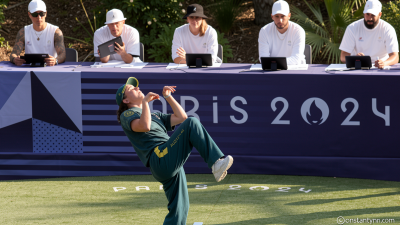
From Panic Attack to Global Headlines: Rachael Gunn’s Unscripted Olympic Story
Constantvpn.com – In August 2024, a 38-year-old Australian university lecturer found herself the subject of memes, late-night television sketches, concert shout-outs from Adele, and a public endorsement from actor Chris Hemsworth — all because of a few seconds of breakdancing on an Olympic stage. Her name in competition is Raygun, and her performance at Paris 2024 became one of the most talked-about cultural moments of the Games, far outstripping the sporting result itself.
Yet the path from a quiet academic career to viral internet fame was anything but smooth. Hours before the Paris opening ceremony, Gunn experienced a full-blown panic attack in the middle of the Olympic village. Surrounded by elite athletes who had spent decades in competitive sport, the reality of her situation crashed down on her with sudden, overwhelming force.
“I just could not stop crying… I had a panic attack. ‘What am I doing? What have I done? Should I be doing this?'”
She described feeling like a fraud among seasoned competitors. Breaking — the competitive form of breakdancing — was making its Olympic debut at Paris 2024, and Gunn was one of only a handful of athletes in the world to qualify for the event. Within hours of that crisis, however, she was aboard a barge on the River Seine, waving to crowds alongside the rest of the Australian delegation.
A Qualification Built on Merit
Gunn’s route to the Olympics began in 2023, when she competed at the Oceania Breaking Championships in Sydney and earned her spot on the Australian team. She had never before competed at a level where international judges scored every move.
“I’ve never participated in anything of such high stakes before. It was all international judges, but I was relieved and excited when I qualified. And then the next whirlwind happened.”
Once qualified, the infrastructure of elite sport wrapped around her quickly. In February 2024 she received a scholarship at the New South Wales Institute of Sport, which opened access to a structured strength-and-conditioning programme. The adjustment was jarring: she was training alongside athletes who had been in those programmes since childhood.
“That was great, but also overwhelming because I was training with people who had been doing that stuff since they were kids.”
The Viral Moment and Its Aftermath
At the Games themselves, Gunn competed in three round-robin battles and did not win any of them. Still, she left the competition floor satisfied. World champion Dominika Banevic — known as Nicka — applauded her moves after their final bout, and the event’s MC celebrated her performance. The atmosphere, she recalled, was positive.
What no one predicted, including Gunn herself, was that one particular routine — featuring unconventional moves she had developed, including a “sprinkler” and a kangaroo hop — would detonate across social media. Memes proliferated. A sketch landed on The Tonight Show Starring Jimmy Fallon. Adele referenced the performance during a concert. Chris Hemsworth defended Gunn on Jimmy Kimmel’s show. Australian Prime Minister Anthony Albanese publicly praised her for having “a crack.”
“It was pretty wild the way I became a topic of conversation in spaces I never thought I would be.”
Conspiracy Theories and Mental-Health Toll
Alongside the affectionate teasing came darker currents. Online conspiracy theories alleged nepotism in her selection, claiming that her husband and trainer, Samuel Free, had sat on the committee that approved her qualification — a claim that was factually incorrect. Gunn found the sustained questioning of her credibility and motivations exhausting.
“It was really tough when mine and Sammy’s credibility, ethics and motivations were being called into question. You could just spend 30 seconds researching and find plenty of sources to debunk these conspiracies, but that’s not how people use the internet anymore.”
The cumulative pressure took a measurable toll. In a Netflix documentary covering this period, Gunn describes feeling as though her life was “crumbling” around her, day by day. The film also reveals that during her training run-up to the Games, her mother suffered three brain aneurisms. Gunn herself began taking anti-depressants to manage escalating anxiety.
Reclaiming the Narrative
The documentary project, she says, has begun to restore a sense of agency. After months of processing what happened — the panic, the scrutiny, the isolation of being a public figure overnight — she describes finally having “a voice again.”
“It’s taken a long time for me to process what happened. It’s really exciting for me to finally have a voice again.”
Gunn’s story sits at an unusual intersection: a late-career athlete entering a brand-new Olympic discipline, a university academic thrust into the machinery of elite sport, and a private individual suddenly consumed by global pop culture. Breaking’s debut at Paris 2024 gave the world a narrow window into a subculture that had long existed in clubs and battle halls, and Gunn’s Australian-inflected routine — a creative gamble designed to play to her own strengths rather than imitate established champions — became the most visible expression of that window. Whether or not she wins medals in future cycles, her experience has already reshaped how the public understands what it means to be an Olympian: not only a decade of training, but also the capacity to improvise, to be imperfect, and to survive the aftermath of being seen.
Related Reading
Frequently Asked Questions
What is It s taken me a long?
It s taken me a long is the main topic of this guide. The article explains the context, practical details, and next steps readers should understand.
Why does It s taken me a long matter?
It s taken me a long matters because readers are looking for a useful answer, not just a short summary. Good content should match search intent and help them decide what to do next.