
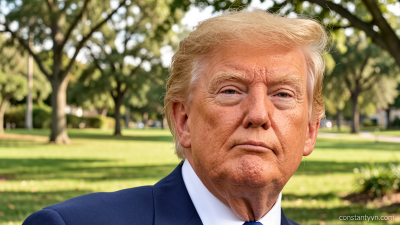
Trump Signals Openness to Revisiting US Stance on Falklands as NATO Spending Tensions Mount
Constantvpn.com – The question of whether Washington will formally challenge London’s claim over the Falkland Islands has moved from the margins of diplomatic speculation into the centre of transatlantic defence debate. Speaking to reporters on Monday, President Donald Trump confirmed that the United States’ position on the islands is being examined alongside a broader catalogue of policy reviews, framing the issue as part of a wider effort to push NATO partners toward greater military expenditure.
“I always review every position. That’s just one of many.”
The remark came in response to a direct question from a BBC correspondent asking whether the administration was reconsidering its long-standing posture on the archipelago. Trump did not elaborate on what a revised position might entail, but he immediately pivoted to pressing the United Kingdom to raise its defence budget, telling reporters that Britain has “got some problems, but they’ll get solved.”
London’s Firm Response
The UK government moved quickly to shut down any suggestion that sovereignty over the islands is negotiable. A spokesperson stated that Falkland islanders “are British with a right to determine their own future,” and added: “The islanders have repeatedly expressed their wish to remain a British overseas territory and our commitment to them is unwavering.”
The response underscores a point that has defined British policy since the 1982 conflict: the islanders’ own expressed preference is treated as the ultimate arbiter of the question, not the preferences of Buenos Aires or Washington. Any US move to formally contest the claim would therefore collide not only with London’s diplomatic position but with the democratic will of roughly 4,000 residents who voted overwhelmingly to remain under British administration in a 2013 referendum.
A Dispute Rooted in a 74-Day War
The Falkland Islands, a scattered archipelago in the south-west Atlantic roughly 300 miles south of Tierra del Fuego, have been the subject of a sovereignty contest between Britain and Argentina stretching back centuries. The dispute erupted into open warfare in April 1982 when Argentine forces landed on the islands to stake a territorial claim. A British task force was dispatched across the Atlantic and, after a brief but bitter campaign, ejected the Argentine garrison.
The conflict lasted 74 days and exacted a heavy toll: 255 British military personnel were killed, along with three islanders and 649 Argentine soldiers. For generations of British and Argentine families, the war remains a defining wound, and any diplomatic manoeuvre touching the islands’ status carries emotional weight far beyond its strategic calculus.
Successive US administrations have formally recognised the United Kingdom’s de facto administration of the territory while deliberately stopping short of endorsing sovereignty. That careful ambiguity has allowed Washington to maintain working relations with both London and Buenos Aires without taking sides in a dispute neither capital has fully resolved.
The Pentagon Email and the Spending Lever
The current episode did not emerge in a vacuum. In April, an internal Pentagon email — first detailed by Reuters — outlined options the US was weighing to pressure NATO allies it judged had failed to back its war effort in Iran. Among the measures floated was the prospect of Washington reviewing its position on Britain’s claim to the Falklands, effectively using the islands as a bargaining chip to extract greater allied contribution.
Those reports had largely faded from public view until recent days, when they resurfaced in connection with defence-spending negotiations. The Daily Telegraph subsequently reported that US defence officials were drawing up concrete proposals to incentivise NATO allies to meet their spending pledges, with the Falklands question listed among possible levers.
Britain’s Defence-Spending Commitments Under Scrutiny
The timing of Trump’s remarks intersects with a period of intense internal debate in Westminster over how quickly and how far the UK should expand its defence budget. Prime Minister Andy Burnham has pledged to honour a commitment made by his predecessor, Sir Keir Starmer, to allocate 3.5 per cent of gross domestic product to core defence spending by 2035.
On Tuesday, Chancellor John Healey told The Times that he would “set out a clear path” to meeting that NATO pledge at the next government spending review, expected in the spring of next year. He also indicated a target date for reaching an intermediate threshold of 3 per cent of GDP in defence outlays.
Healey’s own political trajectory makes the spending question personally charged. He resigned as defence secretary in the Starmer government following a public row over military expenditure. His resignation letter, published in June, laid bare his frustration that the cabinet had no firm timetable for hitting the 3 per cent target — a milestone he believed should have been reached by 2030 rather than deferred to a later date.
What a US Position Shift Would Mean
Should the administration move from “reviewing” to formally contesting British sovereignty, the implications would extend well beyond the South Atlantic. It would represent the first time a US government has taken an explicit position adverse to the UK’s claim, breaking decades of deliberate ambiguity. For Argentina, it would validate a decades-long diplomatic campaign. For NATO, it would introduce a new variable into alliance cohesion at precisely the moment Washington is seeking greater allied burden-sharing.
For the islanders themselves, whose self-determination is enshrined in British constitutional arrangements, any external renegotiation of their status would be perceived as a breach of the compact that has governed their political life since the war ended. The UK government’s insistence that their wishes are “unwavering” is, in effect, a reminder that the question is not one for superpowers to settle over a conference table.
Whether Trump’s “one of many” framing signals a genuine policy shift or merely rhetorical pressure to extract higher defence budgets from London remains to be seen. What is clear is that the Falklands, long treated as a settled footnote in transatlantic relations, have been elevated to a live variable in the arithmetic of alliance spending — and that elevation itself changes the political temperature of the South Atlantic.
Related Reading
Frequently Asked Questions
What is Trump says US position on Falklands?
Trump says US position on Falklands is the main topic of this guide. The article explains the context, practical details, and next steps readers should understand.
Why does Trump says US position on Falklands matter?
Trump says US position on Falklands matters because readers are looking for a useful answer, not just a short summary. Good content should match search intent and help them decide what to do next.