
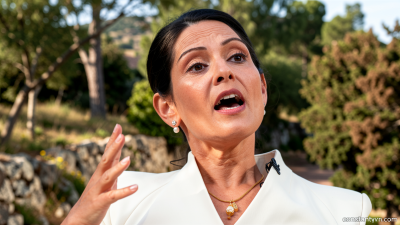
Conservative Shadow Cabinet Reshuffle: Tugendhat Returns to Front Bench as Patel Steps Aside
Constantvpn.com – Kemi Badenoch is set to execute the most consequential personnel change in her shadow cabinet since assuming the Conservative leadership, swapping out Dame Priti Patel from the shadow foreign secretary post and installing former leadership contender Tom Tugendhat in its place. The move, expected to be formalised during a broader reshuffle next month, marks Tugendhat’s first return to a senior opposition role since he finished fourth in the 2024 party leadership contest.
The change also signals a deliberate reorientation of the party’s international-facing work. Patel, who has occupied the shadow foreign secretary seat for roughly two years, will transition into a position centred on cultivating relationships with allied centre-right parties across the globe — a role that, while less visible in Westminster, carries significant weight in the architecture of international conservative networks.
Tugendhat’s Path Back to Senior Politics
The incoming shadow foreign secretary brings a long record in defence and foreign-policy circles. A former British Army reserve officer and Territorial Army veteran, Tugendhat served as minister responsible for security under both Liz Truss and Boris Johnson. Before entering the cabinet, he spent five years chairing the Foreign Affairs Select Committee, a post that gave him sustained oversight of the Foreign Office, the intelligence agencies, and the diplomatic service.
His departure from the front bench in 2024 followed his fourth-place finish in the leadership election that ultimately elevated Badenoch to the party’s top job. Since then he has sat as a backbencher, though his public commentary on international affairs, NATO commitments, and European security has kept him firmly in the policy conversation. His return to the shadow foreign secretary role places him directly in charge of scrutinising the government’s diplomatic record, managing the opposition’s foreign-policy platform, and serving as the party’s principal voice on international affairs in the Commons.
Patel’s Departure and New Mandate
Patel announced her departure from the front bench in a statement posted on X, the social-media platform formerly known as Twitter. She framed the transition as a continuation of her service to the party rather than a retreat from it.
“It has been an honour to lead the Party’s foreign affairs team in Parliament over the last two years. I’m pleased to continue supporting Kemi and the Conservative Party in a new role strengthening our relationships with fellow conservatives and centre right parties around the world.”
She confirmed she would retain her seat as MP for Witham in Essex, meaning the change is one of portfolio and function rather than a full exit from parliamentary life. Patel’s prior ministerial résumé includes a three-year tenure as home secretary under Boris Johnson, during which she oversaw policing, immigration enforcement, and counter-terrorism policy. Her appointment to Badenoch’s shadow cabinet in 2024 followed her sixth-place finish in the same leadership contest that produced the current leader.
The new role she will assume — focused on what she described as strengthening “links with sister parties and centre right movements around the world” — aligns with a long-standing Conservative practice of maintaining institutional ties with parties such as the US Republican Party, Germany’s CDU/CSU, and centre-right formations across Latin America, Africa, and Asia. While less newsworthy than a Westminster portfolio, such a position can shape the party’s international messaging, conference participation, and cross-party coordination on issues from trade to defence spending.
The Wider Reshuffle: Cleverly, Coutinho, and the Chancellor Question
Patel’s exit is one element of a broader realignment already in motion. Shadow housing secretary Sir James Cleverly has resigned from the front bench to devote his full attention to building a campaign for the London mayoral election scheduled for May 2028. He has not yet been formally selected as the Conservative candidate for that contest, nor has he tendered his resignation as MP for Braintree, leaving a short window in which his parliamentary status remains technically intact while his political energy shifts toward the capital’s mayoral race.
Badenoch will therefore need to fill two front-bench vacancies simultaneously: the shadow housing secretary post vacated by Cleverly and the shadow foreign secretary post vacated by Patel. The timing of the reshuffle is further compressed by the impending maternity leave of shadow energy secretary Claire Coutinho, whose absence from the front bench will require a temporary or permanent replacement in that portfolio as well.
Speculation has also swirled around the position of shadow chancellor Sir Mel Stride. In recent weeks, figures inside the party have publicly downplayed the prospect of his removal, yet some internal sources continue to believe Badenoch retains the option of replacing him. The question carries particular weight because Coutinho is widely regarded within the party as a plausible future shadow chancellor. Colleagues have noted the strength of her parliamentary questioning and media performances, and many view her as the natural successor to the finance portfolio. However, appointing her to that role while she is on maternity leave from the front bench would create an awkward administrative gap, making a near-term move unlikely.
What the Changes Mean for the Opposition
For readers tracking the opposition’s capacity to challenge the government, the reshuffle represents both continuity and recalibration. Tugendhat’s appointment restores a figure with deep institutional knowledge of foreign and security policy to the opposition benches, potentially sharpening scrutiny of the government’s diplomatic decisions. At the same time, the simultaneous departures of Patel and Cleverly — combined with Coutinho’s leave — mean Badenoch must reconstitute a substantial portion of her senior team within a compressed timeframe.
The leadership election of 2024, in which Badenoch ultimately prevailed, left several high-profile candidates without front-bench roles. Tugendhat’s elevation now resolves one of those lingering questions, while the fate of other contenders remains unresolved. The coming weeks will reveal whether the reshuffle is confined to the positions already identified or extends further into the cabinet’s structure.
Related Reading
Frequently Asked Questions
What is Patel to be replaced by Tugendhat?
Patel to be replaced by Tugendhat is the main topic of this guide. The article explains the context, practical details, and next steps readers should understand.
Why does Patel to be replaced by Tugendhat matter?
Patel to be replaced by Tugendhat matters because readers are looking for a useful answer, not just a short summary. Good content should match search intent and help them decide what to do next.