
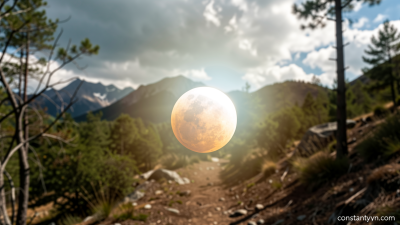
UK Moon Turns Red in Rare Partial Eclipse
Constantvpn.com – The Moon set to turn red over British skies this Friday night, as a partial lunar eclipse sends the full disc plunging into Earth’s shadow. Visible to the naked eye from the south-western horizon, the event marks the second major celestial spectacle of the season, following the partial solar eclipse that crossed the country earlier this year. For roughly two hours before the Moon slips below the terrain, observers with clear sightlines will witness the lunar surface darken and redden in stages.
Peak eclipse arrives at 05:12 BST, when approximately 93 percent of the disc sits within the umbra — the deepest, darkest core of Earth’s shadow. Because the Moon will already be low on the horizon by that hour, the spectacle unfolds against a twilight backdrop rather than full darkness, lending the scene an unusual theatrical quality.
Timeline of the Event
The sequence opens quietly around 02:23 BST as the Moon crosses into the penumbra, the faint outer fringe of the shadow. Most viewers will register little more than a subtle dimming at this stage. The visually compelling phase begins at 03:33, when the leading edge of the disc bites into the umbra and a dark, curved shadow starts to carve across the surface.
From that moment until moonset, the eclipsed portion glows in shades of rust, amber, and deep crimson. The colour arises because sunlight must thread through Earth’s atmosphere to reach the shadowed Moon. Shorter blue wavelengths scatter away readily, while longer red wavelengths penetrate the atmospheric filter and strike the lunar surface, which then reflects them back toward Earth. This is the mechanism behind the “Blood Moon” moniker that has attached to eclipses for centuries.
The partial phase technically concludes at 06:51, but that instant falls after moonset for every location in the UK. Exact setting times vary by geography: 06:00 in Lerwick, 06:15 in London, 06:42 in Enniskillen. In practical terms, viewers will lose the sight somewhere between those hours depending on where they stand.
Why the Display Looks Larger Than It Is
Because the eclipse plays out while the Moon sits barely above the south-western horizon, a perceptual effect known as the Moon illusion amplifies its apparent size. When the disc is framed by trees, rooftops, or open fields, the brain interprets it as farther away than it truly is and compensates by perceiving it as larger. For this particular event, that distortion works in favour of the spectacle, making the shadowed disc appear more massive and more dramatic than a high-altitude eclipse would.
The full Moon responsible for the display carries the folk name “Sturgeon Moon,” a designation tied to its position in the autumn lunar calendar. The name has no astronomical significance but adds a layer of seasonal colour to an already unusual night.
Weather: The Deciding Variable
A low-pressure system sits directly overhead for much of the country during the eclipse window, bringing the prospect of cloud, drizzle, and scattered showers. Slack winds beneath the centre of that low make it extraordinarily difficult for forecast models to pin down exactly where banks of cloud will drift and where temporary breaks might open. Hour-by-hour changes are possible, meaning a location that looks overcast at 03:00 could clear by 04:00, or vice versa.
Computer-model guidance points to the clearest odds in East Anglia, the south-east of England, western Scotland, and Northern Ireland. Elsewhere, particularly across central and western England, a higher probability of persistent cloud and rain is indicated, though isolated gaps cannot be excluded. Anyone hoping to watch should monitor the latest hourly forecast for their specific postcode in the hours immediately before the event.
Practical Viewing Advice
Astronomers recommend choosing an elevated vantage point with an unobstructed arc of sight toward the south-west. A hilltop, a rooftop, or an open field free of tall trees and buildings will maximise the chance of catching the Moon before it drops behind the terrain. Binoculars are unnecessary — the eclipse is comfortably visible to the naked eye — but a stable surface for a camera tripod will help those attempting photography.
Warmth matters. The small hours of an autumn night in the UK can be cold, and a stationary observer watching a slow-moving celestial event for up to two hours will feel the temperature quickly. Layered clothing, a thermos, and patience are as essential as clear skies.
Frequently Asked Questions
Do I need special equipment to see the eclipse? No. The partial lunar eclipse is safely and comfortably visible to the unaided eye. Binoculars or a small telescope can add surface detail, but they are not required.
Is it safe to look directly at the Moon during the eclipse? Yes. Unlike a solar eclipse, a lunar eclipse does not require eye protection. The Moon is simply receiving less direct sunlight; its brightness remains well within comfortable viewing limits.
What if my area is under cloud? Check the latest hourly forecast within a few hours of the event. Low-pressure systems shift, and temporary breaks can open or close on short notice. If skies remain overcast, the eclipse will still occur — it is simply invisible from your location.
How long will the red phase be visible from the UK? Depending on your latitude and horizon profile, expect roughly one to two hours of partial eclipse before the Moon sets. The deepest colouration occurs near peak at 05:12 BST, so aim to be in position by 04:00 at the latest.
The partial lunar eclipse of this Friday is the second major celestial event visible from the UK in a single season. Combined with the earlier solar eclipse, it offers observers a rare double opportunity to witness the geometry of Sun, Earth, and Moon in action.