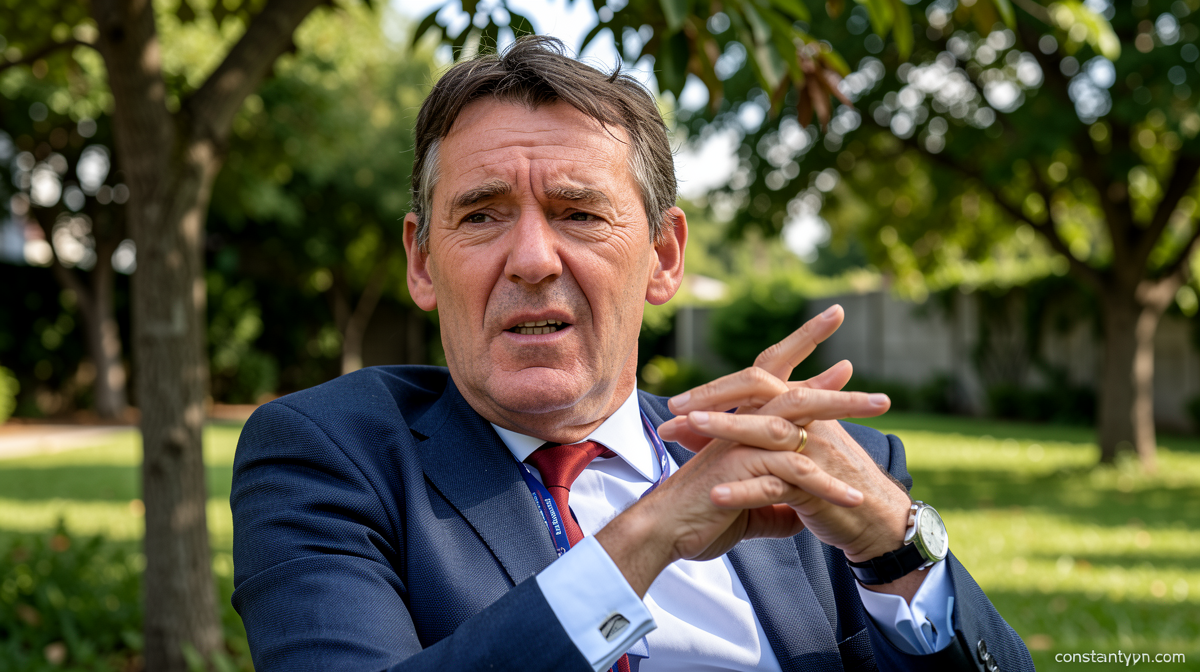
Economist Lord O’Neill Steps Back from Formal Role in Burnham’s Economic Team
Constantvpn.com – Andy Burnham’s newly assembled economic advisory circle lost one of its most prominent names before it ever fully convened. Lord Jim O’Neill, the crossbench peer and former Goldman Sachs chief economist who had been widely expected to anchor the prime minister’s economic strategy, confirmed on Thursday that he will not accept a formal government post. Instead, he intends to remain available as an informal sounding board, preserving both his independence and his existing commercial commitments.
The decision, which had been circulating in financial press circles before being publicly confirmed, carries weight beyond a single personnel choice. Burnham, who took office with a mandate to reshape how the state interacts with regional economies, had reportedly been lining up O’Neill as his principal economic adviser. Losing that candidate at the final stage forces the new administration to recalibrate its top-tier economic staffing while simultaneously signalling that the line between formal ministerial authority and informal expert counsel remains deliberately porous in this government.
Why the Blind Trust Was the Dealbreaker
O’Neill was candid about the practical friction that made a formal role unworkable. Under UK ministerial rules, anyone holding a cabinet-level or senior advisory post must place personal shareholdings into a blind trust, meaning the holder cannot inspect how those assets are managed. For an individual still actively engaged in business ventures, that opacity is not merely an inconvenience; it is a structural constraint on decision-making.
“I’ve decided to not take a formal role. It’s not because of any policy disagreements. I’m a massive fan of the focus on devolution and I hope Andy and his team will be bold on this and everything else.”
He elaborated that he wished to avoid “the constraints of a blind trust and all the constraints that would be necessary,” adding that he was enjoying his current work too much to surrender operational control of his business interests. The remark underscores a broader pattern in recent British politics: senior technocrats and market-economist figures increasingly prefer advisory access without the full regulatory apparatus that accompanies a formal appointment.
A Career Spanning Two Worlds
O’Neill’s résumé straddles the City of London and Whitehall in a way few contemporaries can match. Before entering politics, he spent decades at Goldman Sachs, rising to the position of chief economist and becoming the public face of the bank’s macroeconomic research. It was in that capacity, in 2001, that he popularised the acronym BRIC — an abbreviation for Brazil, Russia, India, and China — to flag a cluster of large, rapidly industrialising economies that he argued would drive outsized investment returns over the following decades. South Africa’s later inclusion expanded the grouping to BRICS, a label now embedded in multilateral diplomatic vocabulary.
His foray into government came later. Between 2015 and 2016, serving as commercial secretary to the Treasury under Chancellor George Osborne, O’Neill helped shape Conservative economic policy at the most senior level. He was a central architect of the Northern Powerhouse initiative, a programme designed to redirect growth, infrastructure investment, and institutional capacity toward England’s northern regions. Having grown up in Greater Manchester, O’Neill brought personal familiarity to the agenda’s ambition of rebalancing a national economy long tilted toward the south-east corridor.
What the Informal Channel Means for Burnham’s Agenda
Burnham’s economic programme places heavy emphasis on devolution — transferring fiscal, regulatory, and planning powers to regional governments so that local conditions, rather than Westminster defaults, determine investment incentives. O’Neill’s public endorsement of that direction, coupled with his willingness to stay in the orbit of the prime minister’s office, suggests the new government will retain access to his analytical judgement without the administrative overhead of a formal appointment.
“I’ll continue to, hopefully, maintain an informal relationship with the PM and his team.”
That arrangement is not without precedent. Successive British governments have drawn on outside economists, former central-bank officials, and industry strategists through advisory panels, think-tank partnerships, and informal briefings. The distinction here is one of proximity: O’Neill’s prior role as a direct adviser to the prime minister’s office, even if now unofficial, places him closer to daily decision-making than a typical external consultant.
Broader Implications for the New Administration
The episode also highlights a staffing challenge unique to Burnham’s government. Coming to power after a period of economic turbulence — elevated borrowing, inflationary pressure, and a fiscal position that demands difficult trade-offs between spending, taxation, and growth — the administration needs credible economic voices both inside and outside the formal structure. O’Neill’s departure from the formal track does not remove his influence; it simply relocates it. Whether that informal channel proves durable, or whether the pressures of a full ministerial workload eventually sever even the loosest advisory ties, remains to be seen.
For the Northern Powerhouse legacy that O’Neill helped build, the question is whether the devolution agenda he endorsed will receive the institutional resources and political will to move beyond rhetoric. His stated hope that Burnham’s team will be “bold” on devolution and “everything else” reads less as a partisan endorsement than as a professional economist’s assessment of where the next decade of British growth strategy must point. The formal title is gone. The advisory relationship, by his own account, is not.
Related Reading
Frequently Asked Questions
What is Burnham economic adviser O Neill rules?
Burnham economic adviser O Neill rules is the main topic of this guide. The article explains the context, practical details, and next steps readers should understand.
Why does Burnham economic adviser O Neill rules matter?
Burnham economic adviser O Neill rules matters because readers are looking for a useful answer, not just a short summary. Good content should match search intent and help them decide what to do next.
