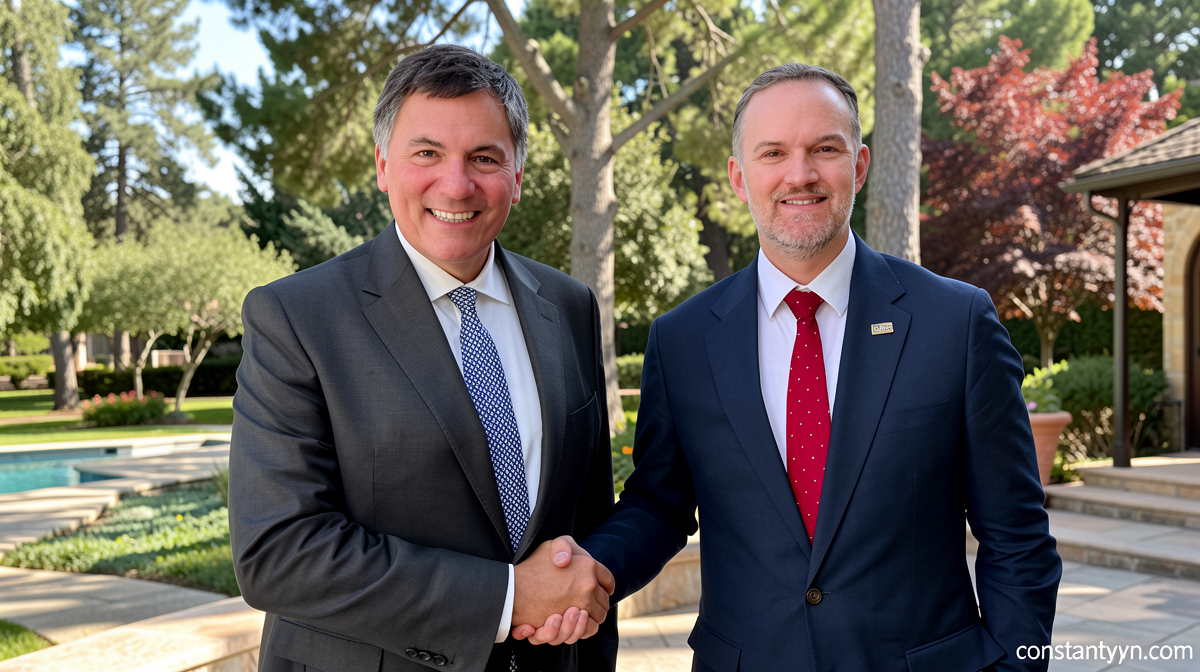
Three Days of Relentless Negotiations Bring Ottawa and Washington to the Brink of a Trade Settlement
Constantvpn.com – After an extraordinary seventy-two-hour sprint of back-to-back talks, Canadian and American trade officials are on the verge of sealing an agreement that both governments are framing as a landmark achievement. President Donald Trump and Prime Minister Mark Carney have each publicly championed the developing deal, with Trump telling audiences it will be embraced by American farmers and factory owners, while Carney insists the framework locks in “the best terms” for sectors Ottawa considers strategically vital and delivers long-term predictability for bilateral commerce.
The urgency of the final round was triggered when Trump suspended a fresh tranche of tariffs he had threatened to impose overnight across a broad swath of Canadian exports. That pause opened a narrow window during which negotiators convened for a third consecutive day of talks on Wednesday, compressing weeks of diplomatic work into a single weekend.
What the Agreement Appears to Cover
Full textual details have not yet been released to the public, but reporting from both sides of the border points to a package touching several high-stakes commodity categories. Canadian steel and aluminium shipments would reportedly see the American tariff rate slashed from fifty percent down to twenty-five percent. Vehicles manufactured in Canada could see the headline US tariff trimmed from twenty-five percent to fifteen percent. On the reciprocal side, American alcohol products would re-enter provincial retail shelves after a year-long boycott.
The timing suggests the deal could be formally concluded as early as Friday, though officials have not confirmed a signature date.
Washington’s Stance
US Trade Representative Jamieson Greer emerged from a forty-five-minute session with his Canadian counterpart and told waiting reporters that the American side was “very happy” and that the arrangement removes “some of the irritants” that had poisoned the bilateral relationship.
“We feel confident that we’ve reached an agreement that will not only continue to protect American workers, American jobs, American supply chains, but really strengthen the North American economy,” Greer said.
He added that he would brief members of Congress and key US industry stakeholders on the specifics in the coming days. Separately, Trump told reporters that Ottawa had agreed to scrap tariffs levied on American agricultural exports, though he declined to identify which farming sub-sectors would benefit. Pressed on whether Washington would reciprocate by easing some of its own levies on Canadian goods, Trump offered only that the reduction would be “a little bit.”
Ottawa’s Position and Provincial Consultations
Carney took to the social platform X on Wednesday to announce that “significant progress” had been achieved and that the two governments were converging on a framework addressing “Canada’s most important strategic sectors.” Later that afternoon, the prime minister convened his cabinet alongside premiers from across the country to walk them through the shape of the emerging deal.
Nova Scotia Premier Tim Houston, speaking after the session, revealed that Carney had asked provincial governments to reinstate US alcohol on store shelves. Houston offered a wry observation about consumer appetite:
“It’s been something that has kind of really bothered the United States for so many reasons. Now, whether Canadians will really buy it when it’s back on the shelf, that’s a whole other discussion.”
The alcohol ban was enacted by most provinces in retaliation for Trump’s tariff escalations of the previous year, making its reversal a politically sensitive concession for Ottawa.
The Dairy Question
Washington has pressed for a series of additional concessions, including the dismantling of Canada’s remaining retaliatory tariffs on American automobiles and a reshaping of dairy import quotas to widen market access for US cheese makers. On Wednesday, Minister LeBlanc was asked directly whether the latest round would yield meaningful dairy openings. His answer was categorical: Canada’s supply-management programme — the regulatory architecture that governs production quotas, pricing, and import ceilings for dairy, eggs, and poultry — would remain “entirely intact.”
The dairy issue has long sat at the centre of Anglophone-Francophone domestic politics and has been a recurring flashpoint in every iteration of North American trade talks since the 1990s. Its preservation in this round signals that Ottawa drew a firm line even as it moved on metals and vehicles.
Public Sentiment and Business Pressure
Opinion polling conducted by Leger indicates that a majority of Canadians would be displeased if the Carney government made substantial concessions to Washington, with fifty-six percent of respondents favouring a hardline negotiating posture. Yet the commercial establishment on both sides of the border has lobbied intensively for a swift settlement, warning that further tariff escalation would inflict damage on supply chains in both economies.
Dennis Darby, president of Canadian Manufacturers and Exporters and a member of Carney’s advisory committee on Canada-US trade, told the BBC he remained optimistic that a finalised text was within reach.
“The committee was informed this morning that the negotiations continue and that and we’re close, and that’s more positive than we’ve seen in some time,” Darby said.
Darby framed the expected deal as a first step toward restoring the tariff-free flows that defined the North American Free Trade Agreement, now known as the United States-Mexico-Canada Agreement (USMCA), under which the vast majority of goods cross the three borders without duty. For manufacturers embedded in integrated regional supply chains — particularly in automotive, aerospace, and agricultural processing — the absence of a stable rules-based framework has meant months of uncertainty over inventory planning, sourcing decisions, and capital investment.
Broader Implications
If the deal is signed by Friday, it will represent the first substantive de-escalation since Trump’s tariff programme began reshaping North American trade flows. The arrangement does not, however, restore the pre-tariff status quo: the twenty-five percent rate on steel and aluminium, even if halved from fifty percent, remains a significant cost layer for downstream fabricators. Likewise, a fifteen percent vehicle tariff, while reduced, still distorts pricing for consumers and complicates just-in-time logistics across the border.
For Canadian provinces, the alcohol question will test whether political goodwill translates into shelf presence. For American dairy producers, the preservation of supply management means continued exclusion from a market they have sought access to for decades. And for the broader North American economy, the deal’s durability will depend on whether both governments treat it as a floor rather than a ceiling — a distinction that will become apparent in the next round of congressional briefings and provincial consultations.
Related Reading
Frequently Asked Questions
What is Canada and US say they are finalising?
Canada and US say they are finalising is the main topic of this guide. The article explains the context, practical details, and next steps readers should understand.
Why does Canada and US say they are finalising matter?
Canada and US say they are finalising matters because readers are looking for a useful answer, not just a short summary. Good content should match search intent and help them decide what to do next.
