Large crowds gather in Tehran on first day of Ayatollah Khamenei’s funeral
Large crowds gather in Tehran on first day of Ayatollah Khamenei’s funeral
Large crowds gather in Tehran on first – Tens of thousands of mourners filled the courtyard of Tehran’s main mosque on Saturday, marking the beginning of a solemn six-day mourning period for Ayatollah Ali Khamenei, Iran’s former supreme leader. His body, laid out in the Grand Mosalla, will remain on display for three days before being moved to a series of symbolic locations across the country. The event is anticipated to draw 15-20 million participants from both Iran and Iraq, underscoring its national and regional significance. This gathering comes more than four months after Khamenei was killed in a coordinated strike by US and Israeli forces, which escalated tensions in the Middle East.
Mourning Begins
The scene outside the mosque was one of quiet reverence, with attendees draped in black, their faces solemn as they filed past the casket. The funeral processions, a blend of tradition and political symbolism, have become a focal point for expressing grief and solidarity with the leadership. As the ceremonies unfolded, chants against the United States and calls for retribution echoed through the streets, reflecting the deep-seated anger over Khamenei’s assassination. Many participants emphasized their unwavering loyalty to the late leader, who was revered as a central figure in Iran’s Islamic regime.
“We came because we promised the supreme leader we would stand by him to the very end,” said Reza, a 37-year-old professor, as he stood in the Grand Mosalla’s courtyard. “For a long time, we shouted that we would sacrifice our lives for the leader, but it was he who sacrificed himself for us.”
Reza’s words captured the sentiment of many present, who saw Khamenei not only as a political leader but as a unifying symbol. The funeral was not merely a religious event; it was a powerful display of national unity, with attendees from all walks of life coming together to honor his legacy. Meanwhile, Arash Rahimi, a 40-year-old participant, voiced the broader determination of the crowd. “Everyone here has come to avenge the blood of their supreme leader,” he told Reuters. “Our leader has said we have a blood feud with the United States. Our relations with them will never be good.”
The Path to Burial
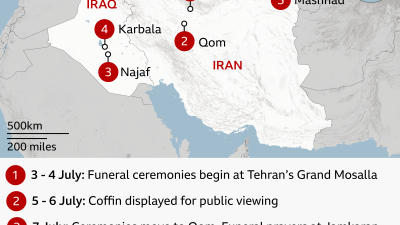
The funeral processions are set to follow a carefully planned route, with Khamenei’s body traveling from Tehran to Qom, a key religious center, before heading to Najaf in Iraq. In Qom, the ceremony will take place at Jamkaran, a site of profound religious importance for Shia Muslims. From there, the body will proceed to the shrine of Imam Ali in Najaf, where it will be honored before moving to Karbala. The final resting place will be the Imam Reza Shrine in Mashhad, Iran’s most important pilgrimage site, where Khamenei is expected to be buried on Thursday.
This multi-day event is designed to maximize public participation and reinforce the regime’s narrative. The first three days will focus on the Grand Mosalla, where Khamenei’s body will be placed alongside the remains of family members killed in the same air strikes. The inclusion of these relatives adds a personal dimension to the mourning, highlighting the collective loss felt by Iran’s leadership and its followers. Central Tehran will be under strict lockdown over the weekend, with roads closed and security heightened to ensure the smooth flow of attendees.
Analysts note that the funeral is more than a tribute to a leader—it is a strategic move to consolidate support for the regime amid ongoing regional conflicts. The large turnout is expected to set a record for the proportion of Iran’s population attending a single event, underscoring the cultural and political weight of the ceremony. As the procession continues, the message is clear: the loss of Khamenei has galvanized a nation determined to hold the US accountable.
A Nation in Grief
The impact of the funeral on Iranian society is profound. For many, it represents a moment of catharsis after months of political turmoil and military confrontations. The mourning period, spanning 40 days, will see nationwide commemorations, with events planned to mark the first anniversary of Khamenei’s burial. This extended period of remembrance is intended to solidify his place in history as a leader who guided Iran through critical moments of regional strife.
The US has been a central target of the mourning, with participants framing the funeral as a step toward retaliation. President Donald Trump’s comments, including his remark about granting Iran a “week off for a funeral,” have added to the tension. While the remark was lighthearted, it highlighted the ongoing diplomatic battle between the two nations. The funeral has also become a platform for reaffirming Iran’s stance against US influence, with chants and slogans echoing the determination of the Iranian people.
As the ceremonies progress, the role of the Islamic regime’s supporters remains central. The presence of thousands in the streets of Tehran and other cities across Iran demonstrates their commitment to the late leader’s vision. The funeral is not just a moment of grief but a reaffirmation of loyalty to the system that Khamenei built. His assassination in late February marked a turning point, and the funeral processions are now a way to honor that legacy.
“We have a blood feud with the United States,” Arash Rahimi, 40, told Reuters. “Our relations with them will never be good.”
With the funeral processions, Iran is signaling its readiness to escalate tensions further. The ceremonial route through key religious and political sites is symbolic, reinforcing the idea that the US and its allies are the primary adversaries. The nation’s response has been one of unity, with attendees expressing a shared sense of loss and purpose. For those who have been following Khamenei’s leadership, the funeral is a testament to his enduring influence.
The Successor’s Uncertain Role
Khamenei’s passing has also raised questions about his son, Mojtaba, who now holds the title of supreme leader. Since assuming the role, Mojtaba has been largely absent from public view, prompting speculation about his health and readiness to lead. Whether he will appear at the funeral is a key point of discussion, as his visibility could impact the perception of his leadership. The transition from Khamenei to Mojtaba marks the end of a long era of centralized authority, and the new leader’s ability to maintain the same level of influence will be closely watched.
Despite the uncertainty surrounding Mojtaba’s presence, the funeral processions are expected to proceed as planned. The event’s scale and the emotional weight of the moment will likely overshadow any concerns about the succession. However, the absence of the new leader may lead to questions about the continuity of Khamenei’s policies and the stability of the regime. As the ceremonies unfold, the focus will remain on honoring the past while setting the stage for the future.
Ultimately, the funeral of Ayatollah Ali Khamenei is a moment of profound significance for Iran. It serves as both a tribute to a revered leader and a rallying cry for the nation’s aspirations. With millions expected to participate, the event will leave a lasting impression, cementing Khamenei’s legacy and reaffirming the resolve of those who mourn his loss. The path to his burial, marked by reverence and determination, is a testament to the enduring impact of his leadership on the Iranian people and their aspirations for the future.
