‘Absolute madness’: Row over plan to demolish Nazi bunker under Berlin
‘Absolute Madness’: Row Over Plan to Demolish Nazi Bunker Under Berlin
Historical Debate Heats Up in Berlin’s Urban Development Plans
Absolute madness – In the heart of Berlin, a contentious discussion has emerged regarding the demolition of a significant piece of Nazi-era architecture. The bunker, a last-standing relic of Adolf Hitler’s power hub, is set to be dismantled as part of a proposed redevelopment project. This decision has sparked fierce debate, with local historians and preservationists arguing that the structure holds vital historical value, while city officials see it as an obstacle to modern urban expansion.
A Symbol of Nazi Rule and War’s End
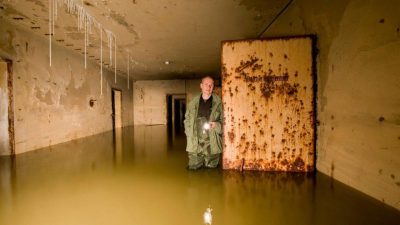
Once a central hub of Nazi governance, the New Reich Chancellery—designed by Hitler’s favored architect Albert Speer—was heavily damaged during the final days of World War Two. Following the war, Soviet forces ordered its destruction in 1949, leaving only the bunker intact. Today, this structure stands in a neglected stretch of wasteland, a stark reminder of the regime’s legacy. Dietmar Arnold, a prominent member of the Berlin Underworlds Association, has been vocal in his defense of the site, emphasizing its role as a key location in the Nazi hierarchy.
“It is a site of the perpetrators,” Arnold remarked in a recent interview with the BBC. “It was the power centre of Nazi Germany, Hitler’s New Reich Chancellery, and these are the last remains. To tear it down would be ‘absolute madness’.” His comments highlight the emotional and symbolic weight of the bunker, which he believes should be preserved as a museum and memorial space.
Arnold’s vision includes collaborating with the Holocaust Museum to transform the site into an educational exhibit about the war’s conclusion. He stresses that the bunker’s preservation would counteract the loss of historical memory in Germany, where both Nazi and Communist legacies have faced erosion over time. “So much history has been destroyed here in Germany, both Communist history and Nazi history. We can’t keep doing that,” he added, underscoring the importance of maintaining tangible links to the past.
Urban Expansion vs. Historical Preservation
Berlin’s Housing Senator, Christian Gaebler of the SPD, supports the demolition, arguing that the bunker no longer serves a practical purpose in the city’s evolving landscape. “We are not standing in the way of new housing developments just to preserve a bunker that might then even become a place of pilgrimage,” Gaebler stated to the BZ newspaper. His perspective reflects a growing priority for infrastructure and residential growth in the city.
The proposed development would replace the bunker with residential and commercial spaces, a move that critics view as a betrayal of historical responsibility. However, Gaebler and other officials contend that the structure is an outdated remnant that could be removed without compromising the city’s cultural identity. The debate has intensified as developers push for the project, while preservationists rally to protect the site.
“We are not standing in the way of new housing developments just to preserve a bunker that might then even become a place of pilgrimage,” said Gaebler, highlighting the tension between modernization and historical commemoration. His stance contrasts sharply with Arnold’s, who insists that the bunker’s physical presence is crucial for understanding the era’s atrocities.
Structure’s Condition and Potential for Reuse
Arnold’s advocacy is rooted in the bunker’s remarkable state of preservation. During his 2007 visit, he noted that the site remained in excellent condition, with 1,200 square meters of the complex still intact. The walls and ceiling, each over 1.7 meters thick, are described as robust enough to support construction on top of them without requiring full demolition. This detail has fueled discussions about the feasibility of repurposing the structure while maintaining its historical integrity.
While the bunker is not the more famous Führerbunker, where Hitler and Eva Braun committed suicide in 1945, it holds its own significance. The current site, located approximately 120 meters to the south, was used by staff of the Reich Chancellery and later became a temporary hospital after the war. This dual role as a site of power and healing adds layers to its historical narrative, making its preservation a matter of broader interest.
Historical Value Recognized by Experts
Despite the push for demolition, the Berlin State Monuments Council has voiced strong opposition to the plan. Last year, the council declared that the bunker possesses “significant historical value,” citing its role as the planning center for World War Two and its symbolic connection to the Nazi regime’s collapse. They recommend a thorough assessment of its preservation status and potential as a historic monument by the State Office for the Preservation of Historical Monuments.
The council’s concerns align with those of many historians who argue that the bunker offers a unique insight into the final days of Nazi Germany. As the last surviving part of the New Reich Chancellery, it serves as a physical archive of the era’s political decisions and military strategies. Its destruction would not only erase a tangible piece of history but also diminish the city’s ability to educate future generations about the Holocaust and World War Two.
Photographic Evidence and Broader Context
A famous image captures the moment German General Helmuth Weidling emerged from the bunker in May 1945, symbolizing the end of the Nazi regime. This photograph, often cited in historical discussions, underscores the bunker’s role as a witness to pivotal events. The presence of such visual records adds weight to the argument for its preservation, as they provide a direct link to the past.
The controversy also reflects a larger trend in Berlin’s approach to historical landmarks. As the city modernizes, decisions about which sites to keep and which to remove have become increasingly contentious. The bunker’s demolition raises questions about the balance between progress and remembrance, with many fearing that its loss would deepen the historical amnesia that has plagued post-war Germany.
Architects and historians have proposed alternative solutions, such as integrating the bunker into the new development or using it as a cultural center. These ideas aim to honor the site’s legacy while accommodating contemporary needs. However, the challenge lies in ensuring that the bunker’s historical narrative remains intact amid structural changes.
Legacy and Future Implications
The debate over the bunker’s fate highlights the complexities of preserving history in a rapidly changing urban environment. While some see it as an outdated relic, others view it as a vital symbol of the Nazi era’s enduring influence. The decision to demolish or save the site could set a precedent for how Berlin handles its historical heritage, influencing similar projects across the city.
As the proposal moves forward, the outcome will depend on negotiations between developers, city officials, and preservation advocates. The bunker’s fate remains uncertain, but its significance—both as a physical monument and a historical narrative—continues to spark passionate discourse. Whether it is preserved or removed, the site’s story will endure as a testament to the power of architecture in shaping memory and identity.
Additional context from the BBC’s coverage reveals that the bunker’s potential demolition is part of a broader trend of transforming historical sites into functional spaces. This includes plans to convert Hitler’s old home into a police station and other projects that recontextualize the past within the framework of the present. Such initiatives, while pragmatic, have drawn criticism for prioritizing modernity over historical preservation.
