Fifa seeks explanation over VAR official’s hand gesture
Fifa Investigates VAR Official’s Controversial Hand Gesture
Constantvpn.com – The International Football Federation (FIFA) has raised questions about a seemingly innocuous hand gesture made by video assistant referee Shaun Evans during the World Cup match between Germany and Curacao. The incident, captured during the pre-match routine, sparked immediate debate as the gesture was interpreted by some as a symbol of white supremacy. Evans, who was part of the VAR team stationed in Dallas, was seen making an upside-down “OK” sign with his right hand while standing near the touchline. This simple motion, typically used to indicate agreement or approval, has taken on a more complex meaning in recent years, particularly within far-right circles.
Pre-Match Rituals Under Scrutiny
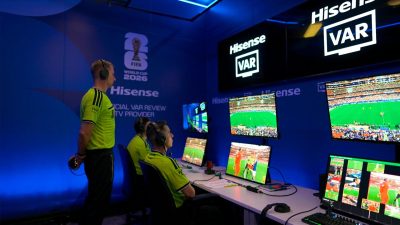
As part of its global coverage strategy, FIFA has been highlighting officials in the world feed during pre-match ceremonies. This includes a brief display of their names and roles on the screen before the game begins. Referees and their assistants traditionally walk to the touchline, where they are showcased alongside a graphic featuring their identities. Following this, the camera shifts to the VAR team at the referee hub in Dallas, where they are usually shown monitoring the action. However, in the past, the VAR officials would occasionally pose for the camera, with their names appearing on screen. This routine changed after the Germany-Curacao game, with the VAR team opting to face the monitors instead of the camera in subsequent matches.
Evans’ gesture occurred during one of these pre-match segments. While the camera focused on the VAR team, he was observed standing with his arm by his side before making the distinctive upside-down “OK” sign. This raised eyebrows, as the symbol is now associated with far-right groups. The Anti-Defamation League (ADL) added the sign to its list of hate symbols in 2019, noting its use by white supremacist organizations as a form of communication. The gesture, in which the hand is positioned below the waist and the fingers are curled inward, has also been linked to a playful prank known as the “circle game,” popularized in the US sitcom *Malcolm in the Middle* and later embraced as an internet meme.
Social Media Reaction and Calls for Clarification
The gesture quickly became a focal point on social media, with fans and analysts speculating about its implications. Some interpreted it as a harmless moment, while others saw it as a subtle nod to racial ideologies. BBC Sport has sought clarification from FIFA multiple times but has yet to receive an official statement. However, sources indicate that FIFA is actively investigating the matter, particularly targeting Evans, who is an Australian official. The organization has also reached out to the Fare network, which collaborates with FIFA and UEFA to combat racism, to seek further insight.
“Advice from our experts is that the gesture used clearly resembles an upside-down ‘OK’ hand symbol used as a ‘white power’ symbol in global far-right circles,” Fare stated in a recent release.
Evans, 38, has been on FIFA’s referee list since 2017. He is a seasoned VAR official, having been appointed to oversee matches at the 2022 World Cup in Qatar. In Australia, he has officiated in the A-League since 2012, including the Grand Final in 2019. Despite his experience, the gesture has cast doubt on his neutrality, prompting discussions about the role of VAR officials in representing the sport’s values.
Context of the Gesture in Sports and Culture
The upside-down “OK” sign has a dual significance, with one interpretation being a playful gesture and the other tied to racial symbolism. The ADL highlighted this in 2019, noting that the sign has become a “popular trolling tactic” among right-leaning individuals. Social media users have increasingly posted images of themselves making the gesture, often in a casual or humorous context. However, its adoption by far-right groups has led to greater awareness of its potential to convey divisive messages.
While the gesture itself is not inherently offensive, its appearance during a high-profile international match has amplified its impact. FIFA’s decision to include the VAR team in the world feed during pre-matches underscores its effort to maintain transparency and visibility for officials. Yet, this moment of exposure also brought scrutiny to Evans’ actions. The change in the VAR team’s behavior after the Germany-Curacao game—where they no longer posed for the camera—suggests a conscious effort to avoid controversy.
Broader Implications for FIFA and the World Cup
The incident has prompted reflection on how FIFA and other governing bodies manage the image of their officials. With the World Cup serving as a global stage, any perceived association with extremist symbols can have lasting effects. The Fare network, which works alongside FIFA and UEFA to address discrimination, has emphasized the importance of clear communication in such cases. “We are committed to ensuring all symbols used by officials are understood in their intended context,” a Fare representative added in a statement.
Additionally, BBC Sport has learned that Kick It Out, a UK-based anti-discrimination organization, has also written to FIFA seeking clarification. The group has long advocated for inclusivity in football, and this gesture has reignited conversations about the sport’s role in combating prejudice. While the upside-down “OK” sign is not the only symbol with racial connotations, its presence in a FIFA-sanctioned event has drawn attention to the need for vigilance in on-field conduct.
The VAR team’s decision to avoid posing for the camera in the three games following the incident indicates a shift in protocol. This change, while seemingly minor, reflects FIFA’s sensitivity to public perception and its desire to minimize any potential for misinterpretation. Nonetheless, the controversy highlights the growing influence of social media in shaping narratives around sports events, often turning a single moment into a broader cultural discussion.
VAR Teams in Focus
- The Netherlands v Japan VAR team
- The Ivory Coast v Ecuador VAR team
- The Sweden v Tunisia VAR team
As the World Cup progresses, the role of VAR officials continues to evolve. Their presence in the referee hub and their interactions with the camera have become part of the matchday experience. However, the upside-down “OK” gesture has introduced an unexpected layer of complexity. While FIFA has not yet provided an official explanation, the incident has prompted a review of the pre-match rituals and their cultural implications. The organization’s response will likely shape how such gestures are perceived in future matches, both on and off the field.
The World Cup has also seen the emergence of other tactical trends, such as the use of false nines and the 4-4-2 formation, which have influenced the way teams approach the game. Alongside these developments, the debate over symbolic gestures has added another dimension to the tournament. As fans continue to engage with the event, the importance of clear communication and representation in football remains a critical topic. The upside-down “OK” sign, once a simple hand movement, now serves as a reminder of how even small actions can carry significant meaning in the context of global sports.
Additional Coverage
For more insights, BBC Sport offers a range of resources, including its new World Cup predictor game, updates on fixtures and group standings, and guides on how to watch the tournament on the BBC. These tools aim to enhance the viewer experience while keeping the focus on the evolving dynamics of the competition. The gesture by Evans, though brief, has become a symbol of the broader conversations surrounding football’s role in promoting inclusivity and equality.
