Sudan war: Why Hemedti’s legitimacy push in Uganda falters amid RSF atrocities
Sudan War: Why Hemedti’s Legitimacy Push in Uganda Falters Amid RSF Atrocities
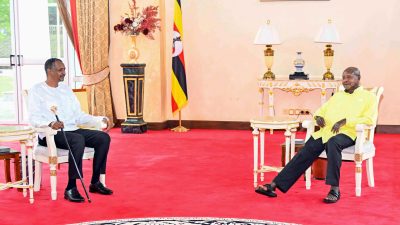
On 20 February, Mohamed Hamdan Dagalo, commander of Sudan’s Rapid Support Forces (RSF)—commonly known as Hemedti—landed in Kampala, Uganda, meeting with President Yoweri Museveni. This marked Hemedti’s most prominent diplomatic outreach beyond Sudan’s borders in recent months.
The visit occurred shortly after a UN investigation uncovered RSF involvement in genocide in Darfur, while the U.S. sanctioned three RSF officials for their actions in el-Fasher. It came amid ongoing global criticism of the RSF’s role in atrocities, including a December 2023 U.S. ruling classifying their actions in Darfur as ethnic cleansing and multiple Security Council resolutions throughout 2024.
Accompanied by allies from the Tasis movement—a political framework he helped establish in Nairobi—the RSF leader aimed to present a civilian-led administrative model for his forces’ territories. The initiative failed to secure broad Sudanese political support and was largely rejected by governments, regional bodies, and international organizations, including the UN.
Sudan’s government criticized Uganda’s reception of Hemedti, framing it as an affront to the Sudanese populace and global humanity. By hosting him, Kampala must be viewed as more than a courtesy gesture; it represents a recalibrated bid for regional recognition.
The RSF now holds administrative authority over areas under its control, fostering the development of alternative governance systems parallel to state institutions. This evolution raises concerns about Sudan’s potential fragmentation into de facto regions.
The timing of the visit signals a strategic shift, positioning Hemedti beyond combat zones and domestic audiences to leverage a regional platform for influence. His presence in Kampala underscores a broader effort to shape narratives, cultivate allies, and assert legitimacy beyond national borders.
His assertion that RSF strength now exceeds 500,000 soldiers aims to bolster internal morale, reassure backers, and assert the group’s role in Sudan’s future.
Despite accusations of mass abuses, Hemedti’s rhetoric emphasizes unity and opposition to partition, framing the conflict as a struggle against Islamist networks. His speech in Uganda also highlights a commitment to dialogue, positioning the RSF as a viable force for civilian-led political processes.
Yet, the commander of a force accused of widespread abuses now promotes democratic ideals while overseeing a political structure separate from recognized state institutions. The contradiction reveals a deeper challenge: how can a paramilitary group seeking legitimacy avoid surrendering military autonomy?
Analysts at the International Crisis Group have consistently warned that Sudan’s conflict has evolved into a battle over sovereignty claims, with dual authority dynamics in African wars often leading to entrenched fragmentation. The Kampala visit serves dual purposes—image rehabilitation under international scrutiny and diplomatic normalization of the RSF as a legitimate political actor on par with the state.
Uganda was chosen strategically, as Museveni has long championed “African solutions to African problems,” and the country maintains a neutral stance within the Horn and East African diplomatic spheres. Hosting Hemedti elevates Kampala’s profile as a potential interlocutor without binding it to one Sudanese camp.
The visit links to broader mediation efforts involving the African Union and the Intergovernmental Authority on Development (Igad), yet Museveni’s engagement with Hemedti requires careful balancing to avoid entanglement with any single Sudanese faction.
