Woman has pioneering womb surgery to fix ‘miracle’ baby with intestines outside its body
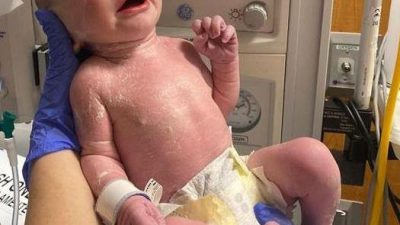
Unborn Baby Receives Groundbreaking Womb Surgery for Rare Intestinal Condition
Constantvpn.com – A remarkable medical achievement has been accomplished as doctors successfully performed pioneering surgery on an unborn child to correct a serious birth defect while the baby remained safely inside the womb. The five-month-old infant, named Theo, is now thriving following the extraordinary procedure that took place while his mother was 26 weeks pregnant.
Maisie Savage, a 29-year-old teacher from London, underwent the operation in the United States alongside her husband, Josh French, also a 29-year-old teacher. Theo was diagnosed with gastroschisis, a condition in which the belly button fails to develop correctly, resulting in the intestines growing outside the body rather than within the abdominal cavity.
A Journey Across Continents
The family’s path to this groundbreaking treatment began when they discovered something was wrong during a routine 20-week scan. Josh French recalled their excitement at simply seeing an image of their unborn child, noting they had not yet learned the baby’s gender at that point. The diagnosis of gastroschisis came as a shock and proved “incredibly scary” for the expectant parents.
At 24 weeks of gestation, specialists at London’s Great Ormond Street Hospital prepared Maisie and Josh for the challenging months ahead. However, when doctors identified that Theo had the more severe form known as complex gastroschisis, they made the critical decision to refer the family to Texas Children’s Hospital in Houston.
Before the main surgery, Maisie traveled to Leuven Hospital in Belgium, where medical specialists administered a Botox injection through her womb into Theo’s abdominal wall. This treatment helped relax the muscles, making the subsequent repair procedure significantly easier to perform.
The Pioneering Procedure
The family then flew to Texas, where the operation took place in November of last year. Dr. Michael Belfort, the clinical lead on this first-of-its-kind trial, directed a team of foetal and paediatric surgeons. Belfort had previously pioneered a similar in-womb surgical approach for babies suffering from spina bifida.
During the procedure, doctors partially exposed Maisie’s womb to properly position the uterus and baby. The amniotic fluid was carefully drained and replaced with carbon dioxide gas, which expanded the operating space. Using keyhole surgery techniques, the medical team gently pushed Theo’s organs back inside his abdomen before stitching the area closed.
Maisie emerged from the operation with a scar twice the size of a typical C-section incision. Unlike other mothers recovering from such surgery, she still had 14 weeks of pregnancy remaining. She described the recovery as difficult, noting that Theo would frequently kick inside her, sometimes hitting her scar and causing pain. “It was a hard recovery,” Maisie explained. “But, it was worth it.”
Remarkable Outcomes
The surgery proved to be a complete success. Theo was carried to full term and born via vaginal delivery in Texas in February. Theo became the first British baby to receive this type of womb surgery specifically for complex gastroschisis, and he was only the third child worldwide to benefit from this clinical trial.
Gastroschisis affects approximately one in 3,000 babies in the UK each year. While some infants require only weeks in intensive care with nutritional support through tubes or IVs, complex cases like Theo’s demand far more extensive treatment. These babies may spend up to six months in neonatal intensive care, undergo multiple surgeries, receive IV nutritional feeding for as long as two years, and potentially require an intestinal transplant. Even with the highest standard of medical care, one in ten babies with this condition will not survive.
“The mother, the baby, the surgery, the time of the surgery, the fact that we had zero complications during the foetal surgery and after the foetal surgery, just remarkable,” said Dr. Belfort, who serves as obstetrician and gynaecologist-in-chief at Texas Children’s Hospital.
Maisie and Josh expressed their profound relief at the successful outcome. “He’s a little miracle, isn’t he?” Maisie told BBC News. The couple acknowledged that things could have turned out very differently, but they are grateful for the pioneering medical team that gave Theo the best possible start in life.
“The length of that day, it felt like a week,” Josh said of the surgery. “The waiting and just not knowing exactly what was going on at each and every stage.”
If this clinical trial continues to show positive results, it could transform treatment options for families facing similar challenges. Paolo de Coppi, professor of paediatric surgery, has indicated that the potential for this procedure to become a standard treatment option is significant, offering hope to thousands of families worldwide who face the diagnosis of complex gastroschisis.
Related Reading
Frequently Asked Questions
What is Woman has pioneering womb surgery to fix?
Woman has pioneering womb surgery to fix is the main topic of this guide. The article explains the context, practical details, and next steps readers should understand.
Why does Woman has pioneering womb surgery to fix matter?
Woman has pioneering womb surgery to fix matters because readers are looking for a useful answer, not just a short summary. Good content should match search intent and help them decide what to do next.
