
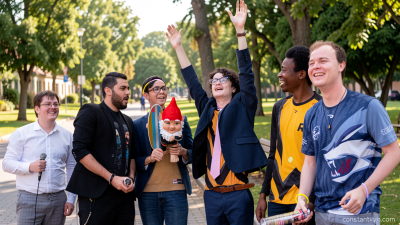
£2,000 a Year to Compete in Video Games While Studying: Inside Roehampton’s Esports Scholarship Scheme
Constantvpn.com – While most families across Britain brace themselves for the financial strain of sending a child to university, a growing number of young gamers are discovering that their competitive gaming skills can translate directly into tuition relief. The University of Roehampton has handed out more than 100 esports scholarships to date, each worth £2,000 per year, allowing recipients to pursue degrees without the usual scramble for part-time income. The programme, which opened its doors to both undergraduate and postgraduate applicants, has quietly become one of the most distinctive financial-aid routes available to UK students.
The timing of the scheme’s expansion coincides with a broader national conversation about the cost of living. Millions of pounds in scholarships and bursary funding go unclaimed every academic year simply because prospective students do not know they qualify. Against that backdrop, Roehampton’s initiative stands out not only for its subject matter but for the sheer accessibility of its application pathway.
What Counts as Esports, and What Does the Scholarship Actually Require?
Esports — short for electronic sports — refers to organised, competitive video gaming conducted before live or broadcast audiences, complete with tournament brackets, cash prizes, and trophies. It differs from casual home gaming in scale, structure, and spectatorship, functioning much closer to traditional sport than to a solitary hobby. Roehampton’s scholarship is aimed squarely at students who can demonstrate excellence in this competitive arena while simultaneously maintaining academic progress.
Applicants must meet minimum ranking thresholds in recognised titles. However, the university does not apply a rigid cut-off: candidates who fall slightly short of the ranking requirement may still be considered if they satisfy alternative criteria, such as commanding a substantial following on streaming platforms like Twitch. Recipients are expected to compete in weekly university-organised tournaments and to represent the institution at external in-person events throughout the academic year.
“This scholarship is about recognising talent in a field that has a growing popularity both around the world and among our students.” — Mark Ellul, registrar, University of Roehampton
From £1,500 to £2,000: How the Award Grew
The scholarship did not arrive at its current value overnight. When the programme first launched, the annual stipend stood at £1,500. As Roehampton’s competitive teams — including its Overwatch squad, which claimed the Team of the Year title in 2022 — climbed the national rankings and attracted larger audiences, the university raised the award to £2,000 to keep pace with the rising profile of its esports programme.
Cameron Dray, a former recipient, first learned of the scheme after reading about analogous initiatives at American universities. He investigated whether anything comparable existed in Britain and found Roehampton’s offer. For him, the financial impact was decisive.
“This money was crucial to me as it gave me the opportunity to study in a very expensive city without the need for part-time work.”
“There were requirements that came alongside the scholarship, but none that were unexpected or not transparent when applying.”
Dray urged fellow students to exhaust every available funding route before assuming they must shoulder the full cost of their education.
“Many of these funds are available to more students than they realise, and everyone should be taking full advantage.”
The Debt Context: Why Even £2,000 Matters
The average English graduate now leaves university carrying debts exceeding £47,500. In that landscape, a recurring annual stipend of £2,000 may seem modest, yet it can eliminate the need for a part-time job during term, freeing up hours that would otherwise be spent on shifts rather than revision. Over a three-year degree, the cumulative effect approaches £6,000 — a meaningful dent in a debt burden that compounds with interest.
Player Perspectives: Gaming as Academic Catalyst
Thomas Cole, a competitive gamer known by the handle “Pac” and specialising in the racing title Trackmania, views university esports scholarships as a double-edged incentive. On one hand, the financial relief lowers the stress that can erode academic performance. On the other, the expectation of representing the institution sharpens competitive focus.
“Uni students being paid to play a game alongside doing their studies, it’s definitely cracking. If I had gone to uni, I would have loved that.”
“If it doesn’t let the academic side suffer, then I think being offered something like that really spurs on people to be better in gaming.”
The Awareness Gap: Why Most Funding Sits Unused
Tom Allingham, a student-money specialist associated with the personal-finance site Save the Student, advises incoming first-years annually to research every scholarship and bursary their institution offers before accepting a standard loan package. His central observation is that the problem is not scarcity of funds but scarcity of knowledge about them.
“Unfortunately, I don’t think there is enough awareness on scholarships.”
“There is a lot of funding that goes unclaimed because students don’t know that they’re eligible for it.”
Save the Student maintains a public directory of scholarships and bursaries, aiming to close the information gap between available money and the students who could legitimately claim it. The organisation’s messaging emphasises that extra funding exists for a wide spectrum of circumstances — academic merit, sporting achievement, creative output, and, increasingly, competitive gaming excellence.
What Comes Next
As esports continues to professionalise and as university sports departments expand their competitive rosters, the Roehampton model — pairing a modest annual stipend with structured competitive obligations — is likely to attract imitation from other institutions. For the student who can hold a top-500 ranking in a major title while keeping a 2:1 in their degree, the calculus is straightforward: the scholarship converts a skill already in hand into tangible financial relief, and the weekly tournament schedule ensures the competitive edge never goes stale.
Related Reading
Frequently Asked Questions
What is Why students are being paid 2 000?
Why students are being paid 2 000 is the main topic of this guide. The article explains the context, practical details, and next steps readers should understand.
Why does Why students are being paid 2 000 matter?
Why students are being paid 2 000 matters because readers are looking for a useful answer, not just a short summary. Good content should match search intent and help them decide what to do next.