
Four Dead at Iranian Wedding After US Missile Strike in Southern Province
Constantvpn.com – A US missile struck a building in southern Iran during a wedding celebration, killing four people including a child, according to the Iranian Red Crescent Society. The attack came amid a sharp escalation in hostilities between Washington and Tehran, with Iran launching waves of missiles and drones at American military targets spread across the Middle East after US forces resumed their campaign of strikes against Iranian positions.
The human toll of the strike has drawn immediate attention because of the setting: a gathering of family and friends celebrating a marriage. In Iranian culture, weddings are among the most significant communal events, drawing extended relatives, neighbours, and community members into a single space for days of feasting, music, and ceremony. A missile impact at such a gathering transforms a private joy into a public grief, and the loss of a child among the dead has intensified scrutiny over how the strike was planned and executed.
Iran’s retaliatory salvo
In the hours following the resumed American strikes, Iran fired missiles and drones at US military installations throughout the region. The breadth of the Iranian response — targeting multiple locations simultaneously — reflects Tehran’s effort to demonstrate that its long-range strike capability remains operational and that American forces anywhere in the theatre face a credible threat. The salvo also served as a political signal to domestic audiences, reinforcing the narrative that Iran is not merely absorbing punishment but actively imposing costs on its adversary.
US military explanation
The American military acknowledged awareness of the reports surrounding the wedding strike. In its public statement, the Pentagon maintained that it does not target civilians and explained that the strikes were directed at Iranian military objectives in response to what it described as:
“recent attempted attacks” on American forces and commercial shipping in the Strait of Hormuz.
The Strait of Hormuz is the narrow waterway through which roughly one-fifth of the world’s daily oil supply passes. For years, both sides have accused each other of provocative actions in the corridor: Iran has used fast-attack craft, mines, and drones to harass tankers, while the US Navy has conducted patrols and escort operations to keep the lane open. The framing of the strikes as a reaction to “attempted attacks” positions the American campaign as defensive, even as it inflicts damage on Iranian soil.
Independent verification of the impact
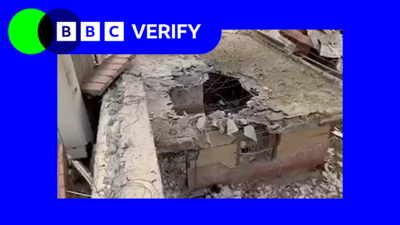
Footage released showing the aftermath of the strike was subjected to independent verification. Analysts examined the video for consistency with a direct missile impact, looking at crater geometry, debris scatter patterns, and structural failure modes of the building. Separately, a weapons specialist was consulted to identify munition remnants visible in the imagery — fragments of casing, propellant residue, and guidance-system components that can distinguish one class of ordnance from another. This kind of forensic analysis helps establish whether the weapon that struck the site matches the type the US military says it employed, and whether the impact point aligns with the coordinates of a declared military target or falls short of them.
The verification process matters because, in fast-moving conflicts, both sides release imagery within minutes of an event. Without independent examination, footage can be misread, selectively framed, or misattributed. Confirming the nature of the munition and the geometry of the blast provides a factual baseline against which official statements can be measured.
Broader context of the confrontation
The exchange sits within a longer arc of US-Iran military tension that has cycled through near-war episodes since 2019, including the downing of a US surveillance drone over Iranian airspace, the sinking of a British tanker in the Strait of Hormuz, and the US assassination of General Qasem Soleimani in Baghdad. Each episode has raised the question of whether the two powers are locked into a pattern of tit-for-tat strikes that escalates incrementally toward a wider war, or whether both sides retain enough restraint to keep the conflict contained.
The current round differs in that American forces have resumed sustained strikes rather than conducting single punitive sorties. Iran’s decision to answer with a multi-target missile and drone barrage, rather than a single retaliatory shot, suggests it views the American resumption as a qualitative shift in intensity and is calibrating its response accordingly.
What the civilian toll implies
When a strike kills civilians at a social event, the political calculus on both sides changes. For Tehran, the deaths provide a ready-made narrative of American aggression aimed at ordinary Iranians, reinforcing public support for continued resistance. For Washington, the Pentagon’s insistence that it “never targets civilians” must now be tested against the forensic record: if the munition remnants and blast geometry indicate the weapon was aimed at a military installation adjacent to the wedding venue, the question becomes one of collateral-damage calculation. If the impact point was closer to the celebration than to any declared target, the explanation grows harder to sustain.
The four dead — three adults and one child, per the Red Crescent’s count — will be mourned in a country where state media and social networks amplify every casualty into a symbol. Their deaths are unlikely to be absorbed quietly into the broader conflict narrative. They will be named, photographed, and invoked in speeches, and they will shape how Iranians understand the purpose and proportionality of the American campaign now underway.
As both sides continue to trade fire across the region, the central question for observers is whether the next round of strikes will be measured by military necessity alone, or whether the memory of a wedding hall in southern Iran will impose a constraint on targeting choices that no briefing document can fully anticipate.
Related Reading
Frequently Asked Questions
What is What we know about reported strike?
What we know about reported strike is the main topic of this guide. The article explains the context, practical details, and next steps readers should understand.
Why does What we know about reported strike matter?
What we know about reported strike matters because readers are looking for a useful answer, not just a short summary. Good content should match search intent and help them decide what to do next.