
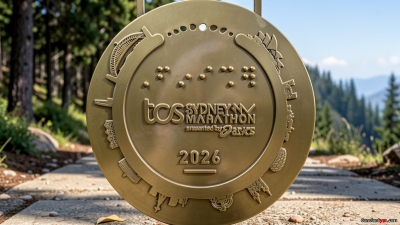
Sydney Marathon Embraces Its Most Unintended Trophy Design
Constantvpn.com – When the Sydney Marathon unveiled its finisher medal earlier this week, runners and spectators expected the usual celebration of local landmarks. What they got instead was a small architectural mix-up that turned a routine pre-race announcement into a viral moment of good-natured confusion. The medal’s engraving featured the silhouette of Munich’s Allianz Arena in the lower-right corner rather than the similarly named Allianz Stadium that anchors Sydney’s Olympic Park precinct. Organisers responded not with a retraction but with a shrug and a joke: they were, in their words, not going to run from it.
“A little too much international flavour has found its way onto the back of the finishers medal, with an incorrect depiction of the stadium.”
The spokesperson for the event called the slip “an unfortunate error” but made clear that no corrected version would be produced. Every runner crossing the finish line on race day would receive the same piece of metal bearing the wrong city’s skyline.
Two Arenas, Two Very Different Faces
The confusion is understandable given the shared “Allianz” branding, but the two structures look nothing alike once you know what to look for. Munich’s Allianz Arena, home of Bayern Munich and the German national team, is wrapped in a lattice of thousands of diamond-shaped, air-inflated cushions that glow red or white depending on which side is playing. Sydney’s Allianz Stadium, by contrast, presents a comparatively flat, angular profile softened by long bronze-coloured fins running vertically along its exterior. Anyone familiar with either building could spot the swap within seconds, and social media users did exactly that within hours of the design going public.
The rest of the medal’s front face, however, is unmistakably Sydney. The Opera House and the Harbour Bridge appear as recognisable landmarks along the 42.2-kilometre (26.2-mile) course that runners will traverse. The juxtaposition of correct local icons beside an imported Bavarian stadium gave the piece an almost surreal quality, as though a travel brochure had been accidentally laminated onto a city-identity token.
Munich Joins the Laughter
The stadium itself in Munich did not sit quietly on the sidelines. Its official Instagram account weighed in with a playful post, acknowledging the coincidence with characteristic self-awareness.
“Oh wow, we didn’t have that on our bingo card!”
The caption went on to riff on the shared architectural pedigree: “Perhaps they tried to find something else they had in common: Allianz Arena – Sydney Opera – Unique Architecture – Both are worth a visit!” The exchange underscored how quickly a production mistake can become a lighthearted cross-continental conversation, with neither city’s fans left feeling slighted.
The Reverse Side: A Separate Artistic Statement
While the front face generated headlines, the medal’s reverse carries a far more deliberate design. First Nations artist Ambrose Killian created a gold-and-indigo pattern of intricate, ornate geometry that has drawn widespread praise for its craftsmanship. Killian confirmed that he had no involvement in producing the stadium engraving on the opposite side; his contribution was confined to the decorative motif that now shares a single disc of metal with the accidental Bavarian silhouette. The pairing of his culturally specific artwork with the misplaced arena image only deepened the medal’s odd, layered character.
Scale of the Event and What Comes Next
The Sydney Marathon is scheduled for 30 August and is expected to field roughly 40,000 participants. That figure represents a record turnout, drawn from a ballot pool exceeding 120,000 entries. Organisers have highlighted both the participation numbers and the fundraising totals as milestones for this year’s edition. The medal controversy, while amusing, sits atop an event of considerable logistical and charitable weight: tens of thousands of runners will complete a full marathon distance through Sydney’s streets, and the finish-line ceremony will hand out the very token now circulating in memes and group chats.
Organisers framed the situation with characteristic marathon humour, noting that the incident had “certainly given everyone something to talk about this weekend, mostly in good humour,” and that the piece remained “a beautiful medal, and now a little more unique.” In a sport where finish-line tokens are collected, traded, and displayed for decades, a single engraved error becomes a permanent footnote in the object’s biography. For the runners who will wear the medal around their necks on race day, the Munich cameo will serve as an unlikely souvenir of a city they never intended to visit — a small, metallic reminder that even the most carefully planned event can carry an accidental passport stamp.
Related Reading
Frequently Asked Questions
What is We re not going to run?
We re not going to run is the main topic of this guide. The article explains the context, practical details, and next steps readers should understand.
Why does We re not going to run matter?
We re not going to run matters because readers are looking for a useful answer, not just a short summary. Good content should match search intent and help them decide what to do next.