Ukraine hits major oil terminal in Russia’s St Petersburg
Ukraine’s Attack on Russia’s Oil Terminal in St Petersburg Sparks Fuel Crisis
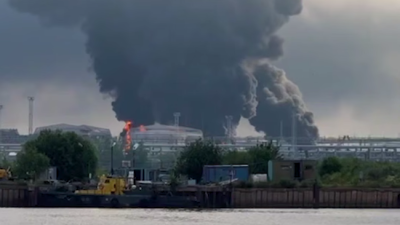
Constantvpn.com – Overnight, Ukraine launched an attack on a significant oil terminal in St Petersburg, Russia’s second-largest city, according to President Volodymyr Zelensky. The president emphasized that the facility served as a critical “infrastructure that generates revenue for Russia’s war.” Concurrently, Ukraine claimed a major Russian naval base in the region was also targeted. St Petersburg Governor Aleksandr Beglov confirmed the city endured a “massive” drone assault, stating that the oil terminal was hit but noting no casualties were reported.
Ukraine’s military has been escalating its long-range drone strikes on Russia’s vital energy systems, contributing to severe fuel shortages across the country. The president’s office indicated that nearly 43% of Russia’s oil refining capacity had been “disabled” as a result of these operations. However, this claim remains unverified by independent sources. Zelensky highlighted the strategic importance of such targets, arguing that they directly impact Russia’s ability to sustain its war effort in Ukraine.
St Petersburg’s Oil Terminal: A Strategic Target
The Ukrainian military characterized the oil terminal in St Petersburg as one of the most significant in Russia, capable of producing 12.5 million tonnes of petroleum products annually. The facility’s location in the north-western part of the country makes it a valuable asset for Moscow’s energy exports. Despite the intensity of the drone attack, the extent of damage was not immediately clear. A video shared by Zelensky depicted a drone approaching the target and a massive plume of black smoke emerging from the area post-strike.
Following the attack, the BBC verified that the terminal in St Petersburg had indeed been struck. Governor Beglov reported that 72 Ukrainian drones were intercepted over the city and the broader Leningrad region. He urged citizens to remain indoors until the drone threat subsided, warning of potential disruptions to mobile internet services. With over five million residents, St Petersburg is a key economic hub, and the attack underscores the growing intensity of Ukraine’s strategy against Russia’s critical infrastructure.
Putin’s Admission and Russia’s Countermeasures
Russian President Vladimir Putin, who recently acknowledged fuel shortages attributed to Ukrainian strikes, signed a legislative bill to bolster domestic fuel supply. This move came amid mounting pressure as the energy crisis deepens. The attacks on Russian oil and gas facilities, according to Kyiv, are legitimate targets, given Moscow’s reliance on fossil fuel exports to finance its war in Ukraine.
Putin’s admission of fuel shortages highlights the vulnerability of Russia’s energy sector to Ukrainian operations. The strikes on St Petersburg are part of a broader campaign targeting energy infrastructure, which has seen increased frequency and precision. The Russian defense ministry later accused Ukrainian forces of attempting to divert attention from the aftermath of a major strike on Kyiv on 2 July, which was described as one of the deadliest in the conflict. The ministry also criticized the “catastrophic failure” in Kostyantynivka, a key eastern Ukrainian town.
In a separate development, Ukraine’s military denied that Kostyantynivka, a heavily-fortified town in the Donetsk region, is now fully under Russian control. Maj Andriy Kovalyov, a military spokesman, informed the BBC that “Kostyantynivka remains under the control of the Defence Forces of Ukraine.” While admitting to “cases of infiltration by small infantry groups deep into the combat formations of our forces,” he stated that these groups were being identified and neutralized. This contradicts Putin’s earlier assertion that Russian control was established in June.
“If Kostyantynivka is now under Russian control, then Putin will probably have no problem meeting me there and finding diplomatic solutions to finally end the war. But still, he will not cross the front line: the truth is very different from Putin’s words.”
Zelensky’s remarks underscore the political dimension of the conflict, with both sides vying for narrative dominance ahead of the upcoming NATO summit in Turkey. The attack on St Petersburg and the simultaneous denial of Kostyantynivka’s status reflect the strategic maneuvering between Ukraine and Russia. The Kremlin leader’s recent comments about Russian control in the town were met with skepticism, as no concrete evidence was provided to support the claim.
As the war continues, both Ukraine and Russia are positioning themselves to influence international opinion. The Ukrainian strikes on civilian facilities, such as the oil terminal, are framed as necessary to weaken Moscow’s war economy. In contrast, the Russian defense ministry accused Zelensky of using these attacks to “distract the attention” of Ukrainians and foreign allies from the broader consequences of the conflict. The ministry also framed the assaults as a sign of Ukrainian military inefficiency, particularly in Kostyantynivka, which is part of the “fortress belt” of Ukrainian strongholds in the occupied Donetsk region.
Meanwhile, Putin’s outreach to Donald Trump, a congratulatory message sent on Saturday for the 4th of July celebrations in the United States, signaled a potential shift in diplomatic strategies. The gesture, which called for “constructive relations” between Russia and the U.S., coincided with the escalating tensions over fuel supply and territorial control. Analysts suggest that both sides are preparing for the NATO summit, where political decisions could reshape the conflict’s trajectory.
The attacks on St Petersburg and Kostyantynivka illustrate the evolving tactics of Ukraine’s military, which has increasingly focused on disrupting Russia’s economic and logistical capabilities. As the war enters a new phase, the strategic importance of these targets and their impact on Russia’s ability to sustain its operations will likely remain a central issue in the conflict’s narrative. With the backdrop of a deepening fuel crisis and contested territorial gains, the battle for influence over the international stage continues to intensify.
