
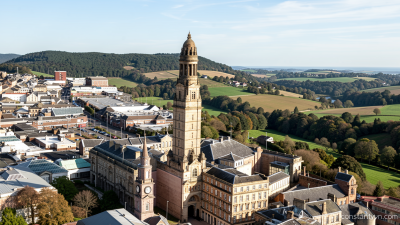
Scotland’s West Coast Town Bets Its Future on Welcoming New Arrivals
Constantvpn.com – On a quiet stretch of Greenock’s High Street, a shopfront that did not exist five years ago now displays crates of yams, bundles of plantain, jars of okra, and whole catfish. Anik African Store, which opened its doors in May, has planted a small slice of Nigerian commerce into a Scottish coastal town that has watched its population bleed away for decades. Just metres down the same road, a second African grocery caters to the same growing community. The transformation is visible, rapid, and — according to the local council — deliberately encouraged.
Inverclyde Council, which governs Greenock and the surrounding area, has placed repopulation at the very top of its strategic agenda. The authority’s plan explicitly seeks to attract additional legal migrants and people granted refugee status, while also trying to persuade those already working or studying in nearby Glasgow and Paisley to put down permanent roots closer to home. The rationale is stark: no local authority in Scotland has suffered a steeper demographic slide. Inverclyde’s resident count now stands at roughly 78,000, a figure 22,000 lower than it was in 1981. Projections suggest another 16 per cent decline over the coming twenty years unless the trend is reversed.
A Shopkeeper’s Welcome
Christianah Omilana, who arrived in the United Kingdom in 2021, runs Anik African Store and describes the reception she has received from Greenock residents as overwhelmingly warm.
“Scottish people are lovely and accommodating,” she says. “Immigrants will come when there is work.”
Her assessment echoes the experience of Sunday, a recent arrival from Devon who has taken up a post at a Glasgow hospital while his wife works at Inverclyde Royal Hospital in Greenock. He describes the town as “lovely, friendly” and frames the council’s job-creation ambitions as the single variable that could reshape the area’s demographics.
“If the local council can provide [jobs], everything in Greenock will change, because people [from Africa] would like to come,” he says.
The Economic Wound Beneath the Strategy
Yet the very absence of employment is what hollowed out Greenock in the first place. Walk through the town’s commercial centre and the vacancies are as conspicuous as the new arrivals. Tiffany, a 29-year-old mother of one whom we met at a local parent-and-toddler group, left Greenock years ago to find work and returned to raise her child. Now she is weighing another departure.
“It’s a ghost town,” she says. “There’s just nothing in it. There’s nothing to do, there are no shops. There is no employment.”
“I’m struggling to find jobs that suit both childcare and myself. I’ve considered moving from here to Paisley because there is so much more to do there.”
The industrial collapse is not a recent blip. In the nineteenth century, Greenock earned the moniker “Sugaropolis” as a global hub for refining sugar. Shipbuilding sustained the town for nearly three centuries. More recently, IBM maintained a campus nearby employing more than 5,000 staff until the site shut entirely in 2016. In the four years since, a further 1,500 positions have evaporated. Amazon, EE, and a string of other employers have relocated. This week, the local shipyard announced it would cut approximately a quarter of its workforce. Greenock Morton, the town’s football club, has launched a fan-led fighting fund to ward off financial collapse.
Scotland’s First Minister, John Swinney, is scheduled to visit Greenock this month to hear the community’s grievances first-hand — a signal that the scale of the problem has reached the highest levels of government.
Who Stays, Who Leaves, Who Remembers
Many of the African residents now living in Greenock hold skilled-work visas — commonly called sponsorship — and are employed in health and social-care roles, often commuting to Glasgow or Paisley for shifts. Cheap housing has drawn them to the town, and the council’s repopulation strategy is built on converting that temporary presence into permanent settlement. But for locally born residents and newly arrived refugees, suitable work remains scarce.
At Lyle Gateway Community Cafe, housed in a church a short walk from the High Street, dozens of elderly residents gather between rounds of table tennis and inexpensive, hearty meals. Muriel, one of the regulars, offers a blunt summary of what decades of depopulation have done to the town’s character.
“When the work disappears, people disappear.”
She and fellow regular Pamela recall a Greenock that was full of footfall, full of open shopfronts, full of the ordinary noise of a town where people wanted to be. That memory now functions less as nostalgia and more as a benchmark — a measure of how far the place has fallen, and how much the council’s migrant-attraction plan would need to succeed before the gap begins to close.
The stakes extend beyond one town. If Inverclyde’s experiment in demographic renewal works, it could offer a template for other post-industrial communities across Scotland and the wider UK that face the same arithmetic: fewer residents, fewer taxpayers, fewer customers, fewer reasons for services to remain. If it fails, the projection of another 16 per cent population loss becomes not a forecast but a schedule.
Related Reading
Frequently Asked Questions
What is The town whose council wants migrants?
The town whose council wants migrants is the main topic of this guide. The article explains the context, practical details, and next steps readers should understand.
Why does The town whose council wants migrants matter?
The town whose council wants migrants matters because readers are looking for a useful answer, not just a short summary. Good content should match search intent and help them decide what to do next.