
French School Protests Raise Pressure on Government Ahead of Elections
Constantvpn.com – Blockades at secondary schools across France have placed Emmanuel Macron’s government under renewed strain, reviving a familiar political concern: when young people take to the streets, unrest can quickly grow beyond its original demands.
The demonstrations began almost two weeks ago in Seine-Saint-Denis, a lower-income area north of Paris, before spreading rapidly to other parts of the country. By Thursday, hundreds of lycées — schools serving pupils aged roughly 15 to 18 — had been affected by blockades. Although conditions had calmed somewhat by Friday, about 400 lycées were shut as a safety measure for pupils and staff.
University students are now beginning to participate, increasing concerns that the movement could broaden further. The atmosphere at many school entrances has been described as energetic rather than openly furious, but the scale and speed of the protests have unsettled ministers.
Damage, injuries and arrests
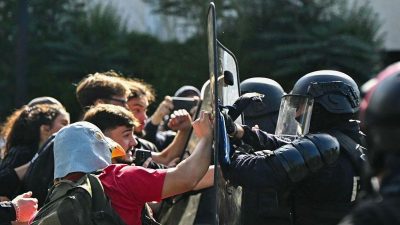
Several protests have turned violent. In Nantes, a fire destroyed the main hall of a lycée on Thursday. Other blazes have been set at school gates in towns and cities around France, with the resulting damage expected to cost millions of euros.
Education Minister Édouard Geffray said 65 education workers had been injured, including 40 school heads. He suggested that many of those involved in confrontations were not pupils from the schools affected.
“Most of the staff who were hurt said that the people they were facing… were not their own pupils,”
Authorities have also said that around 300 police officers and firefighters received treatment for injuries, while approximately 2,000 people, mostly minors, were taken into custody. Student groups, meanwhile, say numerous demonstrators have been hurt during police operations. Two teenagers have suffered serious eye injuries, and another lost many of his teeth.
The competing accounts underline the risks for the government. Heavy-handed policing of young demonstrators can rapidly become a national political issue, particularly when injuries involve minors. At the same time, officials face pressure to restore order and prevent further damage to schools.
Why youth protests carry such weight in France
French political leaders have long treated student unrest with particular caution. The upheaval of May 1968 remains a powerful reference point: protests that began among students developed into a much wider crisis involving workers and trade unions. Charles de Gaulle famously dismissed the disorder as chienlit, a crude expression conveying chaos.
Youth movements can be difficult for governments to contain because they often do not have a single leadership structure capable of negotiating on behalf of everyone involved. Their demands may shift as protests spread, and other social groups can be drawn into the dispute. Public sympathy may also lean toward young people who argue that their education and future prospects are being neglected.
That history helps explain why the current movement has prompted such intense attention. France is approaching presidential elections, and the possibility of wider disruption comes at a politically sensitive time.
Schools seeking more resources
The protesters’ demands centre on the condition of the education system. Students have called for more funding, additional teachers, smaller classes and improved school buildings. Requests can be highly practical: more school nurses, better-maintained facilities and insulation for dining areas are among the types of concerns being raised.
These grievances resonate beyond the schools themselves. Financial constraints have become a central issue for public services, and many families and education workers share concerns about staffing and infrastructure. Yet the government’s room to offer major new spending appears limited.
Prime Minister Sébastien Lecornu has unveiled a draft budget for the following year built around significant reductions in public expenditure. His stated objective is to cut €54bn, equivalent to £46bn, from state spending. Whether that target can be achieved remains uncertain, but the proposed direction makes large concessions to protesters less likely.
For students, this creates a difficult contrast. The problems they identify may be widely understood, while the fiscal environment makes quick, costly solutions harder to deliver. The traditional French pattern of easing social tension through additional public spending may be becoming less viable.
Political tensions deepen the challenge
The dispute is not solely about education policy. Parties on the right and in the centre argue that France Unbowed, known as LFI, is seeking to influence or exploit the movement. LFI figures have appeared alongside students, including Jean-Luc Mélenchon, the party’s prominent presidential candidate.
Bally Bagayoko, the mayor of Saint-Denis, has also faced criticism after saying that violence can sometimes be legitimate. Such statements have intensified accusations that political actors are encouraging a confrontation that could widen in an already polarised country.
Student activism has often carried a symbolic force in France far beyond the school gates. The government must now balance security, public confidence and genuine concerns over education funding, while avoiding a response that gives the protests even greater momentum. With elections only months away, every closure, confrontation and budget decision is likely to be closely watched.
Related Reading
Frequently Asked Questions
What is School protests send shivers down French?
School protests send shivers down French is the main topic of this guide. The article explains the context, practical details, and next steps readers should understand.
Why does School protests send shivers down French matter?
School protests send shivers down French matters because readers are looking for a useful answer, not just a short summary. Good content should match search intent and help them decide what to do next.