
Riyadh Airport Hit Again as Houthi Attacks Raise Regional Tensions
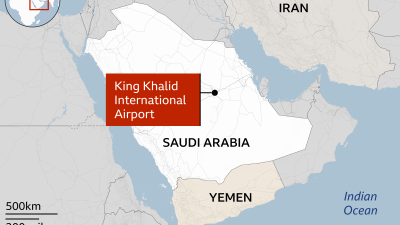
Constantvpn.com – King Khalid International Airport in Riyadh was struck again on Sunday, only a day after a deadly attack at the same facility left 13 people dead and 308 injured. The latest incident caused a fire in one of the airport’s passenger halls and resulted in further injuries, Saudi officials said.
The attack marks a sharp escalation in a series of strikes targeting Saudi airports and energy infrastructure. It also underlines the growing risk to civilian air travel in a conflict that has spread beyond Yemen’s borders.
Fire in Passenger Hall
Saudi-led coalition spokesman Maj Gen Turki al-Maliki said air defences intercepted a missile near Riyadh airport. At the same time, emergency services responded to a blaze at Passenger Hall No 4 after what he described as an “unknown projectile” hit the building.
Saudi Arabia’s civil aviation authority confirmed that people were injured, although no immediate breakdown of casualties was released. Images from the airport showed smoke and flames in the aftermath of the incident.
The Houthi movement in Yemen said it carried out the operation. Its military spokesman, Brig Gen Yahya Saree, said the group had used ballistic missiles, cruise missiles and drones against Riyadh airport during the previous 24 hours.
“Escalating operations deep inside Saudi Arabia”
Saree said the group would continue such operations and warned that Saudi airports could be targeted, with the exception of airports in the holy cities of Mecca and Medina. He also said Houthi forces had struck oil sites and Dammam airport in eastern Saudi Arabia.
Deadly Attack the Day Before
Saturday’s strike on Riyadh airport was the deadliest single assault on a Gulf Arab country since the war involving Israel, the United States and Iran began in February. Saudi authorities called the attack a “war crime” and pledged a response.
Among those killed were four Saudi nationals, two people from Bangladesh, and one person each from the United States, Jordan, Palestine, Syria, Sudan and Egypt. The Indian embassy in Saudi Arabia said on Sunday that an Indian man later died from injuries suffered in the attack.
US Secretary of State Marco Rubio condemned the strikes and confirmed that an American citizen was among the dead. UK Foreign Secretary Ed Miliband said he was “appalled” by the violence.
US President Donald Trump said Washington would “make a decision” and “move very quickly” on whether to strike the Houthis. UK Defence Secretary Wes Streeting said Britain could “potentially” provide further support to Saudi Arabia.
A String of Airport Strikes
The latest attack was not an isolated event. Riyadh airport was also hit on Thursday, when three Saudi nationals were killed. The Houthis claimed responsibility for that assault and said cruise missiles had been used.
Two other deadly attacks on airports in Abha and Riyadh took place in the preceding two days. The repeated strikes have put renewed attention on the vulnerability of civilian infrastructure during the conflict and on the dangers facing passengers, airport staff and nearby communities.
Several western governments have urged caution over travel in Saudi Arabia and the wider region. The UK Foreign Office advises against travel to some parts of the kingdom, including areas within 10km of the Yemeni border.
Conflict Extends Back Into Yemen
While Saudi authorities dealt with the latest Riyadh incident, Houthi-run Al Masirah TV said Saudi forces had carried out an air strike on Sanaa International Airport in Yemen’s capital. Saudi Arabia had not confirmed the claim, and it could not be independently verified.
Abdullah Al-Alimi Bawazir, vice-president of Yemen’s internationally recognised government, called on regional and international partners to take “decisive actions.”
The Houthis say their attacks are linked to Saudi support for Yemeni government forces in the country’s civil war and to an earlier air strike on Sanaa airport. Saudi Arabia views the group’s expanding military reach as a major security threat along its southern border.
Ceasefire Collapse Deepens Crisis
Violence has intensified since a temporary truce between the Houthis and Saudi-led forces collapsed in July. That ceasefire, brokered in 2022, had reduced fighting for a period but did not resolve the underlying struggle for control of Yemen.
The conflict worsened after the Houthis captured strategically important sections of the Red Sea coastline in a rapid offensive, prompting Saudi air strikes. Yemeni pro-government forces later said they had regained those areas.
The Houthis currently hold roughly one quarter of Yemen’s territory, while governing areas containing as much as 80% of the population. The Iran-backed group seeks eventual control of the entire country. Saudi Arabia fears that outcome would create an Iranian-aligned state directly on its border.
For travellers and regional businesses, the renewed airport strikes are a reminder that the consequences of the Yemen war are no longer confined to front-line areas. Civil aviation, energy facilities and transport routes have become central points of risk as the conflict enters another dangerous phase.
Related Reading
Frequently Asked Questions
What is Saudi Arabia s Riyadh airport hit by?
Saudi Arabia s Riyadh airport hit by is the main topic of this guide. The article explains the context, practical details, and next steps readers should understand.
Why does Saudi Arabia s Riyadh airport hit by matter?
Saudi Arabia s Riyadh airport hit by matters because readers are looking for a useful answer, not just a short summary. Good content should match search intent and help them decide what to do next.