Russian online retail warehouses hit by deadly Ukrainian strikes
Ukrainian Drone Assault Targets Russian E-Commerce Giants
Russian online retail warehouses hit by deadly – Ukrainian forces have launched a coordinated aerial assault against critical Russian logistics infrastructure, resulting in significant casualties at two major Wildberries distribution centers. According to official Russian reports, the nighttime drone campaign claimed eight lives and left 62 individuals wounded across the affected facilities. The attacks represent a strategic escalation in Kyiv’s campaign against Moscow’s economic and military supply chains.
Devastation in Tambov and Elektrostal
The most severe losses occurred in Tambov, a city situated approximately 475 kilometers southeast of the Russian capital. Seven fatalities and 25 injuries were recorded at the Tambov warehouse, according to regional authorities. Evgeniy Pervyshov, the governor of Tambov, reported on Telegram that seven employees working the overnight shift perished immediately at the scene. He noted that 28 Ukrainian drones were intercepted before reaching their targets, yet the remaining strikes proved devastating. Most injuries resulted from shrapnel, with seven victims in critical condition.
Meanwhile, a separate Wildberries facility in Elektrostal, located within the Moscow region, suffered one death and 37 injuries. Andrei Vorobyov, governor of the Moscow region, confirmed that eight of the wounded remained in serious condition. He revealed that 48 drones were shot down across the region during the overnight operation. Additionally, a Russian oil depot sustained damage from a falling drone, an incident Vorobyov characterized as having the most severe consequences of the night.
Strategic Objectives Behind the Campaign
Ukrainian President Volodymyr Zelensky explained that the operations targeted “major logistics facilities” serving dual purposes. These warehouses supplied “sanctioned components for drone production and navigation equipment” to Russian military operations. Zelensky further noted that Ukrainian forces simultaneously engaged targets in the Sea of Azov, the Black Sea, and Russian-annexed Crimea.
“The primary rationale for striking Wildberries’ warehouses is to disrupt Russian logistics and the supply of dual-use goods, critical electronics, sanctioned goods and the like to the Russian army and Russian arms manufacturers,” said Serhii Kuzan, chairman of the Ukrainian Security and Cooperation Centre.
Kuzan emphasized to the BBC that Wildberries functions as a “vital component” of Russian logistics networks. The company’s online platform has enabled Russian volunteers to acquire military supplies including walkie-talkies, body armor, and drone parts. He warned that collateral damage from such operations could significantly impact both the Russian economy and public psychological support for the ongoing conflict.
Broader Context and Economic Impact
Wildberries, frequently compared to Amazon as Russia’s premier online retailer, operates as part of the merged RWB group alongside advertising firm Russ. Forbes Russia valued this combined entity at approximately $12.6 billion (£9.3 billion) in 2026. Tatyana Kim, the company’s chief executive and one of Russia’s pioneering female billionaires, described the events as a “terrible night” for both the corporation and the nation.
The warehouse attacks coincided with Russian retaliatory operations. Overnight into Wednesday, 14 people lost their lives in Russian strikes targeting Ukrainian civilian infrastructure. Ukraine has increasingly focused its long-range drone campaigns against Russian energy facilities, contributing to widespread fuel shortages. Kyiv reported that nearly 43 percent of Russia’s oil refining capacity had been disabled, though the BBC has not independently confirmed this statistic.
Russia has historically targeted similar Ukrainian facilities since the conflict’s inception in February 2022, including postal services and electronics distributors. Ukrainian officials maintain that Russian oil and gas installations constitute legitimate military targets given Moscow’s heavy reliance on fossil fuel exports to fund its invasion. Russian President Vladimir Putin acknowledged in June that fuel shortages stemmed from Ukrainian attacks, subsequently signing legislation designed to strengthen domestic energy security.
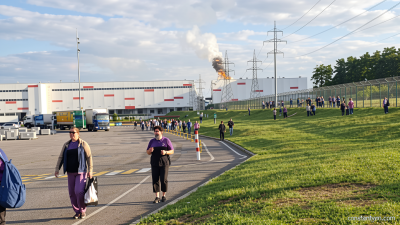
Unverified photographs from the warehouse sites depicted massive flames and towering columns of black smoke rising from the logistics buildings. Dozens of workers could be seen fleeing toward parking areas as explosions continued. Video footage captured warehouse walls crumbling under the intensity of the fires, while terrified and injured staff attempted to escape the chaos. Firefighters, emergency responders, and the Ministry of Emergency Situations remained on scene conducting ongoing operations.
