
UK Inflation Climbs as Fuel and Travel Costs Rise
Constantvpn.com – Higher petrol, diesel and airfare costs drove UK inflation to 3.1% in the year to August, marking its highest point for five months. The annual rate increased from 2.9% in July, putting further distance between consumer-price growth and the Bank of England’s 2% goal.
The sharpest pressure came from transport-related spending. Motor fuel prices were 23% higher than they had been a year earlier, while the August holiday period also brought a substantial increase in air travel costs.
Petrol Reaches a Near Four-Year High
Average petrol prices rose by 9.1p per litre between July and August, reaching 161.3p. The Office for National Statistics said this was the highest recorded level since November 2022, when the impact of Russia’s full-scale invasion of Ukraine had lifted global energy prices.
Diesel prices also increased significantly. The latest moves have followed sustained disruption to oil supply conditions during the conflict involving the US, Israel and Iran. Oil had traded at roughly $73 a barrel before hostilities began earlier in the year, but later exceeded $91. In recent days, Brent crude, the main international oil benchmark, has moved above $100 a barrel.
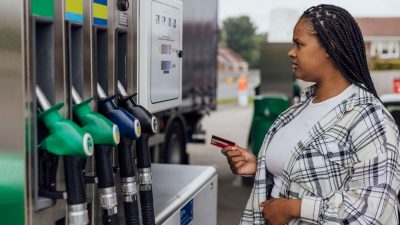
For households, fuel inflation is especially visible because price changes appear immediately at filling stations. A more expensive tank of petrol affects routine commuting, school runs, delivery costs and the budgets of people who rely on a car for work.
Grant Fitzner, chief economist at the ONS, said higher oil costs were also affecting the wider production chain.
“Rising crude oil and petrol prices increased both the annual cost of raw materials and the price of goods leaving factories respectively.”
Pressure on Independent Forecourts
Small fuel retailers are also dealing with the rapid movement in wholesale prices. Goran Raven, who owns the RJ Raven petrol station in Essex, said the business had seen trading fall by about 20% compared with the same time last year.
“Things are down. We’ve got lots of pressure on us at the moment. I’d say we’re about 20% down on this time last year.”
Raven explained that changes in crude prices can feed through almost immediately for smaller operators with limited storage capacity.
“We only have small tanks here, so we need a tanker almost every day at the moment and we have to pay a daily spot price. When the price goes up, we have to go up with it. There’s no way around it.”
He said public perceptions of fuel-station profits can be misleading, with the margin on each litre typically limited.
“The margins here are wafer-thin on fuel. People like to think we’re earning a lot on it. Unfortunately, we really aren’t. It’s single digits of pence we earn per litre.”
Food Inflation Remains More Contained
So far, the rise in oil prices has not produced the same level of inflation in food and drink. Prices in that category increased by 1.3% over the year to August, suggesting the immediate effect has been concentrated in energy and transport rather than spread evenly through household spending.
That may not last if businesses begin passing higher energy and transport bills through their supply chains. Paul Dales, chief UK economist at Capital Economics, said stronger inflationary pressure was expected to emerge.
“Everyone knows that bigger rises in inflation are on their way.”
Dales expects a combination of higher oil and gas prices, along with businesses transferring some energy costs to customers, to push inflation to 4.2% in January. Such an increase would matter not only for household budgets but also for decisions on borrowing, savings and wage negotiations.
Bank of England Decision Approaches
The Bank of England uses interest rates as its principal tool for bringing inflation back towards target. Its rate stands at 3.75%, and policymakers are due to meet on Thursday to decide whether any change is needed.
Interest-rate decisions require officials to weigh several competing risks. Higher rates can restrain price growth by reducing demand, but they can also increase mortgage and business borrowing costs. When inflation is driven by oil, gas or other imported commodities, rate-setters must consider whether the price shock will prove temporary or create broader, longer-lasting cost increases.
Chancellor John Healey said the Middle East conflict was affecting consumers beyond the UK.
“The war in the Middle East is impacting on inflation worldwide, not just here at home. In our bills, our weekly shop and at the petrol pumps.”
“Despite this serious global uncertainty, our UK economy is proving resilient.”
Recent economic figures showed the UK economy grew by 0.4% in July, aided by investment connected to artificial intelligence. However, growth for April to June was also 0.4%, slower than the 0.6% recorded in the first three months of the year.
Energy Bills Face Further Changes
Household energy costs remain another key concern. VAT on domestic electricity bills will be cut from 5% to zero on 1 October, a move expected to save a typical household about £45 a year. At the same time, the energy price cap for gas and electricity will rise by 4%.
For a household using a typical amount of energy, the cap increase means annual costs will be about £60 higher. The VAT reduction will therefore soften, rather than eliminate, the increase in bills.
Yael Selfin, chief economist at KPMG, said rising gas prices linked to the Iran war and interruptions to global supply, including liquefied natural gas, were likely to keep pressure on household energy spending.
“If gas prices remain around current levels, household energy bills could rise by a further double-digit amount from January.”
Shadow chancellor Andrew Griffith criticised the government’s economic approach, arguing that employment measures and energy policy were adding to consumer costs.
“The government’s jobs tax and employment red tape are being passed on to consumers in the weekly shop and their mad energy policies are pushing up costs and leaving Brits exposed.”
With fuel, flights and household energy all under pressure, the next inflation readings will be watched closely for signs that the higher cost of energy is reaching more parts of the economy. For consumers, the immediate effect is likely to remain most apparent at the petrol pump, in travel spending and in the bills arriving at home.
Related Reading
Frequently Asked Questions
What is Petrol and diesel price rises push?
Petrol and diesel price rises push is the main topic of this guide. The article explains the context, practical details, and next steps readers should understand.
Why does Petrol and diesel price rises push matter?
Petrol and diesel price rises push matters because readers are looking for a useful answer, not just a short summary. Good content should match search intent and help them decide what to do next.