
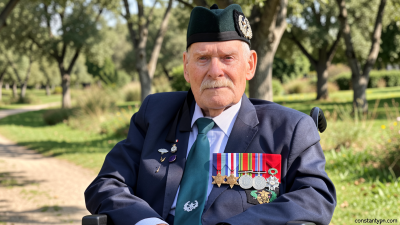
The Last of a Generation: How a 17-Year-Old Forged His Way Into History
Constantvpn.com – Donald Turrell, a London-born soldier who slipped into the ranks of the British Army by fabricating a parental consent letter claiming he was a year older than he truly was, has died at the age of 101. His passing marks the quiet departure of yet another member of the dwindling cohort that carried Britain through the Second World War. The Taxi Charity for Military Veterans confirmed the death on social media, noting that Turrell, who had made his home in Frinton-on-Sea, Essex, in recent years, was surrounded by family members when he died on Friday.
A Boy Who Would Not Wait
Born in 1925, Turrell was only seventeen when he decided the war needed him. The Army required recruits to be eighteen, so he did what countless young men of that era did: he invented a letter from his parents certifying his age. He presented it at the recruiting office, answered every question with the confidence of a man who had rehearsed his answers, and walked out a soldier. He later recalled the episode with a wry, unapologetic shrug.
“I did lie about my age. I pushed it up a bit, gave all the right answers, and I was in. I was happy.”
He had joined the Cameronians (Scottish Rifles), a regiment with deep roots in Scottish military tradition but which recruited across the United Kingdom. In the months before his unit was deployed overseas, Turrell was posted to a succession of garrisons — Bury St Edmunds, Newquay, Newcastle, and Fort William — each stop adding another layer of training and anticipation to a young man who had always dreamed of uniform and service.
Sword Beach and the First Hours
In the days immediately following the Allied landings of June 1944, Turrell’s battalion crossed the Channel and made its way to the Normandy coast. He came ashore at Sword Beach, the easternmost of the five invasion beaches, where the British and Canadian forces bore the brunt of the initial assault. The fighting that followed was savage and sustained, stretching across weeks of hedgerow combat, village-by-village advances, and relentless artillery.
Turrell described the moment of landing in terms that carried the weight of a lifetime’s memory. He called himself “excited and apprehensive” as the craft carried him toward the shore. His first sight of the war’s cost, he said, was not the enemy but the dead — bodies from earlier waves washing back onto the sand as his own feet touched the beach.
Wounded at Eterville
His personal war ended abruptly on 10 July 1944, when he was seriously injured during fighting near the small town of Eterville, just inland from the coast. The wound was severe enough to warrant medical discharge, and he never returned to the front. Yet the campaign left marks far deeper than any physical scar. He spoke movingly of close friends lost in those weeks — some of whom he helped bury in field graves that were later reinterred in Commonwealth war cemeteries across northern France.
A Brother Taken by the Sea
The war’s toll on the Turrell family did not end with Donald’s injury. His older brother Leslie had served as a telegraphist aboard HMS Penelope, a light cruiser operating in the Mediterranean theatre. In February 1944, the ship was sunk off the Italian coast near Naples, and Leslie died with her. Two brothers, two fronts, two separate wounds inflicted on one family within the space of a single year.
A Life After the Uniform
Following his discharge, Turrell settled into civilian life and eventually made Essex his home base. For decades he remained connected to the veteran community, and in later years became a familiar figure associated with the Taxi Charity for Military Veterans, an organisation that provides free taxi journeys to veterans attending medical appointments, memorial services, and social events. His presence at charity gatherings was noted not merely for his rank or his story but for the warmth he brought to every room.
Dick Goodwin, vice president of the charity, paid tribute after the announcement of Turrell’s death.
“Don was incredibly special. He had a warmth and presence that lit up every room he entered, and he touched the lives of so many people. As a World War Two veteran, Don represented a generation whose courage and service we will never forget. It was a privilege for the taxi charity to know him, and he will be remembered with enormous affection and gratitude. My thoughts are with his family and all those who loved him at this very sad time.”
The Shrinking Circle
Each year the number of living British and Commonwealth veterans who fought in the European theatre of 1939–1945 grows smaller. Those who landed on the Normandy beaches in June 1944 were, at the youngest, teenagers — some, like Turrell, barely old enough to vote, let alone to face machine-gun fire and artillery barrages. Their stories, once common in village halls and school assemblies, now carry the weight of finality. When a man who forged his way into a battalion at seventeen passes at 101, it is not merely one life that ends; it is a living link to a period of history that grows ever more distant from the present day.
Turrell’s decision to inflate his age by a single year placed him among hundreds of thousands of young men who made the same small deception at recruiting stations across Britain in the early 1940s. For many, the lie was the only door into a purpose they could not otherwise reach. He never expressed regret. In his own words, he had always wanted to be a soldier, and like “all the young lads” of his generation, he had wanted to play his part in defending his country. The beach at Sword Beach, the hedgerows beyond Eterville, and the field graves he helped dig were not choices made in comfort. They were the consequences of a seventeen-year-old’s determination, sealed with a forged signature and a boy’s stubborn belief that the war needed him now, not later.
Related Reading
Frequently Asked Questions
What is Normandy veteran who lied about age?
Normandy veteran who lied about age is the main topic of this guide. The article explains the context, practical details, and next steps readers should understand.
Why does Normandy veteran who lied about age matter?
Normandy veteran who lied about age matters because readers are looking for a useful answer, not just a short summary. Good content should match search intent and help them decide what to do next.