
Ukrainian Forces Deliver Coordinated Blow to Russian Black Sea Infrastructure
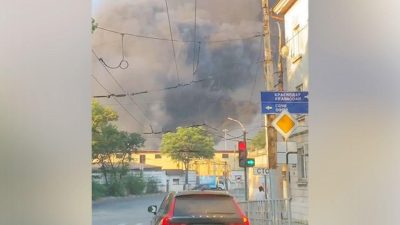
Constantvpn.com – A coordinated assault by Ukrainian forces has struck at the heart of Russia’s Black Sea military and commercial operations, targeting the port city of Novorossiysk with a combination of drones and missiles. The overnight operation damaged critical grain export facilities and hit the Russian fleet’s primary anchorage, marking one of the most significant strikes on Russian territory since the conflict began.
Human Cost and Infrastructure Damage
Local authorities confirmed that three individuals lost their lives during the barrage, including a young child of eight years old. Twenty-four additional people sustained injuries from the attack, which sent repeated explosions echoing across the city throughout the night as air defense systems intercepted incoming aerial threats.
“The occupying fleet and all the infrastructure that supports it will not be safe as long as Russian aggression continues,” President Volodymyr Zelensky declared in a social media statement following the operation.
An emergency situation was subsequently declared in Novorossiysk after the drone assault damaged critical pipelines, leaving the city without its regular water supply. The destruction extended beyond the port area, with regional Governor Veniamin Kondratyev reporting that drone debris killed another man in the surrounding region. Several hundred drones struck multiple locations across the Krasnodar region overnight, damaging dozens of buildings including residential homes.
Strategic Naval Base Under Fire
Novorossiysk has emerged as Russia’s most important Black Sea naval hub since the Russian fleet was compelled to abandon Sevastopol in Crimea. The Crimean port had become increasingly vulnerable to Ukrainian attacks, forcing the relocation of most of Russia’s Black Sea fleet to the more secure Novorossiysk anchorage. This strategic shift made the port a high-value target for Ukrainian forces seeking to degrade Russian naval capabilities.
Ukraine’s military command announced that four Russian warships sustained damage during the operation, including two frigates. While President Zelensky described the assault as a “unique operation” involving rockets, jet drones, and naval drones, he notably did not specifically mention the grain terminals among the targets in his initial statement.
Grain Export Disruption
The agricultural sector faces significant challenges as a result of the attack. A major grain trading company confirmed to Russia’s TASS news agency that its terminal sustained damage during Wednesday’s assault. A second company provided similar confirmation to both Reuters and the Russian outlet RBK.
The Russian agriculture ministry announced it is actively redirecting cargo flows to alternative destinations, including ports in the Baltic and Caspian Seas, as well as land-based routes. While the ministry did not explicitly reference Ukrainian attacks, it acknowledged “taking into account current logistical constraints” in its operational adjustments.
Global Food Security Implications
The timing of the strikes carries particular significance for global grain markets. Russia, the world’s largest wheat exporter, is experiencing substantial disruptions to its shipping operations. According to a Moscow-based analytics firm, Russian grain exports for August could decline by more than fifty percent compared to the same month over the previous five years, driven by disruptions in both the Black and Azov seas.
Ukrainian exports have also suffered, with the Ukrainian Agribusiness Club reporting a twenty-three percent decrease in shipments during July. The Ukrainian Agribusiness Club noted that Russia’s attempts to deter foreign companies from trading with Ukraine through strikes on cargo ships and the port of Odesa have had mixed results, as Ukrainian long-range strike capabilities continue to improve.
Russian foreign ministry spokeswoman Maria Zakharova accused Ukraine of targeting Russian grain and agricultural infrastructure, claiming the strikes resulted in higher global food prices and growing grain shortages.
Retaliatory Strikes and Missile Defense
While Ukraine focused its attention on Russian infrastructure, Moscow launched its own overnight aerial strikes against Ukrainian territory. At least eleven Ukrainian civilians were killed between Tuesday and Wednesday, with the majority of casualties occurring when Russia struck the southern city of Zaporizhzhia with ballistic missiles and glide bombs.
In an interview with CNN, President Zelensky outlined Ukraine’s pressing needs for air defense capabilities. He stated that Ukraine requires one-tenth of the current United States stockpile of interceptor missiles to effectively counter all Russian ballistic missile attacks. Five percent of that American stockpile would be sufficient to sustain Ukraine through the winter months, he explained.
Zelensky highlighted the growing imbalance in missile capabilities, noting that Ukraine currently possesses two and a half times fewer interceptors than it had in 2025, while Russia has doubled its monthly ballistic missile output compared to previous levels.
Strategic Outlook
The escalating exchange of strikes in the Black Sea follows a period of relative calm during the summer months. Ukrainian forces have demonstrated increasing proficiency in conducting long-range operations against Russian territory, with recent attacks on vessels in the eastern Black Sea further disrupting Russian grain shipments.
Zakharova emphasized that Russia would continue targeting facilities used by Ukraine’s armed forces on the Black Sea until “the full elimination of threats to security projected to the Sea of Azov and the Black Sea.”
The conflict, which began with Russian President Vladimir Putin’s full-scale invasion in 2022, continues to reshape both regional security dynamics and global commodity markets. The Black Sea remains a critical theater where military operations and economic interests intersect, with both sides seeking to leverage their positions to achieve strategic objectives.
Related Reading
Frequently Asked Questions
What is Major Russian grain export terminals hit?
Major Russian grain export terminals hit is the main topic of this guide. The article explains the context, practical details, and next steps readers should understand.
Why does Major Russian grain export terminals hit matter?
Major Russian grain export terminals hit matters because readers are looking for a useful answer, not just a short summary. Good content should match search intent and help them decide what to do next.