
A Shoreline Sign Becomes a Diplomatic Statement as Canada Pushes Back on Lake Renaming
Constantvpn.com – The waters separating two nations have become the latest flashpoint in a rapidly escalating transborder confrontation. On Canada’s Lake Ontario shoreline, Premier Doug Ford stood before a freshly erected sign bearing the words “Lake Ontario. Now and Always.” — a deliberate, public rebuke aimed squarely at Donald Trump’s executive order seeking to rebrand the shared waterway as “Lake America.” The gesture lands amid a trade war that has already reshaped tariffs between the two countries, turning a geographic naming dispute into a symbol of national sovereignty.
The Executive Order and Its Immediate Aftermath
Trump signed the renaming decree on Thursday, declaring it effective at once. Under his broad authority over how the United States formally recognises domestic landmarks, the order directs the Department of the Interior to submit the new designation to the Geographic Names Information Service — the federal repository for American geographic nomenclature — within 30 days. Neighbouring countries, however, carry no obligation to adopt the altered name on their own maps, documents, or public signage.
Canadian officials dismissed the move almost immediately. Ford framed the president’s action as rooted in personal animus rather than administrative necessity:
“He didn’t like Ontario and Canada standing up for ourselves.”
Standing directly in front of the newly installed sign, Ford extended the message beyond the moment:
“Just in case President Trump or anyone else forgets, we’ve set up this sign to remind them, it’s Lake Ontario, now and forever.”
His remarks echoed Prime Minister Mark Carney’s earlier public statement, which insisted that “things must be called by their name, and this lake is called Lake Ontario — today and forever.”
AI-Generated Videos Amplify the Provocation
The dispute gained a surreal visual dimension on Saturday when Trump posted a series of artificial-intelligence-generated clips to social media. In one, he is shown physically toppling a “Lake Ontario” sign and swapping it for a placard reading “Welcome to Lake America.” Another clip depicts a flock of Canada geese wearing the president’s signature hairstyle and carrying rifles while patrolling the shoreline of the newly christened water. The videos, widely shared and mocked, underscored how the naming question had shifted from bureaucratic procedure into cultural spectacle.
The Trade War Behind the Words
The renaming episode did not emerge in a vacuum. It followed the collapse of bilateral trade negotiations, after which Washington imposed fresh 50 per cent tariffs on roughly $20 billion (C$28 billion) of Canadian exports. Ottawa responded by announcing “dollar for dollar” counter-tariffs scheduled to take effect the following month. In that context, the shoreline sign functions less as a quaint municipal notice and more as a calibrated political signal: Canada will not absorb unilateral American redefinitions of shared geography while simultaneously absorbing punitive tariff structures.
Indigenous Roots and the Naming of the Great Lakes
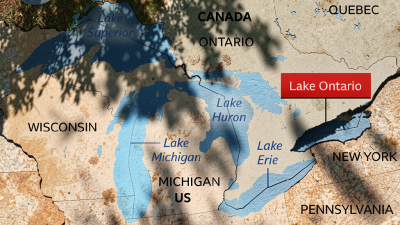
The four Great Lakes bearing names of indigenous origin — Ontario, Huron, Michigan, and Erie — carry linguistic heritage stretching back centuries before European contact. Lake Superior, by contrast, derives from an anglicised French term. Lake Ontario, the smallest of the five Great Lakes by surface area, sits along the border between the Canadian province of Ontario and the American state of New York. Its name predates both modern nations and any executive branch in either country.
That historical depth gives Ford’s “now and always” phrasing a weight that a simple municipal sign would not otherwise carry. The lake’s identity is not a variable subject to administrative revision; it is a fixed point in the region’s cultural and ecological record.
A Precedent Already Set: The Gulf of Mexico
When Trump took office in 2025, he signed a parallel order changing the Gulf of Mexico to the “Gulf of America.” Mexico rejected the alteration, arguing that no single nation can unilaterally rename a shared body of international water. The dispute also produced an unusual legal wrangle with Google, which updated its mapping application to display “Gulf of America” to users in the United States while showing “Gulf of Mexico” to those in Mexico. Viewers in other countries received a hybrid label: “Gulf of Mexico (Gulf of America).” The episode demonstrated how quickly a naming decree can cascade into commercial platforms, cartographic standards, and international friction.
Analysts watching the Lake Ontario episode note that the Gulf precedent makes a repeat pattern visible: an executive order, a foreign government’s public rejection, a tech-platform mapping controversy, and ultimately a question about whether domestic naming authority can extend to waters shared across borders. The answer, as both Mexico and Canada have now made clear, is that it cannot — at least not without consent.
What Comes Next
The 30-day window for the Interior Department to process the Geographic Names Information Service update runs concurrently with Canada’s scheduled counter-tariff implementation. Whether the two tracks remain separate or merge into a single negotiating posture will shape the next phase of bilateral relations. For now, the sign on the Ontario shoreline stands as a fixed, unambiguous statement: the lake keeps its name, and the province will not negotiate that fact away.
Related Reading
Frequently Asked Questions
What is Large Lake Ontario sign installed in Canada?
Large Lake Ontario sign installed in Canada is the main topic of this guide. The article explains the context, practical details, and next steps readers should understand.
Why does Large Lake Ontario sign installed in Canada matter?
Large Lake Ontario sign installed in Canada matters because readers are looking for a useful answer, not just a short summary. Good content should match search intent and help them decide what to do next.