
Washington Unleashes What It Calls Its Most Aggressive Financial Campaign Against Tehran
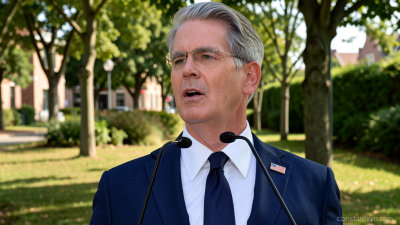
Constantvpn.com – The United States Treasury moved on Monday to cut Iran off from virtually every corner of the global financial system, a sweeping package of sanctions and sector-level determinations that officials framed as an all-or-nothing ultimatum. Treasury Secretary Scott Bessent, speaking at a press briefing to outline what the department has internally branded “Operation Economic Outcast,” described the measure as
“the single greatest financial offensive ever.”
Bessent went further, comparing the operation to a military invasion of the economy itself. He called it an “economic D-Day” for Tehran and declared that Washington would sever all economic ties with the Islamic Republic. The message extended beyond Iran’s borders: any country that continued to do financial business with the regime would, in his words, face its own isolation.
A Two-Path Ultimatum
The framing was deliberately binary. Bessent told reporters that Tehran now confronts
“a very clear choice with only two paths before them: complete global isolation….or a path back to normalcy with an opportunity to rejoin the global economy.”
He added that America was
“no longer managing the Iranian threat, we are ending it.”
The Treasury said it had spent months mapping the web of facilitators, shell entities, and financial channels that Iran uses to move oil revenue past existing sanctions. The resulting package targets five sectors specifically: digital assets, technology, gold, aviation, and shipping. Nearly sixty entities, individuals, and vessels received individual sanctions designations in the same announcement.
Bessent characterized the cumulative effect as designed to
“tighten the noose and block every potential source of revenue”
for both the Islamic Revolutionary Guard Corps and the broader Iranian state apparatus. He warned foreign governments and trading partners that they could not
“claim they are blind to enabling this activity.”
Though he declined to name specific countries, he indicated that President Trump would personally telephone world leaders
“with specific request to cease their interactions with the regime.”
On timing, Bessent acknowledged that counterparties need a window to absorb the new rules, but cautioned:
“they should know that that will move very quickly and that we are serious.”
Context: A Conflict Already Straining Global Energy Flows
The announcement lands against a backdrop of acute disruption. The armed conflict that opened at the end of February has effectively choked the Strait of Hormuz, the narrow waterway south of Iran through which roughly one-fifth of the world’s oil and gas normally transits. Tehran has issued a fresh directive telling shipping operators not to transit the strait without explicit Iranian permission. Iran also warned that if the war drags on, it will shut down all oil exports from the region entirely.
The economic fallout has been immediate and global. Brent crude, the international benchmark, stood at $92 a barrel on Monday. In the United States, gasoline prices have climbed past four dollars per gallon, pushing cost-of-living anxiety to the top of the voter agenda ahead of the November mid-term elections. Diesel and petrol prices worldwide sit well above their levels a year ago.
Skepticism Over Short-Term Impact
Not every economist bought the gravity of the announcement. David Oxley, chief climate and commodities economist at Capital Economics, argued that the practical bite would be muted given conditions already in place.
“With the renewed US naval blockade already strangling Iran’s oil exports, the direct impact of ‘economic D-Day’ on Iran’s energy revenues will be somewhat of a damp squib,”
he said, adding that
“We suspect that the new package will have only a limited direct impact on Iranian energy flows in the short term.”
Oxley pointed to a structural reality: roughly ninety percent of Iran’s oil output flows to China, a buyer that has historically ignored US sanctions and, in his assessment, is
“unlikely to be cowed this time either.”
A Pattern of Escalation and Retraction
The latest financial salvo follows a string of dramatic reversals from the White House. In April, Trump warned that
“a whole civilisation will die tonight”
unless Tehran accepted a deal to end the war and reopen the strait. Washington ultimately walked back that posture after Pakistan stepped in as mediator and pressed for further diplomacy. Multiple deadlines were extended, and earlier threats were softened before this week’s maximalist announcement.
That whiplash raises questions about credibility. If successive ultimatums are followed by quiet retreats, the question becomes whether the current package will be enforced with the consistency its rhetoric implies, or whether it will join a catalogue of threats that expire before implementation.
Domestic Economic Spillover
The conflict’s cost is not confined to Middle Eastern markets. Last week, Bessent announced that the US government would intervene directly in bond markets, buying back government debt to shore up demand and push borrowing costs lower. The effect proved fleeting: long-term yields rebounded within a single trading day. The episode underscores how quickly war-driven inflation and fiscal pressure can overwhelm policy interventions aimed at stabilizing financial conditions at home.
For ordinary Americans, the most tangible consequence is at the pump. Sustained prices above four dollars a gallon compress household budgets, feed into broader inflation expectations, and sharpen political pressure on a Congress that will face voters in November. The sanctions package, whatever its strategic logic, arrives at a moment when the American public is already feeling the war’s price tag in daily life.
Whether “Operation Economic Outcast” delivers the decisive financial squeeze its architects describe, or whether it becomes another chapter in a cycle of escalation and de-escalation, will depend less on the language of Monday’s briefing than on the willingness of third-party states—particularly China, the Gulf monarchies, and European trading partners—to accept the isolation terms Washington has now laid out.
Related Reading
Frequently Asked Questions
What is Iran faces greatest financial offensive ever?
Iran faces greatest financial offensive ever is the main topic of this guide. The article explains the context, practical details, and next steps readers should understand.
Why does Iran faces greatest financial offensive ever matter?
Iran faces greatest financial offensive ever matters because readers are looking for a useful answer, not just a short summary. Good content should match search intent and help them decide what to do next.